
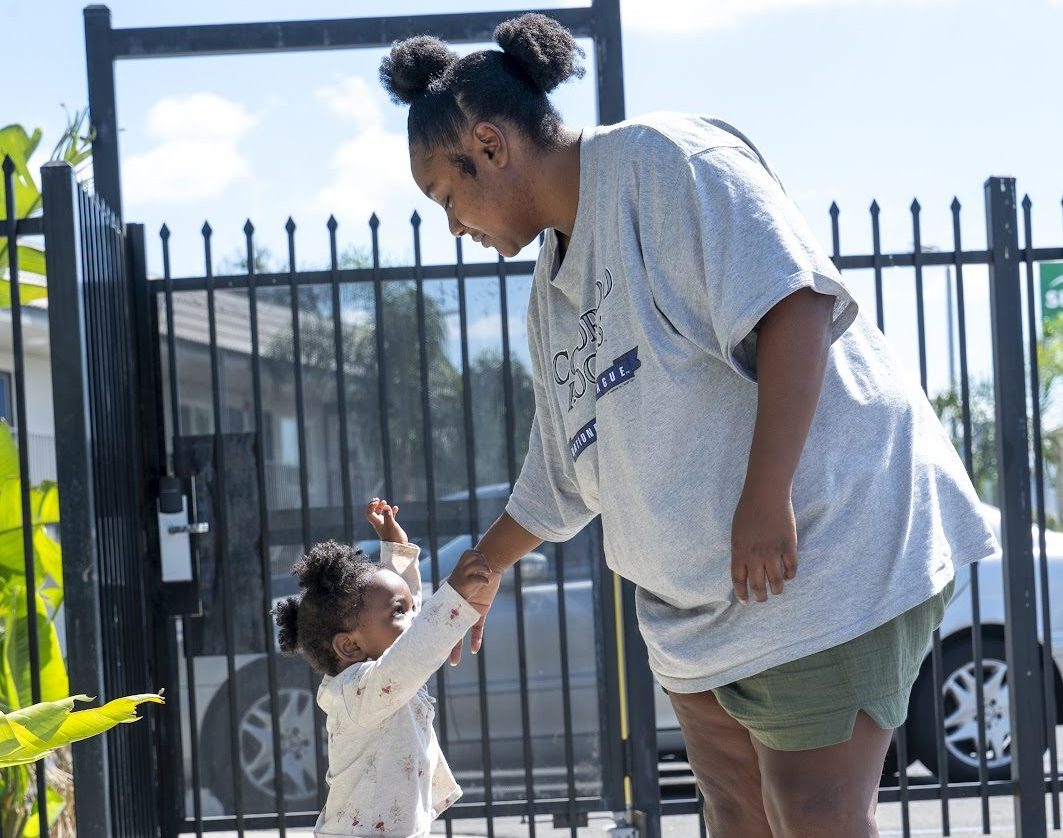
When Tytinisha Mitchell lost her apartment in March 2024, she was several months pregnant and already struggling to stay afloat after aging out of a foster youth housing program.
Mitchell, 26, had been connected to the Next Move program, which offers transitional housing support to former foster youth. She says she was phased out after three years.
A few months before she lost her apartment, the leasing office at her complex received a letter from SHRA saying it no longer would send rent payments for Mitchell’s unit. She says she was not told directly about that decision.
In an email, SHRA public information officer Angela Jones wrote that one of the most common reasons that a family’s participation in the Housing Choice Voucher Program is terminated “is failure to comply with program rules, such as missing deadlines for verifying eligibility to receive and maintain a voucher.”
Other reasons Jones mentioned were “failing to report changes in household members or income changes, or violating their lease.”
She added that SHRA works “closely with families and make[s] every reasonable effort to gain compliance to avoid withdrawing their voucher.”
Mitchell, however, says the reasons for her termination were unclear. “They kind of told me there’s not very much they can do,” she says.
Without housing support, Mitchell fell behind on rent. Her eviction forced her to live in her car. Mitchell describes a cycle of temporary shelter and exhaustion since.
“I’ve been homeless for about seven months, so it’s been in and out,” she says. “I can’t really calculate how long we’ve been in the car exactly, but probably a good total amount of nights, maybe a month. We’re going in and out of people’s apartments, back and forth, sleeping. I have, like, probably four friends’ houses that I’ve slept back and forth at.”
She stayed with her daughter’s father and his mother for about three months but says they asked her to leave when she became pregnant again. After that, she and her daughter alternated between nights in the car and brief stays with friends.
The instability has taken a toll on Mitchell’s mental and physical health. She says she is in the process of being diagnosed with anxiety and depression, conditions she connects to the stress of housing insecurity and her learning disability, which makes it harder to navigate assistance programs.
“I felt like in the beginning I was taken advantage of because I was rushed into something, not knowing what I was really getting myself into,” she says.
The effects worsened during her pregnancy. She was hospitalized once for high blood pressure and later developed preeclampsia, a condition marked by dangerously high blood pressure during pregnancy.
“I was dealing with the hardship of housing, wondering where my child’s going to live,” Mitchell says.
Mitchell also has lost weight and struggled to eat, which has complicated her pregnancy.
“I had to get iron infusions,” she says. “Now the doctors are discussing infusing me with food because I’m not able to properly get my intake for the baby and me. That’s due to depression because I don’t have an appetite.”
Her daughter’s health also has suffered.
“She had pneumonia for two weeks because we were outside and it was cold at night,” Mitchell says. “She has asthma now because we’ve been in the air, having to be outside.”
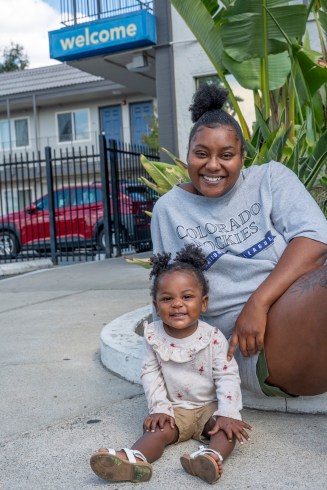 After an eviction in March 2024, Tytinisha Mitchell and her daughter largely lived in Mitchell’s car until the city provided her with a motel voucher in late August. Russell Stiger II, OBSERVER
Research 2021 shows that homelessness during pregnancy is associated with adverse perinatal outcomes. The physical toll of homelessness can be severe, including increased odds of preterm delivery and low birth weight independent of preterm delivery. The 2021 study in the Journal of Perinatology followed 672 women who were homeless at the time of delivery and concluded that safe and long-term housing of expectant mothers may alleviate some risk factors for both the mother and the child.
A report from the Benioff Housing and Homelessness Initiative at UCSF found that 72% of pregnant women who are homeless had at least one chronic health condition and more than 1 in 10 had three chronic conditions. Further, nearly half (41%) said that despite having health insurance, they did not utilize health care services.
Such findings highlight the reality that eviction and homelessness are not just housing issues; they are public health crises that shorten lives and deepen inequality.
Mitchell’s story, housing advocates say, reflects a larger failure in California’s housing policies — one that continues to push low-income families toward homelessness and instability.
Herman Barahona, co-founder of the Sacramento Environmental Justice Coalition, says the state’s economic strength makes its housing shortfall especially troubling.
“California, being the fourth-largest economy in the world, could have done better to build affordable housing that the state had promised for years, and they failed to build them,” Barahona says. “I think it was like a million homes [the state promised] to build — affordable homes — and they didn’t do that.”
He says many local governments also have resisted policies to expand affordability.
“A lot of city councils and county boards really don’t like inclusionary zoning policies, which would mandate at least a 10% to 15% affordable housing construction rate from developers,” he says.
Barahona connects such decisions directly to the growing number of residents without stable shelter. “So this is why we’re seeing people who just can’t live indoors,” he says. “These are policy positions that affect the poor.”
While advocates such as Barahona focus on the policies that create housing scarcity, legal organizations are working on the ground to keep families in their homes.
Adam Murray, CEO of the Inner City Law Center, says his organization assists people facing housing instability at every stage, from those already living on the streets to families on the brink of eviction. Last year, the center handled more than 3,200 cases and recovered more than $20 million for clients.
He says reducing the long-term stigma of eviction could prevent many families from falling back into homelessness.
“I think that limiting or eliminating the ability of landlords to rely on past evictions, or even have access to that information, would be extremely helpful for the people who are most likely to become homeless being able to find housing,” Murray says.
His organization handles 700 to 800 eviction cases each year, and for nearly all of those tenants, the records are sealed once the cases end.
“Even if they are moving out — most of our tenants are able to stay in their homes, but we have a substantial number who ultimately are moving out — at the end of that eviction, the record is sealed,” he says. “It does not follow them. It does not have an impact when they’re out there looking for their next home.”
Murray says there are many advantages that come from having a lawyer’s representation in the eviction process. “But that ought to be automatic for everybody,” Murray says.
In late August, Mitchell contacted 2-1-1, the city’s referral line for housing and social services. The call connected her with a city program that provided a motel voucher. She and her daughter have been at a Motel 6 since early September.
Mitchell says she called 2-1-1 when she still was living with her daughter’s father between April and June 2024, but the motel placement didn’t come through until this summer. It was right on time for Mitchell, whose friends had become less accommodating.
For now, she says, the voucher provides a brief reprieve from months of uncertainty — a chance to rest, shower, and prepare for her new baby.
“I just want to be somewhere safe where my baby can sleep,” Mitchell says. “That’s really all I want right now.”
EDITOR’S NOTE: This is being reported with the support of the USC Annenberg Center for Health Journalism’s 2025 Ethnic Media Collaborative, Healing California.
Related