
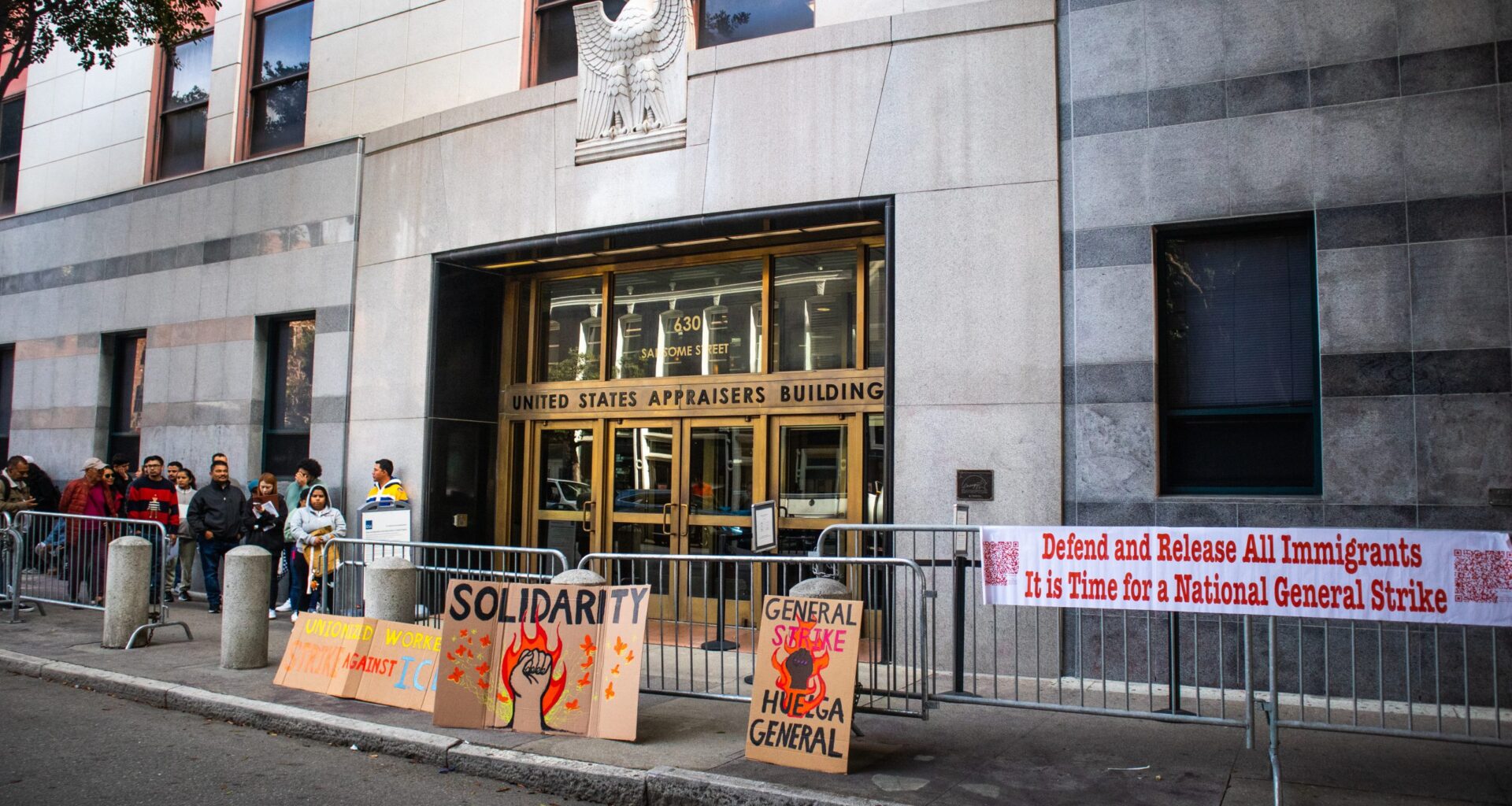
At a time when immigrants across the country risk being detained and deported while awaiting court proceedings, San Francisco’s case backlog has never been higher.
The city’s immigration court has the largest backlog of any immigration court in California, so high that final hearings are being scheduled for as far out as 2029. San Francisco immigration judges had over 120,000 pending cases in fiscal year 2025, according to the Transactional Records Access Clearinghouse from Syracuse University.
Experts pointed to several factors worsening the backlog, including the President Donald Trump’s firing of more than 90 immigration judges this year, low funding given to immigration judges, and novel tactics by federal attorneys that further strain the system.
For immigrants, the delays mean languish. They often wait years for a decision on whether they can remain: In San Francisco, immigrants are waiting an average of 914 days, or two and a half years, since their first “notice to appear.” It’s the longest wait in the state.
Just nine immigration judges remain in San Francisco
It wasn’t always this bad. When retired Judge Dana Leigh Marks first started hearing immigration cases here in the 1980s, the time it took for a case to enter the system and get to a final hearing was about 12 to 14 months, she said. That was, Marks said, “a pretty reasonable amount of time.”
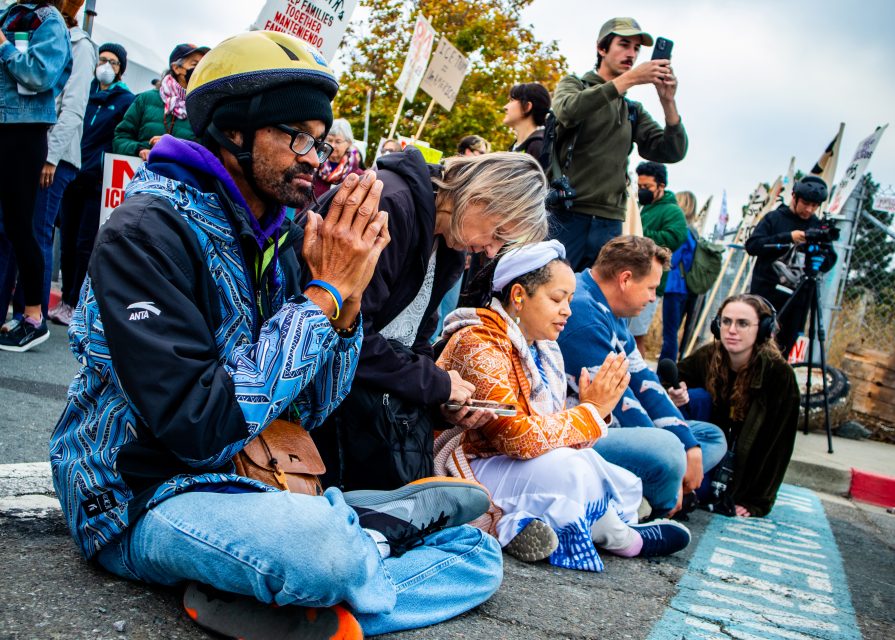 Protesters pray on the front line of an anti-ICE protest at Coast Guard Island in Alameda on Oct. 23, 2025. Photo by Mariana Garcia.
At that time — and until earlier this year — immigrants awaiting court proceedings were able to go about daily life without much risk of arrest or deportation, so long as they were following the law.
But that has changed in the Trump administration. Immigration and Customs Enforcement agents nationwide have swarmed courthouses, detaining people in hallways after proceedings. As attending hearings has become more dangerous, the process is taking longer and longer.
That’s at least partly because the Trump administration has fired over 90 immigration judges nationwide since January, according to the union representing immigration judges, worsening the backlog.
Twelve of the fired judges were in San Francisco, which went from 21 judges earlier this year to nine as of late November.
One of the 12 fired judges, Ila Deiss, had between 4,000 and 6,000 cases open at any given time in her last three years on the bench — and the load was only increasing. When she was fired by the Trump administration in July 2025, her entire docket was reset to 2029.
She was known as one of the most efficient judges in San Francisco, seeing an average of four to five individual hearings on top of a docket of group hearings every day. “If you want to address the backlog, you don’t take out one of the most efficient judges,” Deiss said.
When former Judge Shira Levine first began hearing immigration cases in 2021, some of the cases that crossed her desk had stamps reading “must be completed by 2015.” When she was fired in September, she was hearing cases dated back to 2013, Levine said.
The day she received her termination notice, Levine was presiding over a case with a defendant who had already waited years for his hearing. Her firing, Levine said, bound him to wait even longer. Like Deiss, Levine’s docket was rescheduled to 2029.
While San Francisco is at the top of the backlog, it isn’t alone. Nationwide, a backlog in immigration cases began to accrue in 2006, though it has rapidly accelerated since 2020 as a result of judges being fired, the Trump administration’s efforts to revive old cases and chronic underfunding of the immigration courts.
$75 billion for ICE, $3.3 billion for judges
Another reason for the backlog is the sheer number of immigration cases coming before the courts, and the disproportionate funding given to enforcement. The “One Big Beautiful Bill,” passed by the administration in July, allotted $75 billion in funding to ICE over four years, including for detention facilities and removal operations.
But only $3.3 billion was set aside for immigration judges in the Executive Office for Immigration Review. The bill also caps the number of immigration judges across the country to 800 starting in 2028. There are currently 700.
ICE is following the administration’s orders to arrest as many people as possible. Targeting people who show up to their court hearings, Judge Marks said, is an easy way to satisfy the Trump administration’s “zeal to achieve large numbers of deportations.”
Marks noted, however, that mass deportation efforts didn’t begin under President Donald Trump. Under the Obama administration, immigration judges, including Marks, were temporarily sent to border courts to hear testimonies from recent arrivals in the United States. The expedited hearings that once happened only at the border, however, have been expanded across the country’s immigration courts.
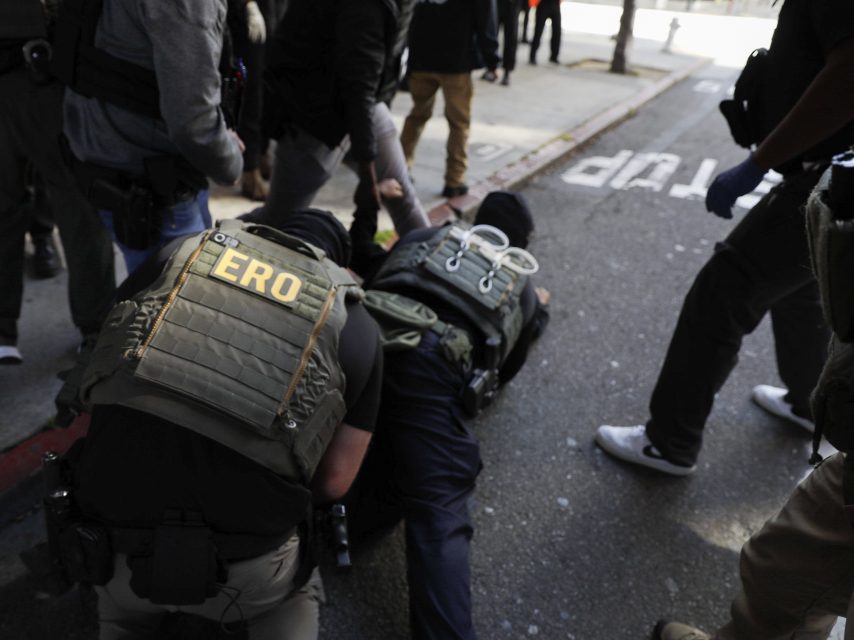 ICE agents zip tying a protester on the ground outside 630 Sansome St. on Aug. 20, 2025. Photo by Zenobia Lloyd.
She added that settlement patterns might also play a role in the sheer number of immigration cases. The large population of Central Americans in the Bay Area has resulted in a larger number of immigration cases in San Francisco than Los Angeles, the city with the third highest backlog in California despite its higher undocumented population.
Marks added that asylum cases — which people from Central America seek at higher rates than other countries — are more “time-intensive and take longer to process through the system.” San Francisco, for example, has a significantly higher number of pending Guatemalan cases than any court in Los Angeles County.
And then, Marks says, all these cases tend to “languish on the docket” because there aren’t enough judges who have time to hear them.
DHS tactics lead to cases languishing
Before her termination, immigration hearings had gotten longer in Levine’s court, she said, due to the Department of Homeland Security’s strategy of dismissing as many asylum cases as possible. Under Biden, she noted that a hearing might take 25 minutes. Under Trump, the same case might take four hours.
In the past, Levine said she would try to run her courtroom like a mediator. At the time, DHS attorneys were more willing to consider an asylum-seeker’s case rather than moving to immediately dismiss it. Even if they disagreed with the judge, it was more common for DHS to allow the judge to rule as they saw fit, resulting in the shorter hearing times.
Now, the Trump administration has limited the prosecutorial discretion that DHS attorneys once had, including their ability to use tactics like deferred action, stays of removal, and orders of supervision to pause certain cases indefinitely, resulting in a lengthy back-and-forth between judges and attorneys. In May, DHS began to “re-calendar” thousands of these previously paused cases, further overloading immigration courts across the country.
Frustrated with the current system, Marks believes that “there’s never been the ability to find an equitable solution” inside the courtroom. “That’s what leaves us with the disconnect that currently exists.”