
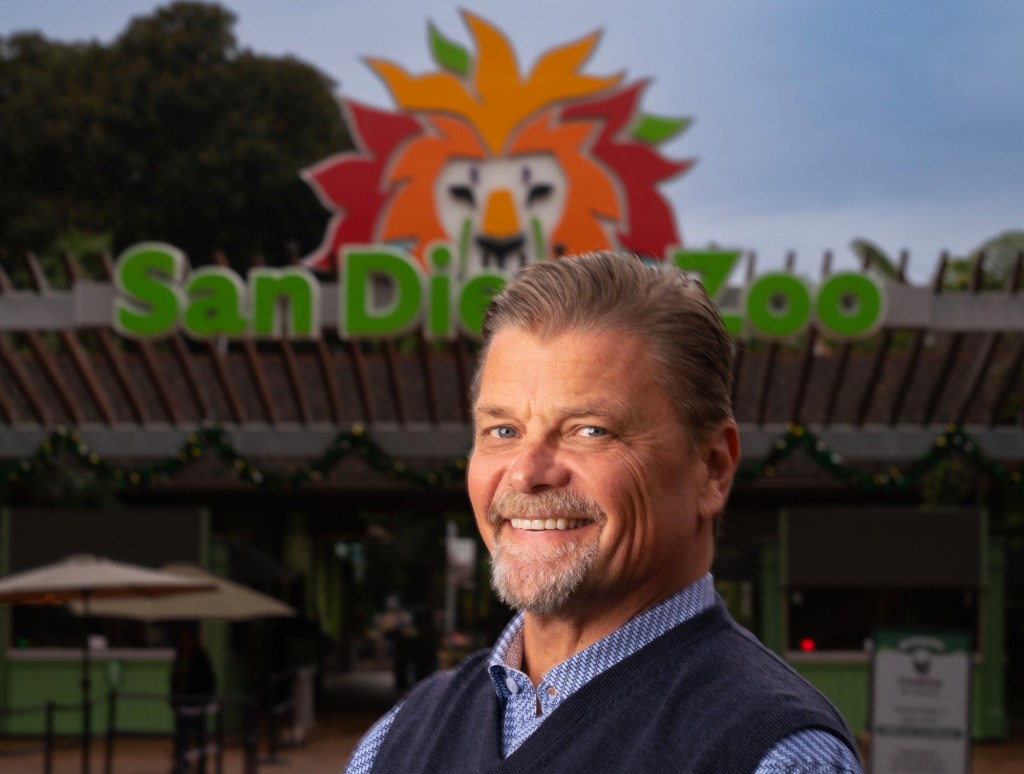
After Shawn Dixon finished college with a criminal justice degree, he packed up his pickup and drove from Sacramento to Alaska. He had planned to stay a summer to enjoy the natural beauty of the 49th state that he had only seen in pictures — instead, he stayed 10 years.
Along the way, plans for a law enforcement career faded, and he began working in the hospitality industry, advancing in management.
By 2016, his business expertise helped him land the chief operating officer job at the San Diego Zoo Wildlife Alliance, a nonprofit conservation organization that runs the San Diego Zoo and San Diego Zoo Safari Park. In March, he was named interim CEO and president, and in October, the Board of Trustees dropped interim from his title.
In his new role, he helped secure a new contract with a union representing nearly 1,800 Teamsters amid strike threats after negotiations dragged on. The organization will soon launch a search to find an executive director for Safari Park to replace Lisa Peterson, who left in April to lead the Houston Zoo.
Dixon, 55, spent his early years in Flagstaff, Ariz., and said he always enjoyed spending time outdoors hiking and camping, which he still does with family when he can. His favorite hobby is pickleball. He fondly recalls his first visit to Safari Park (then known as the Wild Animal Park) when he was around 5.
He loves bears, including the grizzlies and brown bears he first admired roaming along rivers when he lived in Alaska. At the zoo, he enjoys seeing all the bears, including polar bears and pandas. “We can talk about bears all day long,” he said, smiling.
Dixon recently sat down with the Union-Tribune to talk about his background, the first year of the zoo’s giant panda loan with China and what’s ahead at the two parks. The interview was edited for clarity and conciseness.
Q: What are some of your favorite spots at the San Diego Zoo and San Diego Zoo Safari Park?
A: “In the morning, if I come into the zoo and I get some time to walk around before opening… it’s just wherever I go. When I think about the middle of the day, when it’s busy, (I like) going over to Denny Sanford Wildlife Explorers Basecamp and just experiencing the families, seeing the families connect. That just warms my heart to see that and feel that and know that we’re engaging in a different way…
“If I think of other places within the zoo, (there is) walking across the bridge, which is something that was constructed under my term here… the bridge that goes across toward the polar bears and the other side. Walking across that, you get some really long views. I get to look at Africa Rocks, I get to look down below at pandas, and it just gives me a different perspective from that point of view and angle.
“As far as the Safari Park, there’s Walkabout Australia that is a new location in the last six or seven years. It is a wonderful place where you get to engage and walk along the paths, and there’s no barriers between you and the species that you see in there. So it just brings a different flavor and a different viewpoint. That’s another space that was constructed during my time here.”
Q: What challenges do you see ahead?
A: “I would say our challenges are no different than any other tourism organization in the state or really in the country. Just lining up with the tourism trends, which are flat at this point. A tad bit up for California, possibly, but we are looking at somewhat flat growth year over year in ’25 and possibly a little bit into ’26. I’m on the San Diego Tourism Authority board and (am its) past chair now… We spend a lot of time talking about the tourism trends…
“For San Diego Zoo Wildlife Alliance, it is really understanding what those trends are and how they impact us. And so if we don’t have the same growth model we’ve had in past years, it is just running an efficient business and making sure that we are keeping our priorities straight… International travel is down, it has been down since COVID from some of the countries.”
Q: What are the next big things planned at Safari Park and the zoo?
A: “There’s the Denny Sanford Elephant Valley project that will be opening up early next year at the Safari Park. That also has a Mkutano House, which is a two-story dining destination at the base of the Elephant Valley, so you’ll be able to sit at the restaurant, whether it is downstairs or upstairs, and be able to look out over an amazing view of the elephants, almost eye level to eye level. A view like nothing else, a view really like what mimics what you’d see in Africa if you were there…
“At the zoo right now, because we are spending a lot of time and effort on the Safari Park and Elephant Valley, it is really about us transforming experiences — so whether it is Nighttime Zoo, Jungle Bells, HalGLOWeen — it is really us enhancing those experiences and making them different and unique for next year’s visit. And then we have pandas that have only been here a year, so there’s a large population that still needs to come and see the pandas.”
Q: How did the first year of the panda loan work out?
A: “It has been a little over a year of being here, and I can’t attribute pandas (to) direct attendance, but we’ve had a wonderful year here since they’ve been here. I think the other value of having the pandas here is just for us to be able to share the cultural experience in seeing the pandas and also our ability to tell long-form stories about the conservation efforts that we do on behalf of pandas… We’ve had billions and billions of impressions on stories related to pandas…
“The pandas have thrived in their habitat. We have had great collaboration with our Chinese colleagues. The pandas from a (health) standpoint are doing extremely well, they are thriving — and I would say the community and outreach and support has been incredible.”
Q: What are your top priorities now that you’re president/CEO?
A: “It is the people and the culture, continuing to follow our organizational priorities, which haven’t changed — which is our financial house and making sure that there’s stability, world-class experiences and making sure you are coming here… that you are getting the experience you imagined. Being a world-class conservation organization, and a leader in conservation space — and a leader means sometimes following and a leader means leading when you need to, so bringing collaboration together. You pull all those together, and it creates a plan for the future.
“I’m working that plan with the team. But it is also listening to the team. So as a new CEO, I’m spending the next two and a half months or longer, actually, to have listening circles, listening to the team because that will also help formulate the future for us.”