
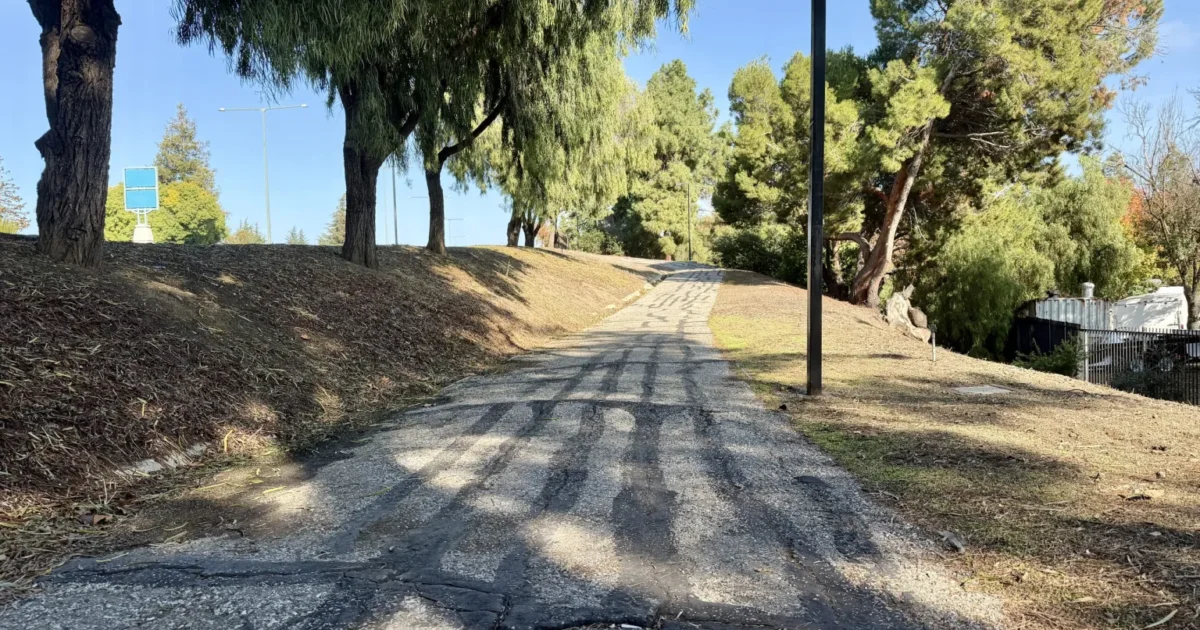
Constructed more than five decades ago, the bicycle and pedestrian path along Shoreline Boulevard between Villa Street and Wright Avenue is in poor condition, with tree roots causing cracked and raised asphalt. That could all change starting next year, after the Mountain View City Council voted last month to move ahead with an $8.7 million improvement project.
The initiative aims to enhance the experience for walkers and bikers traversing a section of Shoreline that crosses above Central Expressway and the Caltrain tracks, which acts as a major connector between downtown Mountain View and the northern portion of the city.
An existing trail that runs along the east side of the roadway will be replaced with a 10-foot-wide path that meets Americans with Disabilities Act standards. The current steep slopes don’t comply with the most recent accessibility requirements, according to last month’s council report.
While the new path would address conditions directly to the north and south of the Central Expressway overpass, the city does not plan to make changes to the bridge itself. Instead, the existing six-foot-wide sidewalk over Central would remain, with the new path connecting to the overpass on both ends, city spokesperson Lenka Wright said.
In addition to the wider path, the city also plans to install a new connection to the recently completed Central Expressway sidewalk, as well as planting 65 native trees and constructing stairs to connect two portions of the pathway north of the bridge. The stairs would include a “bike channel,” which is a smooth ramp that allows cyclists to move their bicycles up and down the stairs more easily.
The plan is to start construction in spring 2026 and be finished in spring 2027, according to the council report. Traffic controls are expected to be in place while work is underway to ensure pedestrian and bicycle access in the area.
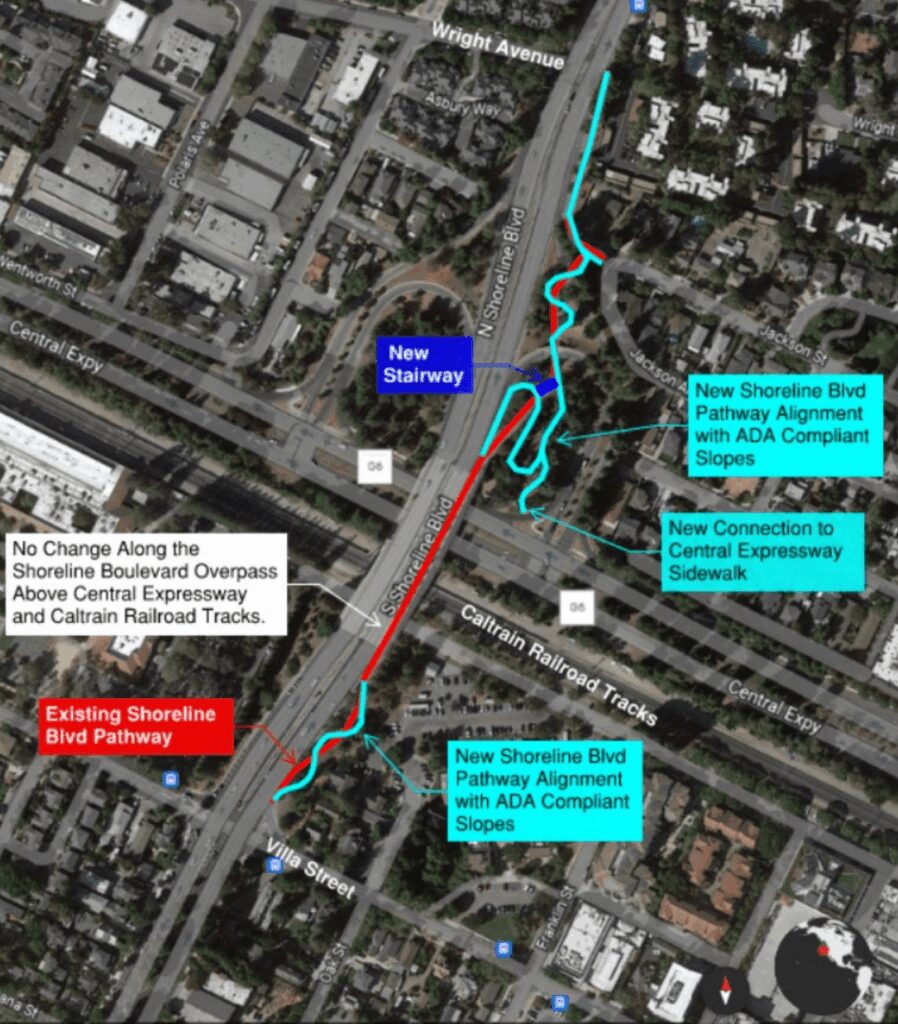 The Mountain View City Council has approved pathway improvement plans for Shoreline Boulevard. Image courtesy of Mountain View.
Roadway improvements a decade in the making
An undertaking like this has been in the works since 2014, but because of a previous lack of funding and staff resources, it was never completed, the council report said. In October 2024, the city council approved plans for staff to award a construction contract for the project to the lowest responsible bidder, so long as the total budget stayed within a roughly $6 million limit.
Due to a grant the city received from VTA, the project required authorization from Caltrans in order to move forward. The city received the green light this September, but the project’s expected cost had by then increased to just more than $8.7 million. Factors included the extended timeline, inflation in construction prices and costs for traffic control during construction, the council report said.
At the Nov. 18 meeting, Councilmember John McAlister pointed out the nearly $3 million jump in costs over the past year, emphasizing that “time is money.”
“This is a particular time that we really need to be on top of getting this project going forward and making sure that we are considerate of all the options going forward,” McAlister said at meeting.
The council unanimously approved the updates to the project as part of its consent agenda, which contains several items that the members typically approve in a single vote.
The project is funded through multiple sources, including roughly $3.5 million from the Measure P business license tax that voters approved in 2018, as well as the $2 million VTA grant.
With all the existing funding sources tallied, the city was still facing a $926,000 shortfall. As part of its approval last month, the council voted to cover that gap with money from its construction and property transfer tax fund.
This story originally appeared in the Mountain View Voice. Emma Montalbano is an education reporter for the Mountain View Voice.