
SAN FRANCISCO (KGO) — Jenni Mork is painting a portrait of her new dog, which she shares with her neighbor.
“I am making my first drawing of our new family relationship,” said Mork, a breast cancer survivor who carries the BRCA gene.
Mork is sitting around a large table at UCSF Medical Center at Mount Zion with about a dozen other people who have also battled cancer.
They’re part of Art for Recovery, a UC San Francisco program that promotes creativity to help people deal with the trauma of a cancer diagnosis.
Taking part in the art program lets Mork cope with the emotional turmoil cancer can bring.
“Having cancer I never had children and having this opportunity to have this dog is really wonderful,” she said wiping away tears. “A program like this lets you celebrate the wins that a larger society doesn’t see as a win.”
MORE: Tatiana Schlossberg, JFK’s granddaughter, reveals terminal cancer diagnosis
Typical art therapy doesn’t always work for people when they’re in treatment because they’re still processing the emotions of the illness and the loss of self, according to Art for Recovery Director Amy Van Cleve.
“People need a space that they can get back in their skin. We’ll accept you wherever you are at. If you need to paint your anger, paint your anger. If you need to paint your resiliency and paint a new version of hope that is true to you, we are there for that too,” said Van Cleve.
Sitting in a separate table is Nanci Reese, who is painting a colorful scene of Mariposa Grove in Yosemite with herself in the center.
“It’s supposed to be me, but it always comes out not looking quite like me,” said Reese, who was diagnosed with endometrial cancer in 2008.
Radiation and oxygen therapy affect her vision.
“Oxygen therapy makes it so your vision is a little blurred so I started doing like Monet. I could not see but that is okay,” explained Monet.
MORE: New 1-day surgery removes cancer and reconstructs the breast in the same operation
Self-portraits are common subjects.
Van Cleve said that when people are first diagnosed with cancer they paint themselves as warriors preparing to battle cancer.
That is sometimes followed by images of grief and about losing their former selves because of weakness, loss of mobility or hair loss.
“The third phase I call the legacy phase. You’re either transitioning to the rest of your life after cancer or they’re transitioning into hospice and letting go and making peace,” said Van Cleve.
The cruelty of cancer is not lost on this group. Portraits of past participants who died from cancer hang nearby.
At the end of each session, the group gets together for a check-in.
“It’s a space where people get to hold up what they made and they can say whatever they want. They can say I’m going into hospice, I have six months to live. We’re just present with them and they can tell their story or retell or reimagine their story however they need to,” explained Van Cleve.
Art for Recovery started in 1988 as therapy for AIDS patients. It’s now offered at all UCSF medical campuses in San Francisco and the East Bay.
The artwork has been displayed at the hospitals, but this year it’s getting more recognition.
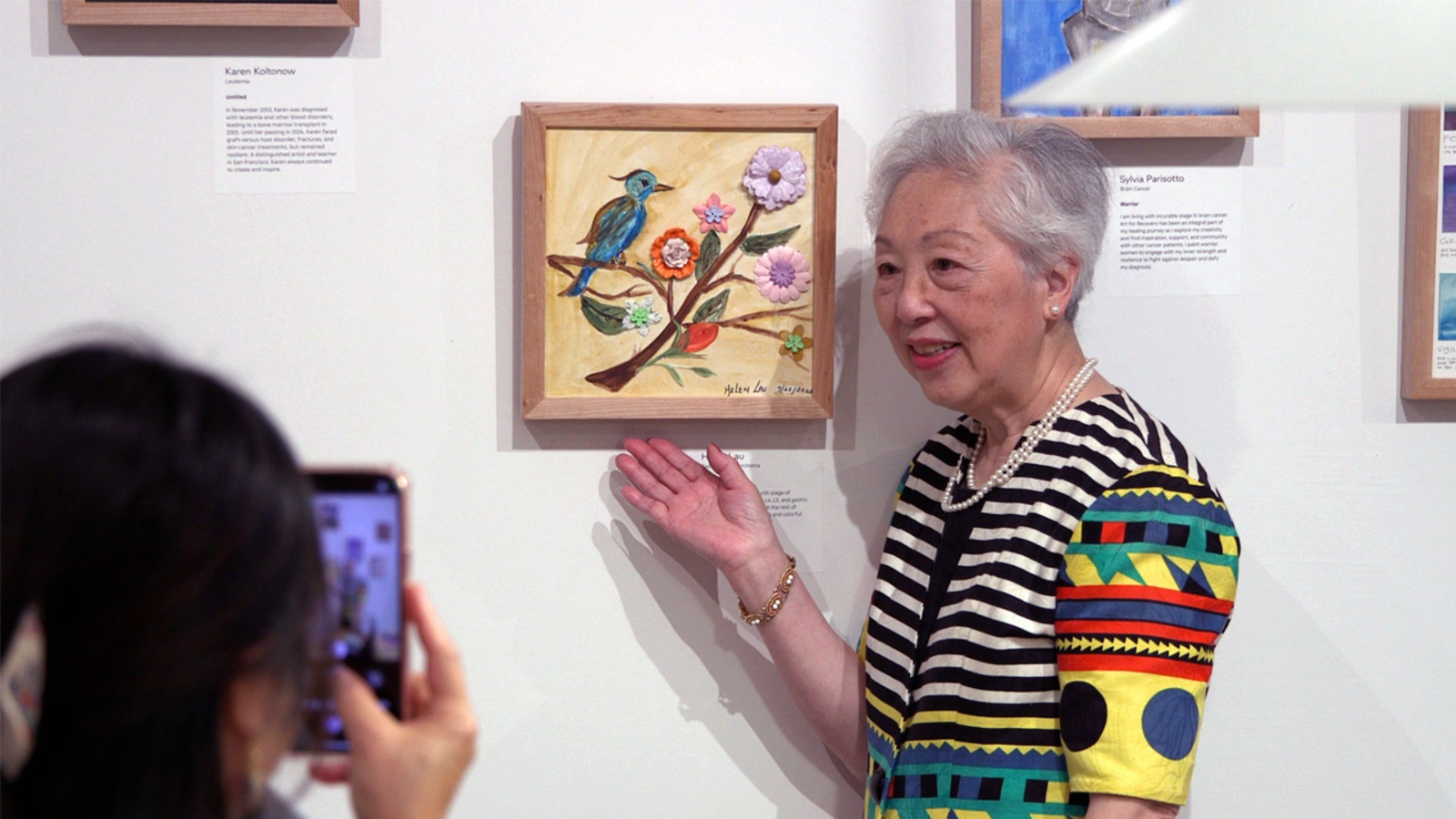
The San Francico Museum of Modern Art is exhibiting works from 30 artists, including two who passed away.
Susana Gershuny was there for the grand opening earlier this month.
She created a piece out of the hair she lost during chemotherapy.
“I learned to weave hair into yarn and then used it to embroider a little pillow,” said Gershuny. “I wanted to sort of flip this loss on its head. I wanted this piece to be about me reclaiming my hair and giving it a higher purpose.”
Gershuny had just given birth to a son when she was diagnosed with breast cancer.
She also created a picture book for her four-year-old daughter to explain why she could not carry her or give her a bath.
“Art for recovery allows you to take these complex emotions that you have inside and put them on paper and when you look at what you’ve created, the thing that you feel inside feels a little less scary to you,” said Gershuny.
According to Van Cleve, the movement of painting puts patients in a different head space that lets them express what they are feeling.
“When you are literally moving through that emotion and you share it, there is a release, there is a letting go,” said Van Cleve
The “Art for Recovery” exhibit continues at the San Francisco Museum of Modern Art until Spring. No ticket is required to view the exhibit.

Copyright © 2025 KGO-TV. All Rights Reserved.