
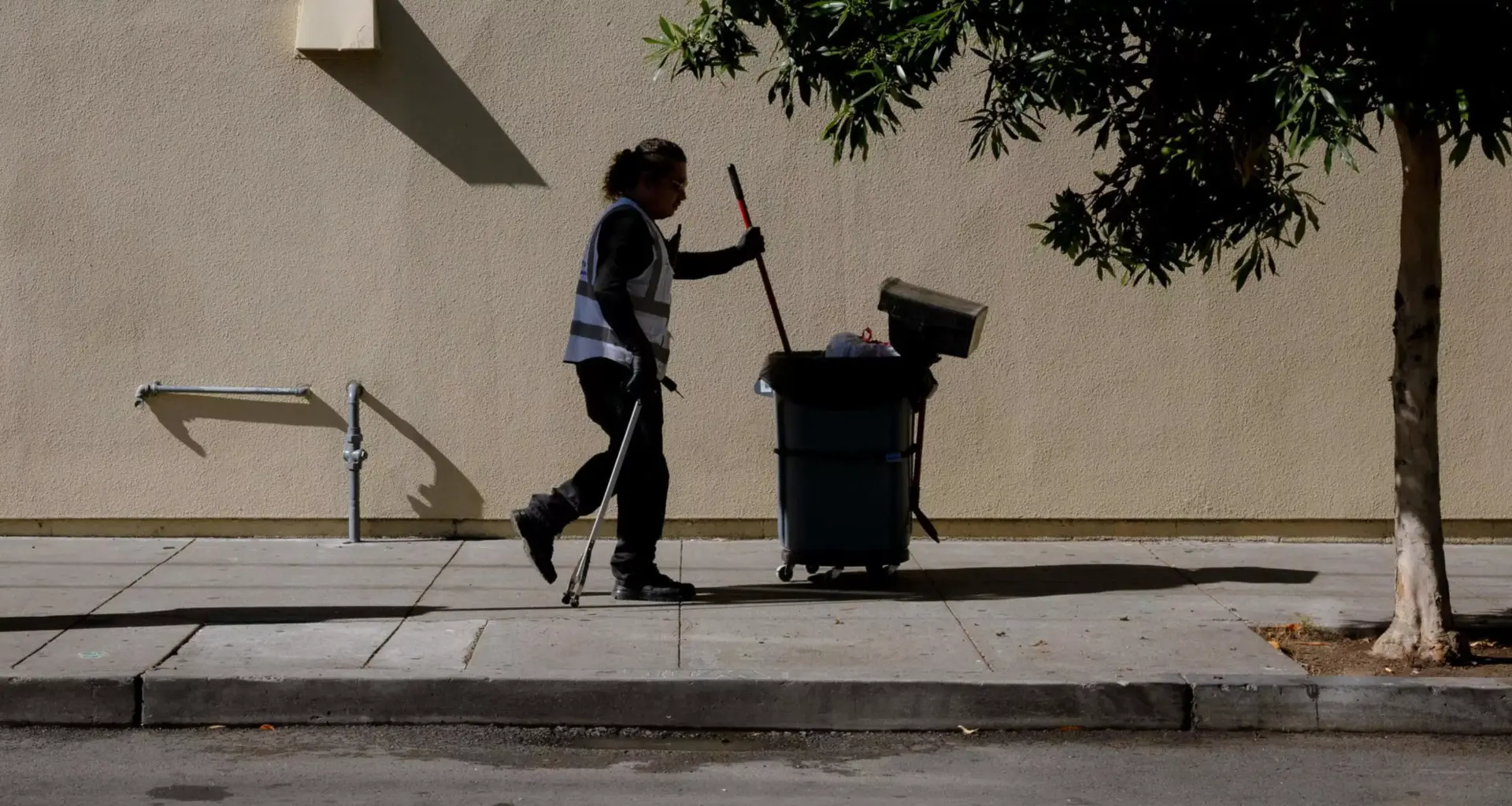
The Mission needed a savior.
Soon after Mayor Daniel Lurie took office in January, he set his sights on clearing drug activity from the Sixth Street corridor in SoMa. The Mission was the obvious next destination for the city’s drug market, with the 14 bus line providing easy transportation for those looking to escape the crackdown.
The 16th Street BART Station had long struggled with an unpermitted all-hours sidewalk market of stolen and second-hand goods. But by late February, conditions had deteriorated: Crowds of users and dealers grew, particularly after dark, leaving businesses struggling, seniors afraid to leave their homes, and families pleading with local leaders for help.
The street ambassador nonprofit Urban Alchemy had seen some success in moving drug markets, homelessness, and trash in the Tenderloin. But the Mission, suddenly plagued by the same problems, was a different community. Neighborhood groups were hesitant of an outside entity taking on local issues, and trusted organizations were wary of entering the Mission’s fierce political climate.
Arleen and Mike Luong and their company, Ahsing Solutions, were ready.
 Ahsing Solutions’ Armond Turner, center, and Jonathan Ruelas ask Lourdes to leave the area.
Since being released from prison — Arleen in 2019, and Mike in 2021 — the Luongs have repeatedly found themselves in the right place at the right time, establishing a Rolodex of City Hall power players who helped them build Ahsing, which deploys street teams to deter illegal activity.
In July, the city tapped the nascent organization to work the front lines tackling drugs and homelessness in the Mission. With no office, no website, and not even an application for the contract, Ahsing landed a six-month deal worth $500,000 to address the city’s most pressing and visible crises. The organization now appears poised to cash in on a two-and-a-half-year, $2.2 million contract extension.
But the Luongs are entering dangerous territory — in both the physical and the legal sense. The Standard found that Ahsing, a for-profit corporation, does not have a license typically required for companies that perform contract security work. Ahsing and city officials contend that street ambassadorships are not “security,” so such licenses are not necessary.
The growth of a cottage industry of street ambassadors raises questions around how the city is outsourcing the high-stakes front-line work on drug use and homelessness to private companies that have little public accountability. Ahsing and other private groups that provide street ambassadors, who are paid less than their public-sector counterparts, are tasked with carrying out the impossibly complex obligations of police, street cleaners, and social workers, all in one.
Mission residents and businesses have praised Ahsing’s rapid impact on their neighborhood. But critics contend that Ahsing is just the latest player attempting to cash in on the street crisis.
“To authorize private security officers to go around on public sidewalks and in public parks and police people with no oversight should be goddamn patently illegal,” said Paul Boden, executive director of the nonprofit Western Regional Advocacy Project. “But it’s a growing business, and they make big bucks doing it.”
The rise of Ahsing
The Luongs’ rise in the Mission was hardly destined.
In 2017, Arleen had nearly completed a six-year sentence for fraud at the troubled women’s prison in Dublin, California, when she received a letter.
Inside an envelope with a return address from a P.O. box in San Francisco, she found a note and a photo of Mike wearing gray sweatpants and a beanie. He was nearing the end of an 18-year sentence for drug trafficking and had seen Arleen’s photo on writeaprisoner.com (opens in new tab), a pen-pal website for incarcerated people. He asked his cousin to send her a note on his behalf.
Arleen was perplexed but intrigued. Communication between prisoners was strictly prohibited. But she wrote back, and the couple exchanged letters and phone calls in secrecy, even after Arleen was caught and sent to solitary confinement.
The relationship blossomed behind bars for several years. Upon Mike’s release, they married and quickly made a name for themselves in San Francisco.
 Ahsing Solution founders Arleen and Michael Luong on Wiese Street in the Mission.
They founded Ahsing in 2023 as a security-services side hustle on top of their regular jobs: Mike at Urban Alchemy and Arleen at the nonprofit community business development organization Excelsior Action Group.
That year, the Luongs secured their first contract with the city to clear illegal sidewalk vendors around 24th and Mission. Ashing picked up the pieces after SF SAFE, the nonprofit arm of the San Francisco Police Department, imploded financially and its executive director was charged with corruption. As part of that contract, Ahsing patrolled the 24th Street BART station, working with Public Works employees to cite unpermitted street vendors and clean sidewalks.
“One thing about the Mission is there is a lot of street politics,” said Santiago Lerma, Mission street lead for the Department of Emergency Management. “We have to be mindful of who we put out there: people who can handle themselves in the community, that have the respect of the community. And that’s something Ahsing has proved itself able to do.”
Ahsing has also proved itself able to drum up private-sector business. Through her role at EAG, Arleen met Yosef Tahbazof, a controversial real estate developer. He hired Ahsing as a leasing agent in the Excelsior this year, tasking the couple with choosing who would live in his low-income complex at 4742 Mission St.
“We needed more money, so I was like, ‘OK what else can we do?’” Arleen said. “Yosef said it’s a lucrative business, and there’s not a lot of companies that could do it.”
 Ahsing Solutions ambassador Jerry Franklin assists Lourdes.
Unlike other street ambassador outfits, Ahsing is a limited liability corporation, which makes its finances and dealings less transparent.
But that hasn’t stopped it from earning the contracts and influence to do work traditionally handled by nonprofits or city employees. In July, as the drug crisis in the Mission escalated, the city handed Ahsing the six-month contract to deploy eight ambassadors around the 16th Street BART Station.
Ahsing ambassadors patrol seven days a week from 11 a.m. to 8 p.m. They are tasked with de-escalating violence, deterring drug activity, and connecting drug users to resources, as well as cleaning up street trash. Ambassadors with the company — who must have previously been homeless, addicted to drugs, or incarcerated — earn an average of $26,000 for the six-month contract.
The deal drew scrutiny from union workers who allege that the city too often outsources street cleaning work to organizations whose workers are insufficiently paid, trained, or resourced.
“San Francisco workers and taxpayers are tired of being ripped off,” said Theresa Foglio-Ramirez, a union representative for employees of the Department of Public Works. “We have seen questionable and shady for-profit and nonprofit street cleaning scams for too many years now.”
The Ahsing contract bypassed the usual competitive bidding process through Lurie’s fentanyl emergency ordinance, raising eyebrows among critics of the mayor.
“Maybe I’m old-fashioned,” said former Supervisor Aaron Peskin, questioning the vetting process that went into Ahsing’s contract. “But I just have this little thing for transparency.”
Nonetheless, the neighborhood is happy with Ahsing’s work. In September, the Mission Merchants Association described the company in a letter to the mayor as “the most impactful solution we have seen.” After years of broken promises from the city, the area around 16th and Mission was seeing progress. Business owners had someone they could call for help. Ambassadors watched over children as they left school. Seniors felt safe to leave their homes.
Ahsing says that since July, it has counted more than 11,500 positive engagements, 550 de-escalations, and 12 overdose reversals, while removing 925 bags of trash.
“It’s like the difference between heaven and hell,” said Josephine Ho, who has lived on 14th and Mission for more than 35 years. “Now I don’t see any drug dealing. The street, on this side, is clean. I feel very safe.”
 Ahsing Solutions’ Terraine Miller across the street from the 16th Street BART station, where the company is not allowed to operate.A legal gray area
In October, Mission Supervisor Jackie Fielder urged Lurie to give Ahsing more funding. On the verge of a scale-up and more money, with a contract that could total millions over years, Ahsing appears here to stay.
But it may be more than the Luongs bargained for.
The July contract with the city requires Ahsing employees to “conduct hourly foot patrols in designated corridors to monitor safety and deter drug use” and “prevent or interrupt street violence, or to prevent crime so long as it does not endanger Ambassadors.”
Several sources in the security industry said the contract clearly describes security work. But a database of licenses managed by the state Bureau of Security and Investigative Services shows no filings for Ahsing Solutions.
“That sure sounds like a security guard to me,” said Jerry Hill, the former state senator who wrote some of California’s regulations on security guards, after hearing details of Ahsing’s contract. “If you’re trying to create a secure environment, and that’s part of the function of the company, that would require licensing.”
The Luongs acknowledge that Ahsing conducts security work outside its city contracts, which would require a license it does not have. But they deny that their city-funded ambassadors are security guards. They argue that there’s a difference between providing “safety” and “security.”
“We keep the community safe. I know we’re not supposed to use words like that, because we’re not security,” Arleen said. “But that’s basically how we view our job.”
To make her point, she told a story about a group of gang members who were angry about Ahsing’s presence around 16th Street when the company started its patrol in July. The Ahsing ambassadors, she said, were able to de-escalate the tensions and reach a “mutual understanding” with the gang members.
“I think that we stop right before security,” Arleen said. “At no point are we gonna restrain anybody. At no point are we doing any of that. We’re able to get those results without having to do that, with our words.”
 Ahsing Solutions ambassador Jose Ruiz patrols Hoff Street.
A spokesperson for the Department of Emergency Management said the city does not regard Ahsing as a security service, but all its employees undergo an eight-hour de-escalation training and a monthly refresher course. Ahsing and the city contend that the company’s employees are told to contact police when situations get out of control. Both deny that the company performs security services for the city.
However, security experts say paid de-escalation of violence can be considered security work, according to California law. Violation of these codes can result in fines, though they are rarely enforced. But more important, experts warn, the laws are in place to ensure that security patrols undergo proper training and that companies are sufficiently insured should something go wrong. And in the business of street ambassador work, things go wrong often.
In 2022, Urban Alchemy weathered some of the same criticism about its own unlicensed security work; the nonprofit and the city denied that a license was needed. That year, an Urban Alchemy worker was shot. Since then, at least two more unarmed street ambassadors at the company have been shot, according to media reports. In the latest incident, in September, a man allegedly used a shotgun to kill an Urban Alchemy safety ambassador who had asked him to move.
Arleen and Mike acknowledge that the work is dangerous and that Ahsing has dodged bullets of its own — literally.
“We’ve been lucky,” Arleen said. “With all the shootings that have happened on Mission, they’ve just missed my employees.”
No end goal
By the time Ahsing ambassadors begin their shifts each day at 11 a.m., there are no empty shelter beds. Still, the group must comply with its city contract and clear homeless people from sidewalks — even if there’s nowhere for them to go.
Ahsing workers root people out of doorways, parks, and back alleys. With some, the workers form lasting relationships that result in real change, they say. Others are asked to move repeatedly, until eventually they disappear altogether. The work is tedious and interminable. Every day, old people, new people — more people — return.
It’s unclear where most go after they’re moved. Terraine Miller, Ahsing’s street director, said he’s heard that some people move to Millbrae during the day and return to San Francisco for the nightly drug markets after the company’s ambassadors have clocked out.
On a recent Monday afternoon, after the Ahsing team finished its morning sweep, Miller watched as a crowd of drug users and street vendors gather at the northeast side of the BART station — just outside the boundaries Ahsing is assigned to patrol.
“Wait until 3 or 4 — that thing will be off the hook across the street,” Miller said. “They know there ain’t nobody allowed over there.”
For all of Ahsing’s successes, the city has generated criticism for using the organization as a stopgap solution, shuffling problems around with no end goal in sight.
“Ahsing has gone above and beyond the call of duty,” said Bryan Tublin, owner of the restaurant Kitava on Mission Street. “But the city needs to really look hard at whether the problem is being solved.”
The issue worsens on the weekends, when most of the city’s social services programs are closed.
 Ahsing Solutions ambassador Jerry Franklin.
 Franklin carries Narcan.
Ahsing ambassador Jerry Franklin said that on a recent weekend, he was approached by a woman who was frantic for help because she had just seen a man who had raped her. Terrified, she wanted to immediately get off the streets and into treatment. But the shelter to which Franklin normally would have referred her was closed. Instead, he called 911, and paramedics took her to SF General Hospital, where she languished for weeks waiting for a drug treatment bed.
“When someone is so sincere about wanting the help and they can’t get it, it bothers me,” Franklin said. “You don’t treat people like mud just because they don’t have anywhere to go.”
Even with the shortage of shelter and treatment beds, city officials believe that they can no longer allow people to sleep on sidewalks or use drugs in public and that without making a discernible improvement in street conditions, taxpayers will lose faith in the investments they make into social services.
Meanwhile, the Mission waits to learn if Ahsing’s contract will be extended.
“Could there be other solutions, or better solutions? I’m sure,” said Ryan Motzek, president of the Mission Merchants Association. “But pulling the rug from under the community when it needs it so badly right now would be devastating.”