
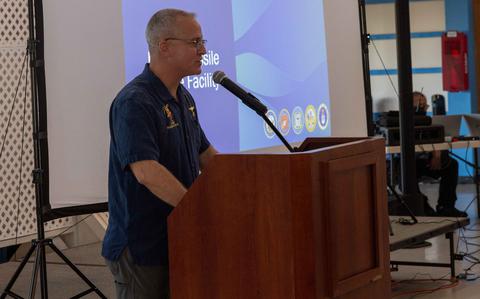
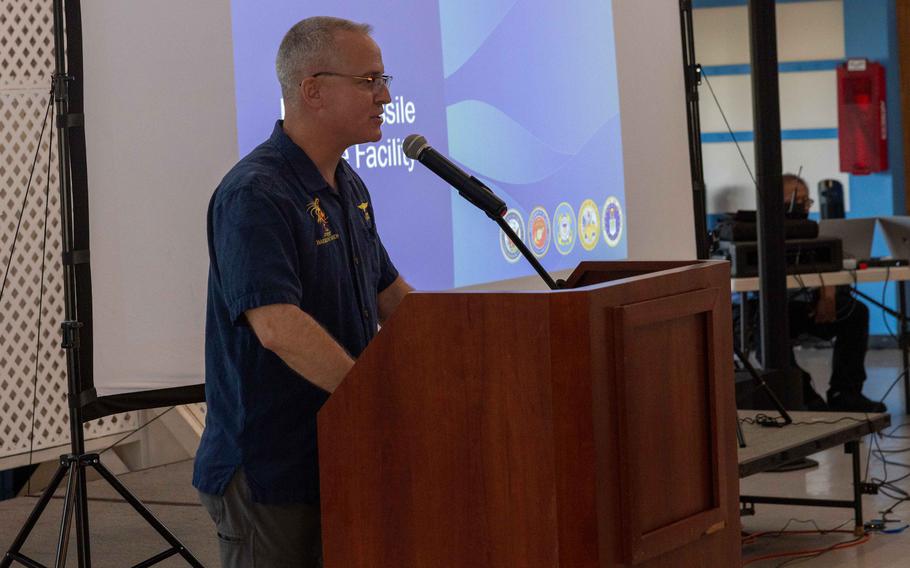
Navy Capt. Brett Stephenson, commander of the Pacific Missile Range Facility on Kauai, speaks during a public meeting in Lihue, Hawaii, on Jan. 16, 2025, regarding the environmental impact statement for the Hawaii-California Training and Testing Study Area. (Louis Lea/U.S. Navy)
The Navy is moving ahead with plans to expand and modernize vast training areas used in waters off Hawaii and California, including the addition of mine warfare ranges, the service announced Tuesday.
The areas, which the Navy calls the Hawaii-California Training and Testing Study Area, have been used by the joint services for decades for air, surface and underwater training and testing.
The Navy contends that modernization of the training areas is needed to complement America’s newest weapons and drone systems that would be used in future conflicts.
“Adversaries of the United States have and continue to acquire modern, quiet submarines that can pose serious threats to national security, the safety of military forces, and the nation’s economy,” a Navy fact sheet states.
“Sonar proficiency is complex and requires regular, hands-on training in realistic and diverse conditions,” the fact sheet states.
The Navy issued a draft environmental impact statement reviewing the proposed changes in late 2024 and published a final draft this fall.
The Department of the Navy’s decision of record announced Tuesday was issued jointly with the Coast Guard, Army and Air Force, which all conduct readiness training in the areas.
Among the planned upgrades is the installation of mine warfare training areas, which would include installation, removal and replacement of non-explosive mine countermeasure targets offshore of Hawaii and Southern California, according to the final impact statement.
In Hawaii, nearshore areas such as Kaneohe Bay and Marine Corps Training Area Bellows on the east side of Oahu will be used for new and more frequent training and testing activities, including mine warfare, a Navy fact sheet states.
Other planned changes are:
• A special use airspace in the Southern California range that would offer real-world maneuvering space for manned and unmanned aircraft.
• Upgrades to the existing Southern California offshore anti-submarine range with the installation of underwater recording devices called hydrophones and undersea cables.
• Two new shallow-water training ranges that would serve as extensions to the offshore anti-submarine range.
• Laying seabed cables and connected instrumentation in Southern California and Hawaii.
• Installation of underwater platforms for underwater vehicle pilot training in Hawaii and Southern California.
Environmental activists have criticized the Navy’s sea training, particularly for its use of sonar and explosives that can harm sea creatures.
Navy vessels hit two whales in the Hawaii-California Training and Testing Study Area in separate incidents in June and July of 2021, according to the National Oceanic and Atmospheric Administration. A third whale was struck in August 2023 in the same waters.
The Navy will undertake steps to lessen the impact of training on sea life and terrain, according to the impact statement.
For example, explosives will not be detonated on or near the seafloor within a horizontal distance of 350 yards from artificial reefs, rocky seafloor or shipwrecks.