
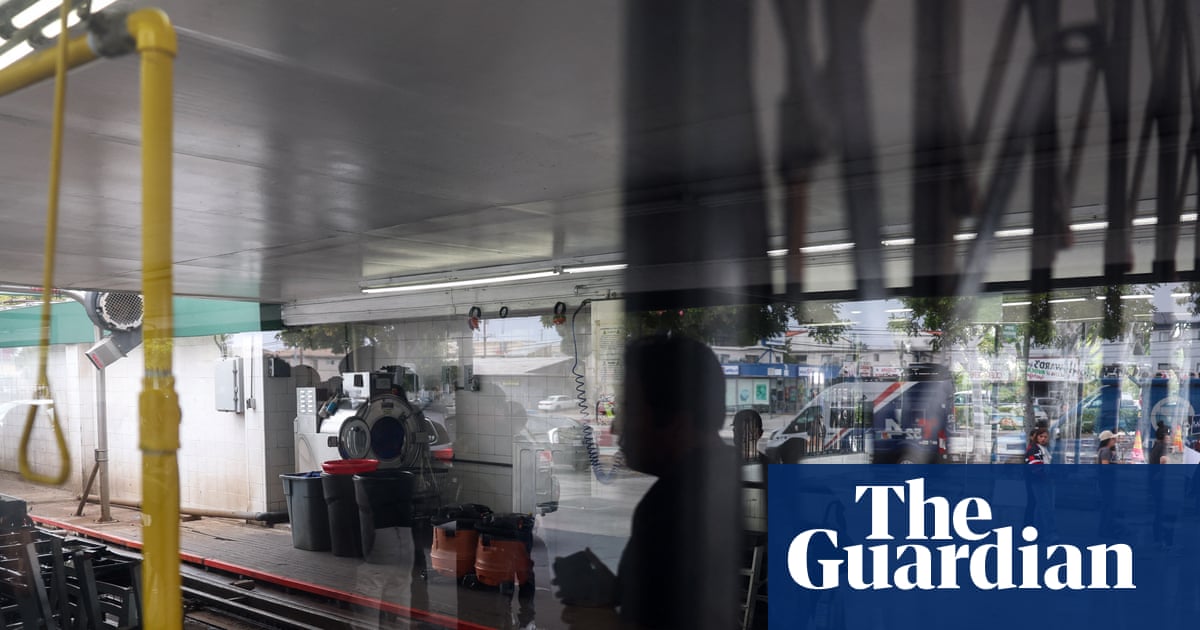
In June, Donald Trump’s administration turned Los Angeles into a testing ground for the tactics that have come to define its sweeping mass deportation agenda across the US – launching large-scale, public arrests aimed at netting as many people as possible into a growing immigrant detention system.
Throughout the raids, one of the recurring targets of US Immigration and Customs Enforcement (ICE) agents has been car wash workers.
Car washes make a logical target for federal agents. It’s common knowledge that a significant share of that workforce lacks immigration authorization. The industry is dominated by small businesses with little political clout. They operate out in the open, making it difficult for workers to anticipate or evade arrest.
But car wash workers also have a unique asset: an advocacy group called the Clean Carwash Worker Center. Since 2007, the center has helped combat the industry’s exploitative labor conditions and unionize workers with the support of United Steel Workers Local 675. Clean was the driving force behind the 2014 Carwash Worker Law that established a restitution fund for victims of wage theft.
Since Trump took office in January, Clean’s work has shifted to confront the administration’s mass deportation agenda. At a time when migrants are being whisked away indiscriminately into detention centers, where they often lack access to a lawyer and face pressure to sign their own removal orders, Clean now serves as a unique link in a chain connecting legal aid groups and bond funds with families fighting deportation cases.
Noemi Ciau said at a press conference organized by Clean, that her husband Jesus Cruz, was detained during an ICE raid at Westchester Hand Wash in LA, in June 2025. Photograph: Patrick T Fallon/AFP/Getty Images
Clean has identified more than 101 ICE operations targeting carwashes in southern California since the raids began, resulting in the arrest of at least 346 car wash workers. Many of them were swiftly deported, according to Clean, but the organization’s efforts helped get 20 of them released on bond.
We spoke with Andrea Gonzalez, Clean’s deputy director, and Norma Fajardo, the organizing director, about how the organization is responding to the ongoing immigration raids. The following interview has been edited for length and clarity.
It seems like these raids are putting undocumented car wash workers in an impossible position where they either show up to work and risk getting deported, or quit work and don’t get paid.
Gonzalez: I think it’s not just undocumented workers, I think it’s all car wash workers who are at risk. Our organization has been able to meet workers who are US citizens, who are legal permanent residents or have an ongoing immigration case that have been detained. The risk factor is there for any car wash worker at this point.
What effect are you seeing these raids having on the car-washing business writ large?
Gonzalez: There’s the financial impact. But since the raids in the beginning of June, many car washes also decided to not open out of security reasons. Others had no choice but to shut down, because there weren’t any workers showing up.
Meanwhile, some customers have been afraid to go get their cars washed because they have also gotten swept up in raids at carwashes.
Have you seen a major change in the number of businesses targeted during the period from July to early September, when a federal judge’s order barred ICE from making indiscriminate arrests in southern California?
Gonzalez: Absolutely not. Things have slowed down now, but not because they’re following a judge’s orders. It’s slowed down because it’s been raining – and car washes don’t open when it rains.
Clean was founded in 2007, which was a time when immigration enforcement was really ramping up – shortly after the creation of [the Department of] Homeland Security and ICE, but before the discretion policies the Obama administration implemented in 2011. How have the raids of the last few months compared with anything your organization has experienced since it was founded?
Gonzalez: This is a time that many of us, as organizers or as advocates, have never lived through. It’s a moment where you really are having to grapple with terror. It’s a terror that’s being inflicted on our communities.
People rally at a closed car wash where workers were detained by ICE agents in west LA. Photograph: Spencer Platt/Getty Images
It’s not just about financially people feeling stressed. It’s more of a psychological warfare. A sense of heightened insecurity, hyper-vigilance that people now have to live with. When we talk to workers after a raid happens, the trauma that is essentially stored in their body – many of them have shared: “I’m constantly looking over my shoulder. Every time I see an SUV or I see a particular vehicle or model, I’m constantly wondering, ‘Is this an agent?’”
That sense of just not feeling safe – not just in your own body, but the only place you feel a sense of safety is your home.
Our role when we started was really just to empower workers in the industry to learn about the rights they have here in California, and most importantly to help them exercise those rights. Right now, it’s beyond workers’ rights. We’re talking about their rights as human beings and their rights to be seen as a human being, and not to be hunted like animals. How do you restore the faith in someone’s humanity, when they are seriously feeling like: “I am being hunted, like an animal.”
Fajardo: When we realized that Trump had won the election, we knew that things were probably going to get a little scary. But in our wildest dreams, we would have never imagined that ICE or federal agents were going to be racially profiling and picking up anyone who looks brown or speaks Spanish or that they would target car wash workers.
I’m curious how you respond to all these threats that folks are facing.
Gonzalez: When we learned about Trump’s election, we took some time to check in with our membership, have conversations about people’s fears and concerns.
As time went on, we focused on preparing our community for attacks, and the ways in which we could continue to empower people to know their constitutional rights.
In retrospect, those things feel like they’re obsolete. Not because they’re not necessary, but it in this time and moment we’ve had to switch to just collaborating with people on the ground, community groups, legal organizations.
Volunteers, organized by community organizations including the Clean Carwash Worker Center and the South Central Unity Coalition, prepare bags of groceries. Photograph: Patrick T Fallon/AFP/Getty Images
We have our mutual aid, which is access to food, but also access to financial assistance through our car wash worker solidarity fund. We also have created a legal fund. And through that legal fund, we’ve been able to help people access legal representation whenever someone is kidnapped from a car wash. And then lastly, the continued collaboration, the coalition of workers’ rights organizations who continue to elevate the crisis that is happening. We’ve partnered with NDLON, the National Day Labor Organizing Network – continuing to partner with the different organizations that are leading the fight to continue to protect our communities.
The people that are being targeted at car washes are some of our most vulnerable community members. The car wash industry is comprised of predominantly Latino males, but there’s also a lot of women in the industry. And some of them have been in the industry for decades. You’re not just talking about people who just got here last year. You’re talking about people that have been in our community for 30 years or more. There are senior citizens. Many of them have existing illnesses. Some of them are cancer survivors.
A lot of car wash workers have been detained since these operations began. What can you tell us about how their cases are playing out in immigration court so far?
Gonzalez: Our organization has been able to identify at least 346 car wash workers that have been kidnapped from a car wash. We’ve identified at least over 100 who were forced or coerced into signing a voluntary departure – which essentially means they didn’t even get a chance to fight their case. They were not given access to due process. These people are not the “worst of the worst”, their only crime was being at a car wash and coming to this country to seek a better life.
Fajardo: We know that there must be other workers we were never able to identify. We have a list of approximately 101 car washes that have been raided. Some of these car washes have been raided four or five times. And these federal agents before leaving, will say “we’ll be back”.
A sign posted on the gate of the Pasadena Auto Wash in August 2025 where six employees were detained in an immigration raid. Photograph: MediaNews Group/Los Angeles Daily News/Getty Images
Gonzalez: Through our legal fund, we’ve been able to help some of those families fight against their deportation. We’ve been able to successfully get 20 car wash workers out on bond. All of them except one have been able to get bond through filing a habeas petition.
Others are still in detention. The administration’s changes have meant that the only way in which people are being granted bond at the moment is through the habeas corpus petition, and fighting that requires the help of another attorney. When a lot of our communities can barely afford an immigration attorney to represent their loved one in deportation proceedings, you can imagine just how inaccessible it is for people then to have to hire a separate attorney to have to file a lawsuit in federal court.
I think that has been the reason why so many people get coerced into signing, because they’re told: “You’re going to be in there forever – you’re going to be in there for six months or more.”
We’re really sad when we hear they signed, and if they’re from Mexico, sometimes if they’re detained on a Monday or on Tuesday they’ll already be in Tijuana. In a matter of 12 hours people’s lives can change.
Is it fair to say in the last 11 months Clean has come to almost fill that role of making sure that people don’t disappear into the detention system?
Gonzalez: That is our role. A lot of workers are here in the US on their own. If they don’t come home, they don’t have somebody waiting for them at home – they don’t even know that they disappeared.
What we’ve also found is that sometimes, because they are churchgoers, so they belong to a church community, their pastor or their church family, will be the ones in communication with Clean fighting for their liberation.
That is essentially what our role has become. But we’re also trying to find people before they disappear. Going out to car washes, talking to employers, trying to let car washers know there’s a community that exists – that there’s a community that they should become a part of, so that whenever the worst happens, they know who to run to, they know who to call.