
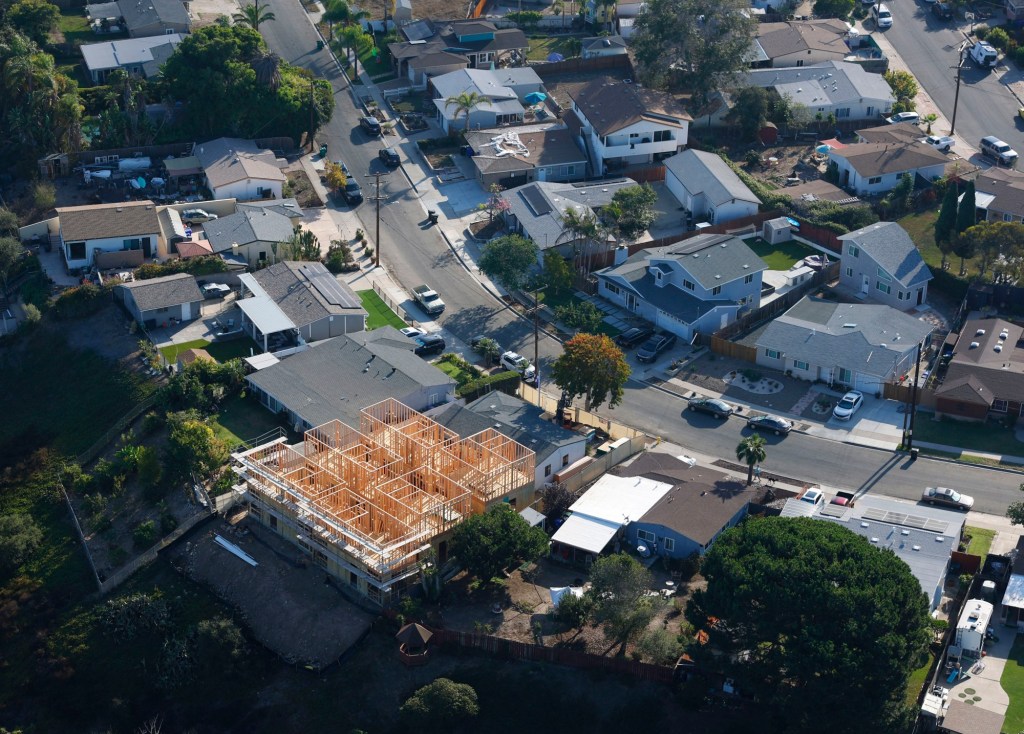
The unincorporated parts of San Diego County are in the middle of an ADU boom — and even more could be coming.
An effort is underway to rewrite the county’s ordinance for accessory dwelling units to allow owners to sell the units as condos in unincorporated areas, a policy shift made possible by a new state law looking to boost homeownership through ADUs.
If adopted, San Diego County would be the second county in California, after San Francisco, to opt into an ADU sales program under the 2023 law known as Assembly Bill 1033.
A handful of other cities like Santa Cruz and San Jose have opted in, and the city of San Diego backed an identical measure as a part of a package of reforms to its ADU rules in June.
Still new, the incentive has so far seen limited success in San Jose, where only one ADU has been sold as a condo since the city became the first to authorize such sales last July.
A county analysis of the update noted formal conversion of ADUs into condos could take up to two to three years. That’s due to lengthy timelines required to comply with state requirements for private access, off-street parking and utility connections.
Vince Nicoletti, the county’s director of planning and development services, said “time will tell” how ADU sales pan out in the unincorporated areas.
“The ability to sell an ADU, it’s definitely a tool in the toolbox that we wanted to bring to the board (of supervisors) for consideration,” Nicoletti said. “We’ll be tracking this closely over the next three to five years to see if it’s something that people start to convert in the future.”
On Friday, the county’s Planning Commission will vote on the ordinance update. The Board of Supervisors will weigh in on the item in March.
Similar efforts to loosen ADU rules have fueled a building boom for the units, sometimes called granny flats or backyard apartments, across the county’s unincorporated areas.
In 2020, just 159 ADUs were permitted in the unincorporated areas where the county has land use authority, according to annual housing reports. Last year, 489 permits were issued in those areas.
ADUs have done a lot to help the county meet its state-mandated goals for housing construction.
From 2021 through 2029, state mandates call for the county to permit 6,700 units of housing in the unincorporated areas. By the end of last year, 5,647 permits had been issued, bringing the county to 84% of its goal.
ADUs accounted for 1,552 residential building permits from 2021 through 2024.
Overall, homebuilding in unincorporated areas has slowed relative to the rest of the county, California and the western United States, county data show.
That’s been fueled in part by uncertainty created by legal challenges to county standards for how new developments must analyze the new vehicular traffic they generate, a key standard for the impact of infill development in the fire-prone areas of the county.
In 2021, the county permitted 960 single-family homes. Last year, it permitted little more than a third that many — just 336.
Between 2021 and 2022, multi-family development jumped from 47 units to 329. But between 2023 and 2024, new multi-family permits fell from 216 to 174.
But officials attribute growth in ADUs to state laws incentivizing their construction — including the elimination of certain requirements for setbacks, permitting and owner-occupancy.
Rami Talleh, the county’s deputy director of planning and development services, said ADU growth in the unincorporated areas has been proportional to population and existing housing density.
“It was a gradual increase, and we’re pretty much in the middle with everybody else,” Talleh said.
Still, the proposed update has seen pushback from some community planning groups, committees of local residents who make advisory opinions to the county about land use and development.
Eileen Delaney, chair of the Fallbrook Planning Group, said more ADUs could put “enormous strain” on public services in unincorporated areas.
Fire evacuation pose concerns too, she said.
“These additional homes could have negative impacts on already congested roads, causing delays when residents need to evacuate especially, when time is of the essence,” Delaney said.
Nicoletti countered that large numbers of ADU conversions would have to take place in any given area even to risk a potential strain on local services. What’s more, ADUs contribute to the property tax base and fund services, he said.
The proposed ordinance also aims to assuage local concerns about the aggressive construction of ADUs, with the proposed language of the ordinance limiting sales to detached ADUs.
Earlier this year, such concerns in the city of San Diego prompted officials to rein in its generous ADU incentive.
“We can always go back and make changes,” Nicoletti said. “We don’t want to not advance the project because of what may happen.”