

Why this matters
Previously, National City did not regulate short-term rentals.
Cut through the noise. Know how National City changes affect you.
Give $10
A new National City rule meant to prevent crime will also force operators of short-term rentals to compete for permits.
Owners or agents of short-term rentals — such as those seen on websites like Airbnb or Vrbo — will be required to get a permit once applications open sometime next year after councilmembers finalized a new policy in September.
Officials settled on capping short-term rentals to 45 per council district. This could total 180 citywide if each of the city’s four council districts maxes out.
The new ordinance also means that for now, short-term rentals are prohibited from operating until the permit process rolls out. Applicants must reside in National City, or within a quarter-mile of the short-term rental.
“There will inevitably be a race for some of these permits, which is something that individual property owners will have to make sure to stay on top of and apply quickly if they wish to operate a short-term rental property in National City,” Councilmember Jose Rodriguez told inewsource. He spearheaded the ordinance this year.
Rodriguez said his office held public forums to speak with short-term rental operators and community members ahead of the council’s vote on an ordinance.
inewsource contacted more than a dozen operators who posted listings in National City, but none agreed to interview requests or responded by the time of publication. Airbnb also did not respond.
Martin Reeder, director of community development, said the city’s small staff doesn’t have the bandwidth to process any more applicants, even if the number of prospective operators exceeds the permit cap.
He predicts that won’t happen though, as operators are limited to just one short-term rental unless they live on or next to the property.
How many short-term rentals can operators list?
It depends. If they host the property, meaning they physically live there or next door, they don’t have a limit. But if the properties are unhosted, the limit is one. inewsource found multiple National City listings on Airbnb and Vrbo with hosts who posted more than one property.
“Anytime we do an ordinance that is more restrictive than what has existed in the past, we get pushback,” Reeder said.
The new ordinance now calls for fines that reach up to $1,500 and possible revocation of the short-term rental permit for any violations.The city can immediately revoke a permit if a felony violation related to use of the rental occurs.
Operators who lose their permit can reapply after a 12-month period.
National City joins other local governments in the region to require permits for short-term rentals.City staff looked at other cities for guidance on permit costs and how vendors have rolled out procedures, such as launching an online portal for applicants.
Vista and Chula Vista, for example, charge $250 permits to operate short-term rentals in their cities.
The city is evaluating quotes from three vendors, Reeder said. That contract is expected to cost roughly $15,000 in the first year, though he said he hopes the city will recoup that through the new permit revenue.
A hotel tax of 10% of the daily room rate will also hit operators of short-term rentals under the new changes. Officials estimate that charging what’s known as the transient occupancy tax onto short-term rentals could generate $3.3 million in additional revenue each year, assuming the city has 180 short-term rentals rented at an average of $500 per night.
The anticipated boost in revenue would come amid financial strains. The city faced an $8.2 million deficit last fiscal year, and councilmembers chose to dip into reserves to balance the budget.
But officials say the intent of the new regulations is not solely to collect more money.
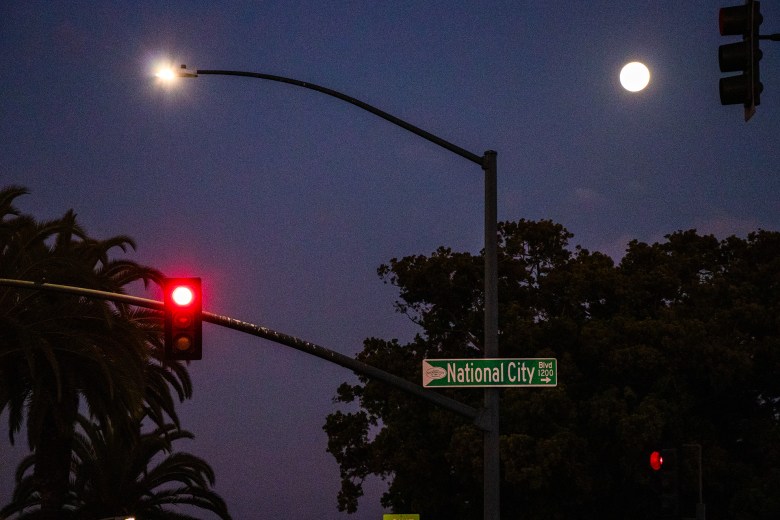 Street lights on a main street in National City on Nov. 4, 2025. (Crystal Niebla/inewsource)
National City Police Chief Alejandro Hernandez told inewsource he suggested the council adopt a short-term rental ordinance because his department faced challenges stopping loud parties, human trafficking and violent crimes at these properties.
“We would both be fooling ourselves if we don’t think that sometimes people use them to have large parties — parties that go south, that turn wrong, and people get injured, and it impacts the community,” Hernandez said.
Hernandez said police are “working backwards” to hold people accountable since occupants of short-term rentals come and go. He said his department needs a system to track known vacation rentals.
“It’s important for us to not be reactive every time waiting for something very serious to happen before we take action,” he said.
Under the city’s new rules, anyone who has a criminal record “related to prostitution or other serious crime” is prohibited from operating a short-term rental. The city attorney’s office did not respond to multiple inewsource inquiries.
What kind of crimes disqualify operators?
National City officials prohibited people with criminal records related to prostitution or other serious crimes detailed in Title 9 of California’s penal code. Title 9 crimes involve sexual assault and those against “public decency” and “good morals.” This can range from rape to illegal gambling at home.
Councilmember Rodriguez said he kept seeing complaints from residents on social media, and has received calls and emails about “nefarious activity” happening on certain streets.
“Our job is to make sure that we’re trying to increase everybody’s quality of life, make sure everybody feels comfortable where they live, that their kids are able to play outside and, and do so feeling safe,” Rodriguez said. “So it did become very clear that these facilities were not good for the neighborhood.”
Crime data was not included in staff’s public reports to councilmembers before they voted on the ordinance. A public records request filed in October for information about crimes reported at short-term rentals has not yet been fulfilled.
inewsource visited an area city officials identified as having instances of crime and spoke with neighbors there.
New renter Jeffrey Scott said his landlord recently reclassified Airbnbs at an apartment complex into long-term rentals. He and his wife are now living there, and he supports the city’s new restrictions on certain criminal records.
“They shouldn’t be renting Airbnb,” he said. “They have to live with the consequences.”
Lifelong resident Veronica Casias said down her block she has seen about 200 people gather for a party and people regularly arriving and leaving a short-term rental near her home. She said she’s also woken up to gun shots. She said she’s concerned about her young children’s exposure to it all.
“We’ve never had a problem here until probably most recent,” she said. “It’s gotten to the point where we sometimes even think about leaving.”
While Casias is also supportive of the city’s new rules, she sympathizes with people with past criminal records who might have now changed their life for the better.
“In my family we do have people with records. The only downside to that law going into effect is it affecting people like that.”
Type of Content
News: Based on facts, either observed and verified directly by the reporter, or reported and verified from knowledgeable sources.