
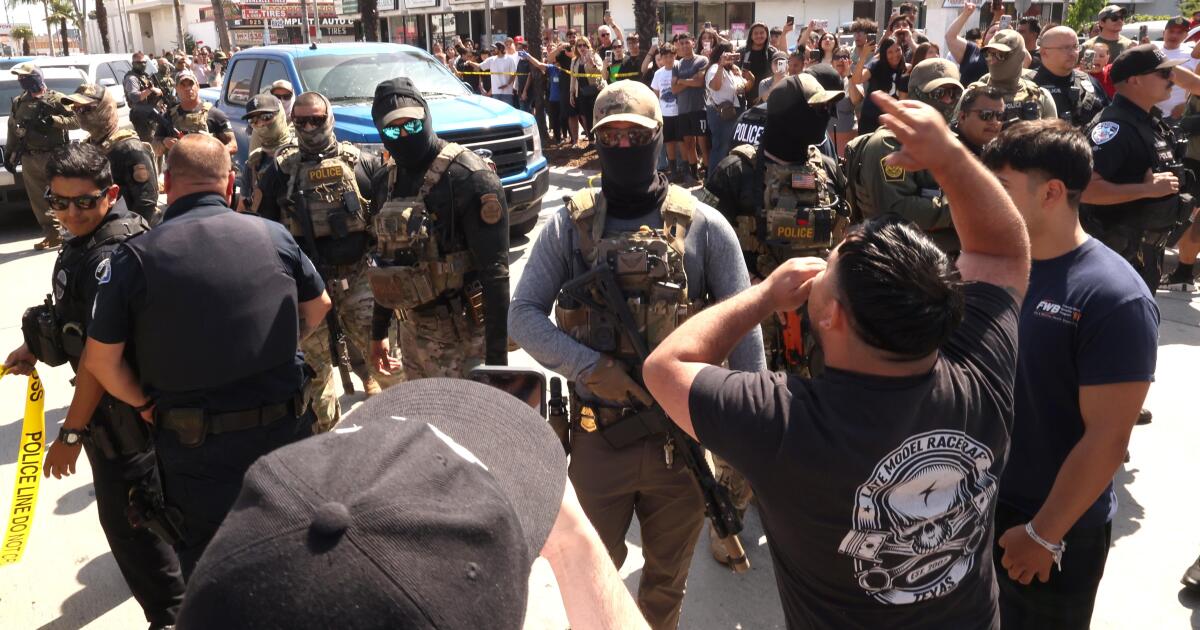
On Tuesday, L.A. County supervisors advanced an ordinance to ban ICE agents from wearing masks or shielding their identities. The ordinance would also require local, state and federal law enforcement officers to wear identification.
It’s not totally clear if this ordinance could be enforced on federal agents as the Trump administration continues to push ahead with its deportation efforts. But it speaks to the pushback ICE agents have received for masking their identities while making arrests on public streets and in front of businesses.
The U.S. Department of Homeland Security recently claimed that assaults against ICE officers increased by more than 1,150% compared to last year, citing reported cases of “hitting, spitting, kicking and biting during arrests.”
Federal officials have used the statistic to justify agents wearing masks and concealing their identities.
But a recent Times story by my colleagues James Queally and Brittny Mejia shows there’s more to this claim than meets the eye.
You’re reading the Essential California newsletter
L.A. Times reporters guide you through the most important news, features and recommendations of the morning.
By continuing, you agree to our Terms of Service and our Privacy Policy.
Three ways the 1,150% increase statistic doesn’t quite hold water
1. The increase in reported assaults on officers comes with a surge in ICE raids and protests in L.A.
Los Angeles saw the first influx of immigration raids over the summer, with thousands of undocumented immigrants, among others, being arrested. The raids prompted massive protests in downtown L.A., involving altercations between protesters and federal agents.
Prior to the raids and protests, contact between ICE agents and citizens was more limited.
Former director of ICE under President Obama, John Sandweg, explained that this increase in assaults is not surprising considering the uptick in activity.
“When you shift those tactics and have agents out there in broad daylight, in Home Depot parking lots, when you have these cities on edge … it’s just going to increase the number of incidents where some sort of an assault happens,” he said.
2. Majority of the ‘assault’ cases did not involve physical injury to an officer
The statistic refers to “assaults and violence” against ICE law enforcement officers, though, according to James and Brittny’s report, more than half of the court cases recorded no physical injury to the affected officer.
In the jurisdictions of the Central District of California and Southern District of California, 27 cases resulted in minor injury and 17 in serious injury. Several cases involving minor clashes between civilians and officers were dismissed, including one in which a woman was accused of assault after the fabric of a flag she was holding hit an officer in the face.
3. Several of the cases were instances of a civilian defending themselves from an agent
While the statistic highlights the increased violence against officers, James and Brittny found that in several cases, “defendants were arrested and charged with assault after Border Patrol or ICE agents initiated physical contact.”
One case was against a 4-foot-11 U.S. citizen accused of striking an officer when she held up a bag to shield herself. Similar cases, many of which have been dismissed, reveal agents having instigated the altercations. However, federal officials continue to use the 1,150% increase to justify increased aggressive tactics among officers and masking, according to The Times’ reporting.
What L.A. County hopes to do
The ordinance, which passed 4-0 on Tuesday and would ban agents from wearing masks, could bring an end to what many believe is an extreme and dangerous practice by federal officers.
The ICE raids have been heavily criticized, not only on the basis of the deportations themselves, but also on the confusion caused by masked officers making chaotic and seemingly random arrests of people, most of whom are Latino, in public locations.
Some legal experts warn that the ordinance could be difficult to enforce, as the federal government could argue that federal law supersedes state law. Still, California officials say they will continue to press the ordinance in a continued fight to thwart the Trump administration’s immigration efforts.
Today’s top stories 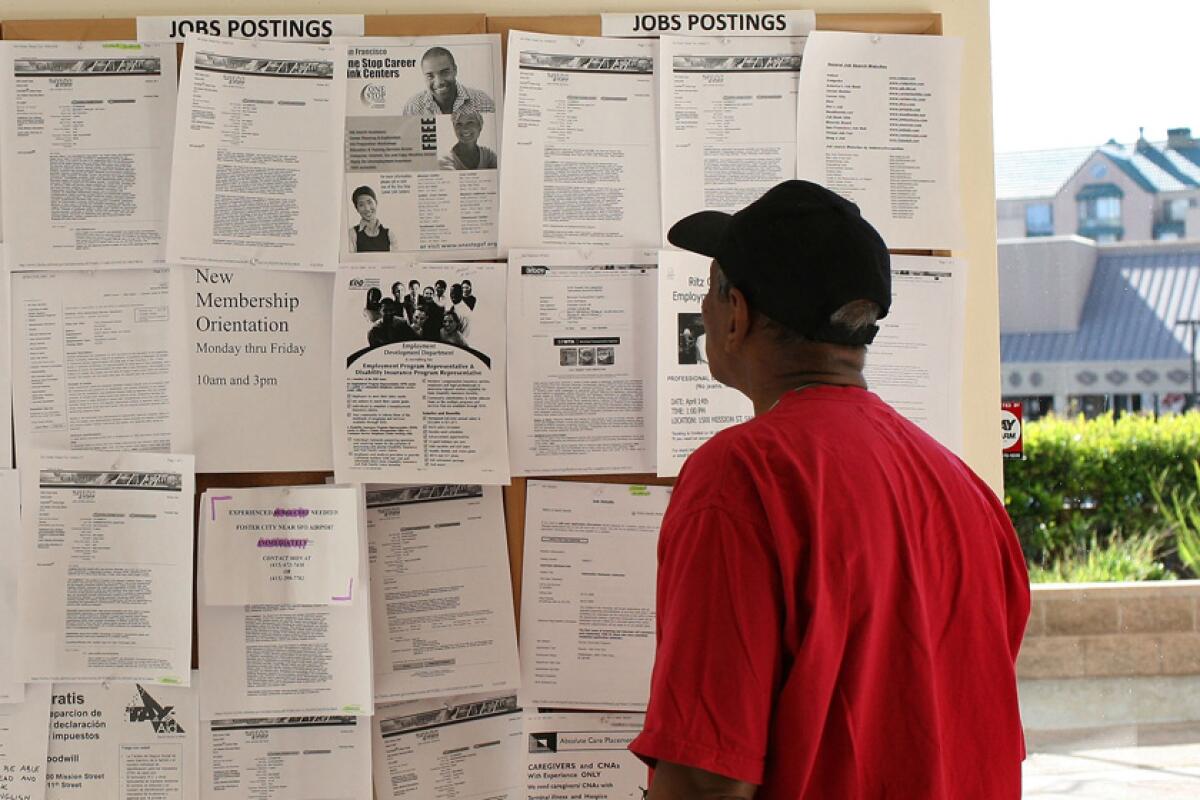
Job seeker Melaku Woldeamanuel browses job listings in San Francisco.
(Getty Images)
California is expected to suffer from a sluggish economy through early next yearCalifornia’s economy has split between higher-growth areas such as Los Angeles benefiting from venture capital spending — and other areas hard hit by tariffs, uncertainty and the government crackdown on immigrant labor.The overall employment picture isn’t rosy, with the state losing 21,200 jobs in the first eight months of 2025, leaving it with an unemployment rate of 5.5%.But growth is expected to accelerate later next year.If elected, this City Council candidate says he will live in a trailer at MacArthur ParkRaul Claros, a 45-year-old community organizer hoping to unseat Councilmember Eunisses Hernandez, acknowledged his plan is a publicity stunt but hopes the publicity will get results.Problems with drug dealing and drug use in and around the park have worsened in recent years.Claros said he will use the trailer as his home and office, taking meetings there, until the park is “cleared out and cleaned up.”The mass shooting that helped Trump redefine America’s immigration debateTen years ago, a husband and wife opened fire at a San Bernardino Christmas party, killing 14 in what became one of the deadliest U.S. terror attacks since 9/11.The police response became a textbook model for response to such shootings, contrasting starkly with law enforcement’s delayed response in the 2022 Uvalde massacre.A decade later, survivors and relatives of victims continue to grapple with the loss while national debates rage on immigration and terrorism.World Cup planning hits overdriveFriday’s World Cup tournament draw will accelerate Los Angeles’ planning for the global event, with eight games secured for SoFi Stadium.The tournament is projected to deliver $594 million in economic benefit to Los Angeles County — more than double the 2022 Super Bowl’s impact.Organizers are preparing massive fan festivals, transportation infrastructure and security measures to welcome millions of visitors.More big storiesCommentary and opinionsThis morning’s must readsOther great readsFor your downtime 
“Bluey’s Best Day Ever!” will launch March 22 at Disneyland’s Fantasyland Theatre and bring the popular animated characters to the resort for the first time.
(Artist Concept / Disneyland Resort)
Going outStaying inQuestion of the day: What do you wear when you fly?
Karen Kungie-Torres said, “I’m of the generation that grew up thinking that taking a flight was a special occasion, so I bristle a little when people come down the aisle in glorified pajamas and slippers. Still, ‘comfort wear’ has evolved dramatically over the decades, so I try to find a happy medium: maybe stretchy or loose jeans and a sweatshirt.”
Email us at essentialcalifornia@latimes.com, and your response might appear in the newsletter this week.
And finally … the photo of the day 
The Rivian display at the Los Angeles Auto Show at the Los Angeles Convention Center on Nov. 28.
(Myung J. Chun/Los Angeles Times)
Today’s great photo is from Times photographer Myung J. Chun at the L.A. Auto Show, which took place last weekend amid the repeal of federal tax credits for EVs.
Have a great day, from the Essential California team
Jim Rainey, staff reporter
Hugo Martín, assistant editor
Kevinisha Walker, multiplatform editor
June Hsu, editorial fellow
Andrew Campa, weekend reporter
Karim Doumar, head of newsletters
How can we make this newsletter more useful? Send comments to essentialcalifornia@latimes.com.