
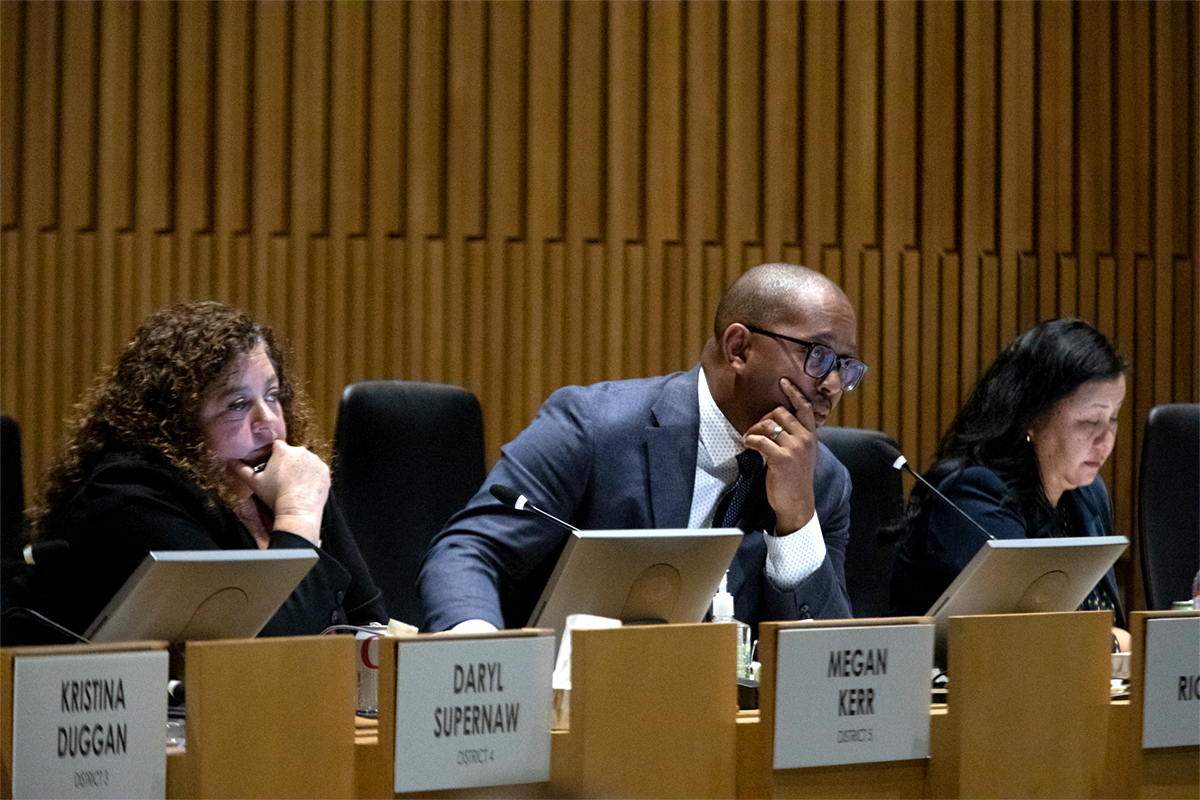
Angry downtown residents and merchants, alarmed at an influx of homeless people — many of whom they feel are too mentally unwell to roam the streets freely — are demanding tougher policing and accusing City Hall of neglect.
With a mix of outrage over a lack of progress and sympathy for people living on the street, the city’s business bloc spoke at the Long Beach City Council meeting Tuesday where more than a dozen asked city leaders to reassess whether their strategy on homelessness is working.
Pressed by the community’s frustration, the City Council requested its administrators return with data on the city’s homelessness programs, the feasibility of increased police patrols and an explanation of how it handles those chronically homeless who are unfit mentally for traditional shelter and need a mental health intervention.
Councilmember Tunua Thrash-Ntuk also tacked on a request for the city to look at how it could apply recent state legislation related to the issue, including programs for those leaving prison and the expedited removal of abandoned RVs.
The item comes as tensions have mounted between the city’s business community and those charged with keeping their storefronts safe and untroubled.
Downtown tenants who spoke Tuesday said they feel unheard. While the city, for instance, recently reported broad declines in crime over the past 20 years, they say their tense and sometimes violent confrontations with homeless people have reached an all-time high.
Some referenced recent interviews given by the mayor and police chief, where they talked about crime being down citywide. They said the city’s interpretation of the data neglected the realities they face daily.
“That’s a slap in our face, and we see all these articles going out, ‘crime’s down,’ ‘crimes the best ever seen,’” said Chris Sweeney, owner of RightMealz. “It’s not. We are facing that reality daily. You guys are up in your offices. We are out here on the ground daily.”
From a historic perspective, crime is down. But most categories, violent and property alike, are higher now than they were prior to the pandemic, with many increasing consecutively each year since. Some areas, like theft and burglary, showed wild fluctuations from year to year. This year, for instance, overall property crime is down 24% year-to-date compared to 2024.
Several speakers gave anecdotes of assault and theft. Others listed the number of times they’ve been burglarized. A lot of people, frustrated by long police response times, said they simply do not report.
Sweeney, whose business is on Fourth Street, said in the past four weeks he’s had two difficult encounters that left him shaken.
The first happened in October, when a woman was masturbating outside his shop and in front of a class of schoolchildren. The second instance was more recent, when last week a homeless woman struck Sweeney upside the head with a bag of glass bottles.
Police response to the latter incident was immediate — within 10 minutes, Sweeney said. But the earlier one took more than two and a half hours before police appeared.
“I feel like we are fighting our own battles down here, with no support from our city manager, from our council members, or even our head chief of police,” Sweeney said.
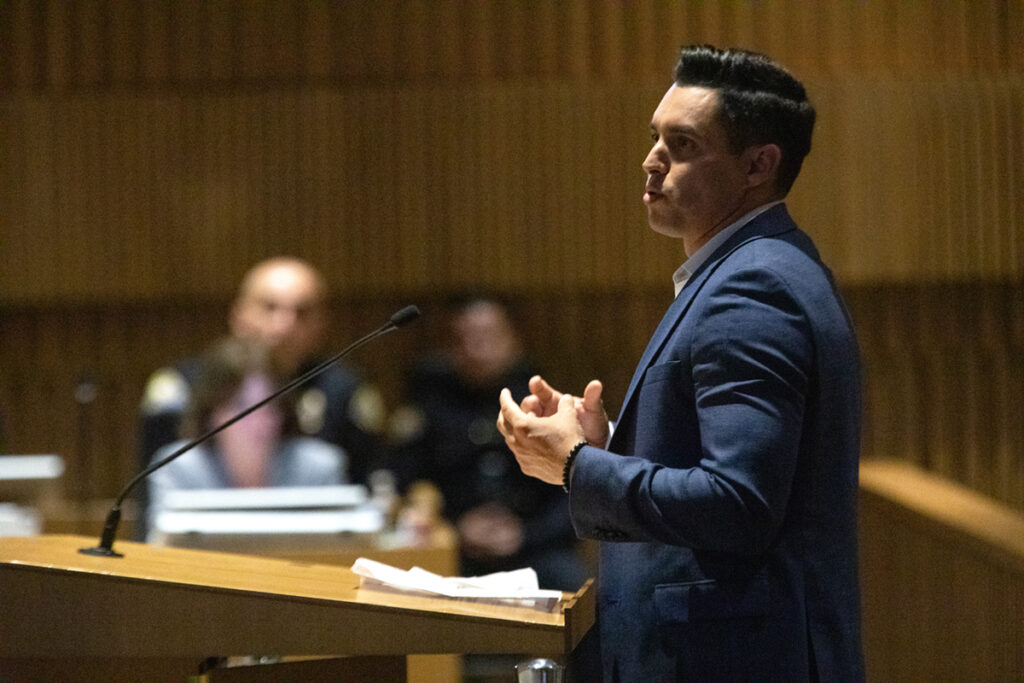 Chris Sweeney, who owns a health-based cafe in downtown Long Beach, shares stories about his dealings with the local homeless population in Long Beach, Tuesday, Dec. 2, 2025. Photo by John Donegen.
Sheva Hosseinzadeh with Coldwell Banker Commercial BLAIR said the state of downtown caused them to lose five potential tenants to Orange County in the past year. One from Los Angeles, she said, was so moved by local scenes of homelessness that he wrote a letter detailing his shock.
Beyond that, her office has been broken into “more times in the past three years than ever in the 35 years that we’ve been here.”
“We just want change,” Hosseinzadeh said. We want safety. We want clean streets. We want to be able to walk down to our restaurants and eat without being afraid that we’re going to be, you know, attacked or yelled at or threatened. We want to be able to come to work and feel safe.”
Another listed the businesses that have left downtown in recent years.
“Federal bar closed for five years, Harbor Bar three years ago, Pier 76 closed four years ago, Rock Bottom closed five years ago, Solita closed one year ago … Octopus five years ago, George’s Greek Cafe closed a few months ago,” said Nick Krinsky, who owns properties on Pine Avenue, adding that Cafe Sevilla, Broadway Pizza and Grill, and Pinkberry are listed for sale.
“Right now, nearly all of my tenants want out because they cannot operate a profitable business or be safe in these conditions,” he added.
Most speakers also emphasized that they do not believe homeless people are evil or the source of the problem, but the government’s inability or unwillingness to help them has created an untenable situation.
City Manager Tom Modica said his staff has recently intensified enforcement against encampments.
Using the city’s anti-camping ordinance, authorities as of October have tallied 696 citations or arrests, he said, a third of which have been in known problem areas – where they saw the highest concentrations of homeless people on public property.
“We are enforcing no-camping, and those are also arrests that are then made when people have warrants and other things that are criminal activity,” Modica said.
Councilmember Joni Ricks-Oddie said she understood the business owners’ frustrations: “When the city puts out what appears to be a much more positive picture, it feels like it invalidates your personal experiences day to day.”
The City Council’s request includes looking into how to actually bring social services to a specific subset: those chronically homeless who are too mentally unfit to decide what’s best for themselves.
This is the trickiest population of the unhoused to help, long protected from most forced treatment or citations. There’s also not a lot of data specific to this group and their needs.
According to the city’s 2025 point-in-time count, nearly 35% of the city’s 3,595 homeless people reported a severe mental health condition, with the highest concentration in the 90813 zip code.
Mayor Rex Richardson pointed out that the city has tried to fill the gap for mental health facilities in Long Beach.
In the first round of funding — finalized in July 2024 — the city didn’t receive any money through the state Proposition 1, a $6.3 billion bond meant to pay for new facilities.
Proposals included $40 million, meant to pay for a treatment center at the city-run Multi-Service Center, which triages the needs of homeless clients
City Manager Tom Modica said Tuesday proposals were resubmitted for the second round of funding — which closed in October — and are pending a determination by the state.
Before voting, council members clarified they do not wish to further criminalize homelessness.
“But we also have to be realistic to know that this is about being compassionate to those who refuse services who are experiencing homelessness that cannot acknowledge what it is they are refusing,” Zendejas said. “Either because they are not mentally stable, or it’s because they’re on drugs, whatever it may be.”