
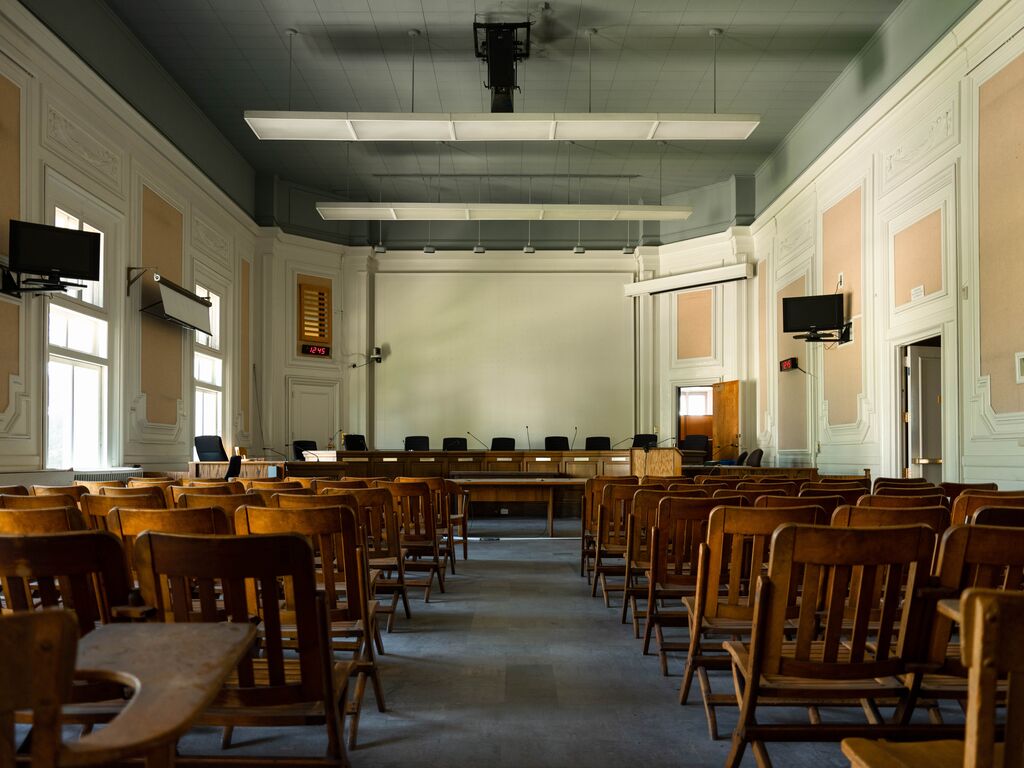
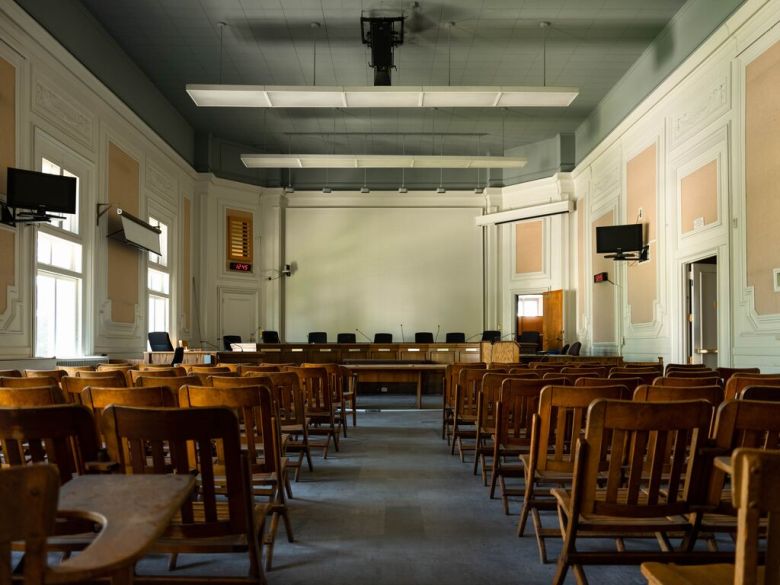
 The former City Council meeting chambers in Berkeley’s old city hall. The Beaux Arts building that opened in 1909 needs a seismic retrofit. Credit: Ximena Natera, Berkeleyside/Catchlight
Berkeley leaders are making early moves toward putting a bond measure on next year’s ballot that would raise hundreds of millions of dollars for projects to improve local infrastructure, ranging from upgrades at fire stations and parks to a revival of the Civic Center complex.
Many of those same officials are wary of whether the effort will win enough support from Berkeley voters, after an attempt to pass a similar infrastructure measure three years ago failed. Still, the Berkeley City Council directed staff Tuesday to survey voters on their attitudes about a potential bond worth $300 million, and members supported the nascent effort they described as a necessary step to shore up public facilities.
“I’m excited that we are on the cusp of moving forward with a major investment in Berkeley’s infrastructure,” Councilmember Brent Blackaby said. “We know we need to do it, it’s just a question of how, when, how much [and] what’s involved.”
Staff in Berkeley’s parks, public works and fire departments envision splitting the bond funding and putting it toward projects they say will improve community spaces, public safety facilities and other “critical infrastructure.” A report prepared for Tuesday’s meeting listed 34 potential projects that could be funded with the $300 million bond, including:
Seismic retrofits of the Beaux Arts old city hall building, known as the Maudelle Shirek Building, and the nearby Veterans Memorial Building on Center Street, which today house a handful of local organizations but have mostly been cleared out because of their earthquake risk.
Renovations of the city’s struggling 911 dispatch center, which has been identified as an important step to improve how the city handles emergency calls.
Modernization projects at two fire stations and the department’s training center in West Berkeley.
Several projects aimed at preparing for rising sea levels, such as building a new sea wall at the Berkeley Marina’s South Cove.
Upgrades at the Frances Albrier Community Center in San Pablo Park.
Continued efforts to build new permanent bathrooms in parks that today have dated restrooms or portable toilets, with new facilities in Cesar Chavez, Cedar Rose, Codornices and Harrison parks.
A bond of that size would cost property owners $44 for every $100,000 of their home’s assessed value per year. That translates to an increase of $242 per year for someone whose home is worth the city’s median assessed property value of $550,000 — although few other than longtime property owners whose assessments are locked in well below market value thanks to California’s Proposition 13 will pay rates that low. Someone who just bought a house at Berkeley’s median home sale price of nearly $1.4 million in October, according to Zillow, would be looking at an increase of about $600 per year.
Deputy City Manager David White told the council prior bond measures have funded important projects to upgrade parks, senior centers and a long list of other public spaces. But White noted Berkeley will issue its last set of bonds from 2016’s Measure T1 next year, and all of that initiative’s funding has been allocated. Meanwhile, the city has identified more than $1 billion in unfunded infrastructure needs.
“The more we delay, the more things deteriorate,” White said. “With all of our existing measures coming to … an end, this would provide an opportunity to keep that machine going.”
City staff plan to refine the proposed bond over the coming months with surveys and other community engagement efforts. The deadline to put measures on the ballot is Aug. 7.
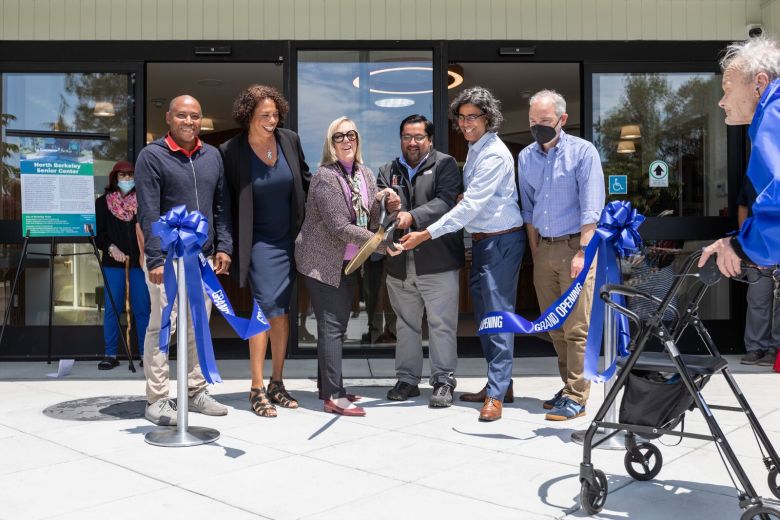 City officials cut a ribbon at a ceremony in 2022 to celebrate the opening of the North Berkeley Senior Center after a renovation project funded by the bond Measure T1. Credit: Kelly Sullivan for Berkeleyside
Can bond clear ‘a very tough threshold’?
Berkeley voters have been willing to back a parade of bonds and taxes over the years to fund public services and infrastructure. But the campaign in 2022 to pass Measure L — a $650 million bond that pledged to ramp up street paving, build affordable housing and improve city facilities — suffered a rare defeat that hung over Tuesday’s council discussion.
“I do think it will be important for us to avoid the shortfalls of Measure L: namely, a high dollar amount combined with an ill-defined scope of improvements,” said Councilmember Terry Taplin. The measure, which needed support from two-thirds of voters, failed with 59% in favor, after it faced opposition over its size and city leaders’ decision not to commit the funding to specific projects.
Berkeley’s next bond will similarly need to clear the two-thirds threshold.
Several councilmembers pointed out the potential measure would land on a 2026 ballot that could also include regional taxes to fund affordable housing and public transit agencies, as well as a parcel tax in the works to support Berkeley’s ailing performing arts groups — all of which will test voters’ enthusiasm to open their wallets further.
“We may need to look at something lower,” Councilmember Rashi Kesarwani cautioned. “We’re talking about a very tough threshold … so I think we need to be very targeted with it.”
White said the city plans to gauge voters’ attitudes about a range of bond amounts during outreach work early next year.
Some councilmembers were particularly wary of the plan for seismic retrofits at the Civic Center buildings, which could run into the tens of millions of dollars depending on how much funding Berkeley can bring in from the federal government. A conceptual plan adopted in 2023 envisioned turning the Maudelle Shirek Building into a “seat of Berkeley’s democracy” housing meeting spaces and city services, while the Veterans Building could become a community arts center with performance venues and exhibition space.
Councilmember Mark Humbert said that at a time when many existing arts venues are struggling to stay open, it wouldn’t make sense for the city to add a new one.
“I’m not convinced the currently envisioned uses for the buildings are the way forward, or would justify the level of investment necessary to put them back into top shape,” he said.
Mayor Adena Ishii countered that the facilities present safety risks in their current state — the City Council moved its meetings out of old city hall years ago, and she noted a winter homeless shelter program that had used the building was relocated this year. (City spokesperson Seung Lee told Berkeleyside the winter shelter, which operates from December to April, was moved to a facility in Emeryville because of a “need to inspect conditions” in the Maudelle Shirek Building, and said officials have not decided on the shelter’s long-term home.)
Ishii argued the project is an opportunity to repair “places that really should be community gathering spaces that fill us with pride, but instead are decaying, unfortunately, before our eyes.”
“*” indicates required fields