

San Francisco public school teachers today voted 99.34 percent to authorize a strike, following nearly nine months of unfruitful contract negotiations.
Today’s five-hour session at Balboa High School in the Excelsior is the first of two required votes that will determine if public school teachers go on strike. If that second vote comes to pass and the teachers and district don’t reach a deal, it would be the first San Francisco teacher strike in 46 years.
The tally is 99 percent of those who voted on Wednesday, not of the union’s total 6,500 members.
From 2:30 to 7:30 p.m. on Wednesday, educators sporting union sweatshirts trickled in the courtyard at Balboa High School to cast their ballots. “Make sure to grab a snack before, because once you vote, you’re out of the building,” a volunteer repeatedly announced over a megaphone.
“We’ve realized that the district is not wanting to approach in a serious manner,” said Frank Lara, vice president of the United Educators of San Francisco. “So it’s pushed us to the edge.”
A long, contentious history between SFUSD and teachers
It’s not the first time: Two years ago, eight days after a 97 percent strike authorization vote, the teachers’ union won a deal that gave them a $9,000 salary increase and an additional 5 percent raise in 2024. It also gave paraeducators a minimum salary of $30 an hour or an 8 percent raise.
“We are following a process with third-party experts to reach a new agreement with the teachers’ union,” the district wrote in a statement. The district remains committed to “negotiate in good faith” with the union and the state to achieve “a fair agreement that avoids disruption to student services.”
 Volunteers at United Educators of San Francisco dance to a camera as educators trickled in to cast their vote. Photo by Junyao Yang on Dec. 3, 2025.
This year’s strike vote, however, came at an especially troubled time for the school district, as it considers significant cuts to fill a $113 million hole in its budget. According to early budget proposals obtained by Mission Local, the district is already weighing laying off security guards and school counselors and slashing middle school health programs, among other cuts.
Right now, the state has authority to “override any decision by the San Francisco Board of Education if it believes that decision could compromise the district’s financial stability,” the district wrote. The district is facing another round of major cuts in the 2026-2027 school year, and “difficult decisions are ahead.”
“Balancing the budget is a core step toward exiting state oversight,” the district wrote.
The teachers’ union, for its part, said many of its demands are low-cost or even no-cost proposals that the district has not responded to since entering into negotiations in March. The district has a history of over-budgeting and under-spending, according to Ryan Alias, a teacher at Balboa High School who’s on the bargaining team of UESF, which represents over 6,500 educators.
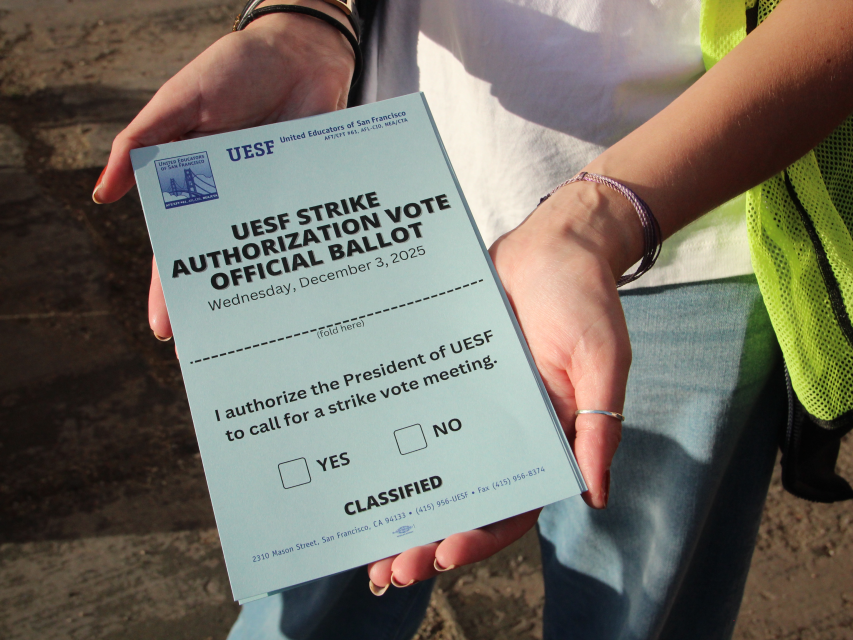 A volunteer holds a blank ballot. Photo by Junyao Yang on Dec. 3, 2025.
“We understand that the district doesn’t have money. We get it.”
And just like that, the time came to vote for or against a strike. It was a swift process, unlike the strike vote two years ago when teachers waited in an hours-long line at the Excelsior schoolyard.
Members who turned out to vote on Wednesday know — better than anyone — that the district is short on cash. “We understand that the district doesn’t have money. We get it. We live it every day,” said Elaine Harris, who has taught in the district for 10 years. “But this is what we can do to advocate for our students.”
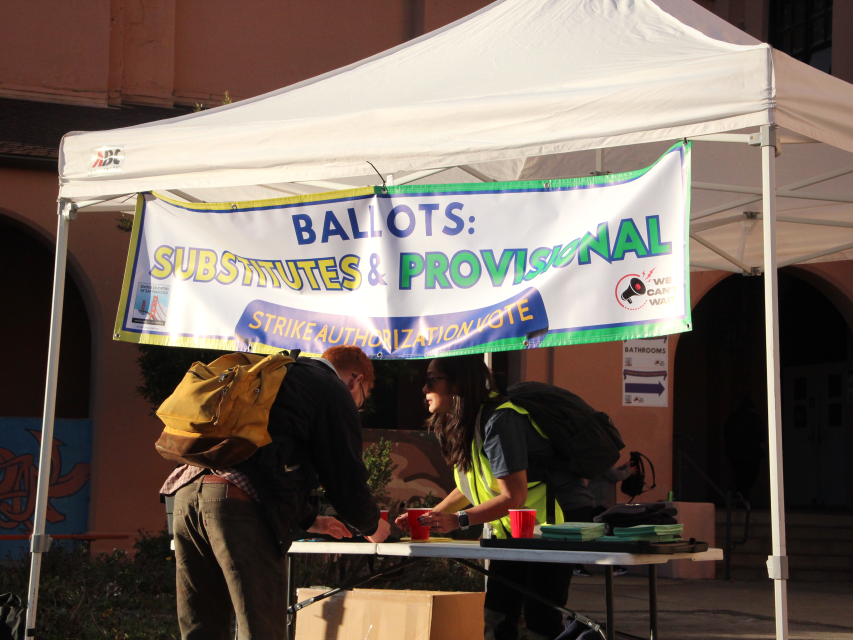 Educators arrive at Balboa High School to cast their ballot on a strike authorization vote. Photo by Junyao Yang on Dec. 3, 2025.
The union is demanding dependent healthcare, pay raises — 14 percent for classified employees and 9 percent for certificated employees over two years — and a special education workload model that will weigh the time spent on each student instead of just the number of students served.
Educators also want the district to provide a more robust sanctuary school policy, putting legal legwork into language that can protect both students and staff from federal officials on and around campus.
In October, amid the potential federal deployment and immigration crackdown in San Francisco, educators told Mission Local that they wanted the school district to train school staff on what to do if federal agents try to force their way into schools, and to create safe zones for students.
The union also wants the district to protect and expand current Stay Over programs that provide a sleeping place for unhoused families like the one formerly at Buena Vista Horace Mann K-8 that is relocated to Downtown High School.
During contract negotiations, the union says it sent some 20 proposals to the school district, but “everything we sent was coming back completely rejected or didn’t get responded to,” said Alias.
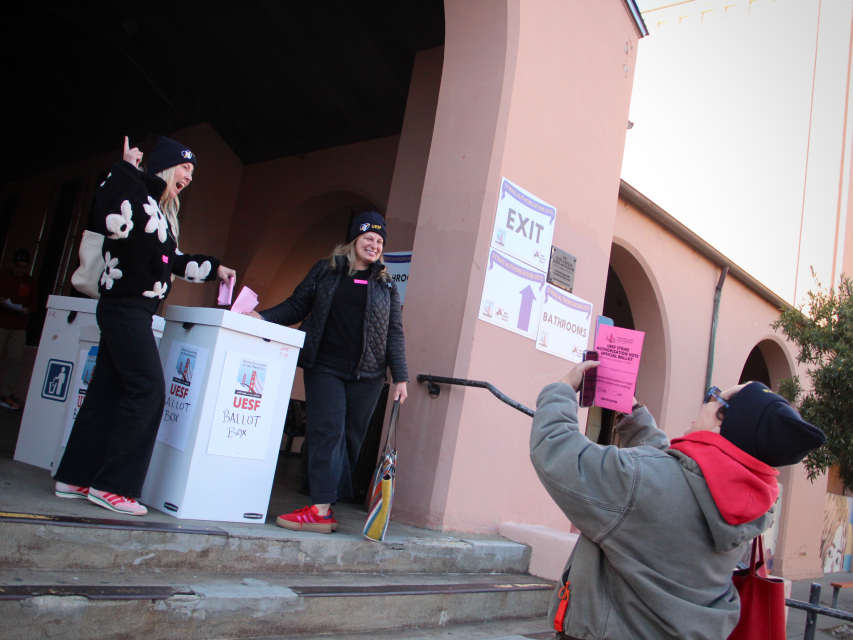 Educators pose for a photo as they cast their votes. Photo by Junyao Yang on Dec. 3, 2025.
In September, the district presented a “packaged proposal” that would offer a 2 percent salary increase over two years. But the proposal would eliminate benefits such as paid sabbatical leave, class size limits, and prep time for teachers who teach AP classes or take on extra responsibilities like serving as department heads.
“The only way that they would bargain with us is if we dug the money out of the things that we have already bargained for and won in previous years,” said Alias. “which was a nonstarter for us.”
After the union rejected the district’s proposal, the school district and teachers were officially at an impasse. They entered the next step — mediation — in October, but that mediation was “unproductive,” Alias said.
Teachers’ motivations
Teachers waiting in line to vote had different reasons for showing up and weighing in. Chad Harada, a fifth grade teacher at Sunnyside Elementary School said that he was most concerned about class sizes.
He considers himself fortunate to have a larger classroom for his 29 students, said Harada, but he has seen colleagues struggling to fit enough tables into their classrooms, let alone make space for students to meet in small groups.
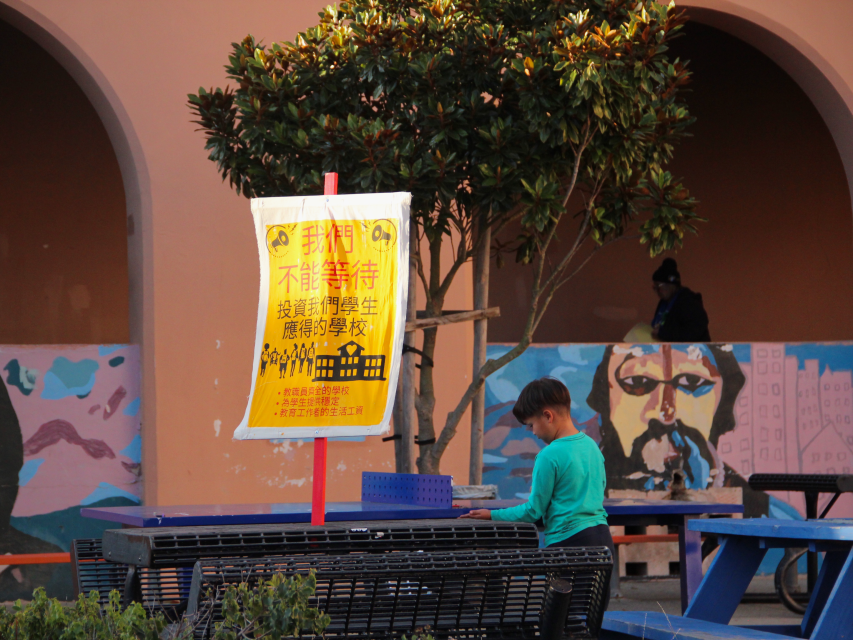 A kid plays by a sign that reads “We can’t wait for the schools our students deserve” in traditional Chinese. Photo by Junyao Yang on Dec. 3, 2025.
Elaine Harris, who teaches second graders at Jose Ortega Elementary School, showed up to advocate for healthcare coverage for her family.
Harris, who has two kids, will have to pay about $1,500 for her family’s healthcare coverage starting next year. “We’re worried and anxious for our future as a family to continue to live and work here in the Bay Area,” she said. Harris and her husband, also a public school teacher, already have had to move to South San Francisco because of the cost of living in the city.
What Harris wants to do, she said, is “just to teach kids, and be able to survive as people and live as humans that are happy and healthy and thriving.”
The next strike vote — depending on the progress of bargaining — would likely take place in January, if it occurs at all.
“The gloves are off. We have seen their inaction,” Alias said. The teachers say they don’t want to strike, “but there comes a point where we have to put the education of our communities and the experiences of our members to the front.”