
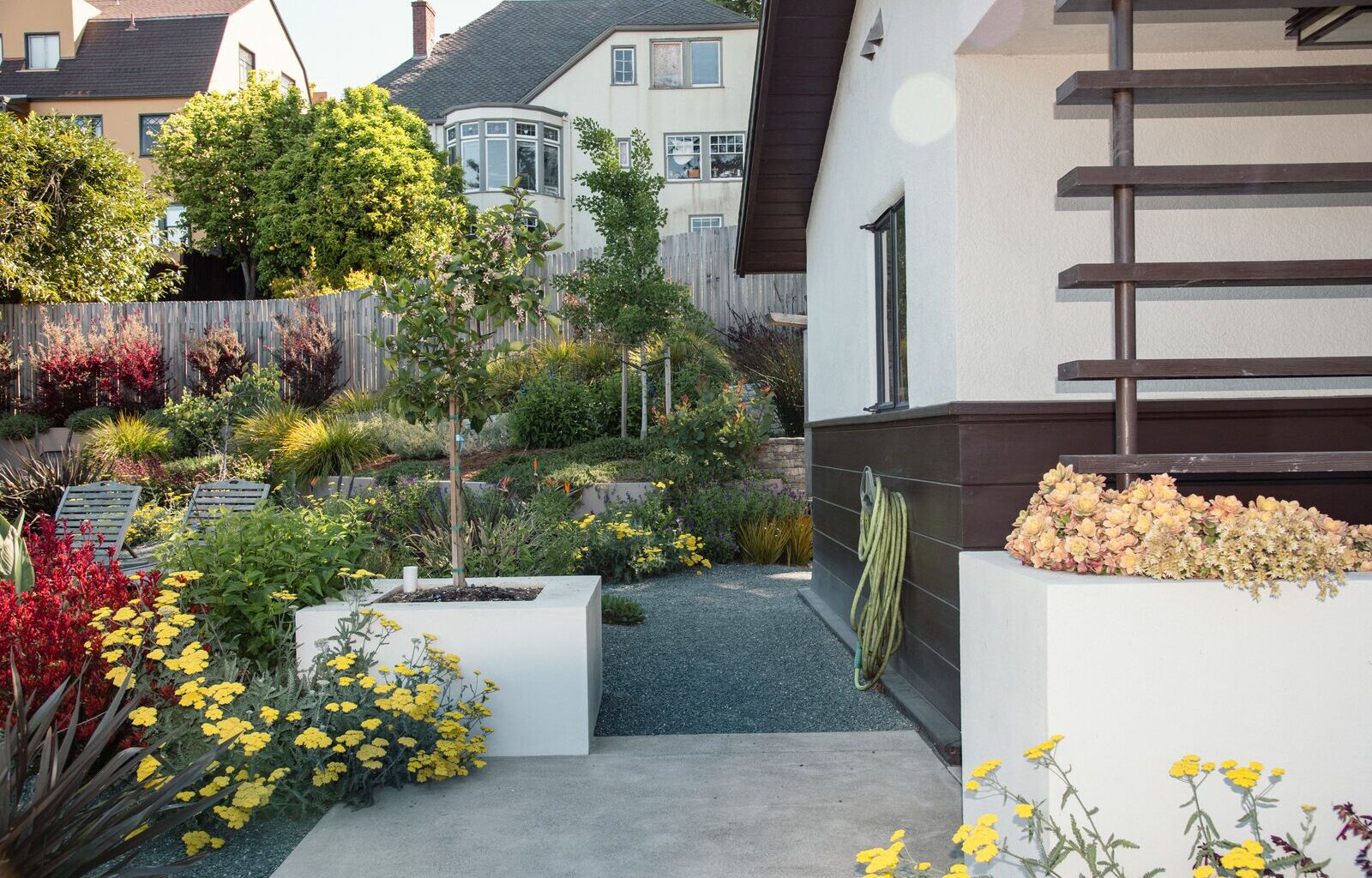
 The owners of this home in the Berkeley Hills redesigned their outdoor space to comply with strict defensible space guidelines that prohibit anything combustible within five feet of the structure. Credit: Ximena Natera for Berkeleyside
Berkeley’s “Zone Zero” wildfire safety requirements are scheduled to kick in Jan. 1. The strict new guidelines ban nearly anything flammable from within 5 feet of about 1,400 homes in the Berkeley Hills.
The City Council approved final language for the new guidelines Tuesday. The rules, fiercely opposed by some hills residents, are meant to create “defensible space” around homes and other buildings to slow the progress of the next wildfire to menace the city. City officials modeled them in part after Cal Fire’s fuel management recommendations.
As happened in firestorms like the 1923 Berkeley Hills fire and the 1991 Tunnel Fire, embers can travel blocks and even miles; when they ignite flammable material next to buildings, and the buildings catch, the new burning structures spew embers blocks and miles further in a chain reaction that can quickly blow past firefighters’ ability to slow it down.
Berkeley won’t be the first city in California to enforce local “Zone Zero” rules, but it is still ahead of state lawmakers. Officially, the state law mandating 5-foot ember-free zones took effect in 2021, but officials in Sacramento have yet to announce an implementation plan and are expected to miss a Dec. 31 deadline, according to the Los Angeles Times.
A great deal of furor, in Berkeley and elsewhere, has focused on what to do about living trees, shrubs and vegetation in the 5-foot area. Berkeley’s regulations do not ban trees and shrubs outright, but do impose rigorous standards for keeping them away from buildings.
While lawmakers in Sacramento have delayed the rollout time and again, the state’s fire experts have pleaded with Californians for years to take similar precautions to what Berkeley will now mandate.
City fire and elected officials first began working on the new regulations nearly a year ago, shortly after a Berkeley Fire Department team traveled south to help fight the Palisades Fire near coastal Santa Monica. Fire Chief David Sprague said at the time that Berkeleyans “have a moral imperative to shift our focus away from only the response,” to focus as well on “what we know will save homes and lives.”
Reactions were mixed. While many hills residents saw the plan as necessary, others balked at removing cherished plants or complained that overhauling their parcels could cost well into the tens of thousands of dollars.
We sought to answer common questions about the rules. If you have a question we didn’t answer, please email editors@berkeleyside.org, and we’ll consider updating this post.
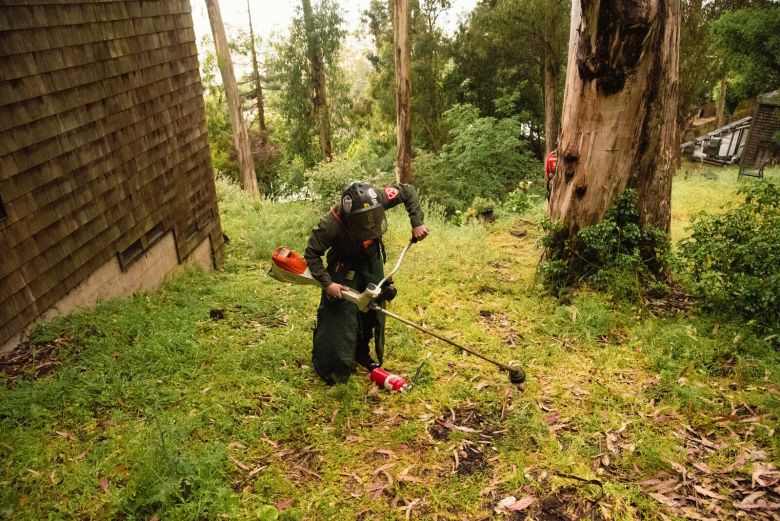 A worker clears overgrown vegetation near a home in the Berkeley Hills. Credit: Ximena Natera, Berkeleyside/Catchlight
When will I need to follow the new rules?
The “Zone Zero” provisions kick in on Jan. 1, but only in two sections of the city, the Grizzly Peak and Panoramic mitigation areas, both on the far eastern edge of the city, closest to where a wildfire is most likely to creep in. BFD estimates these strictest rules will affect 1,400 properties.
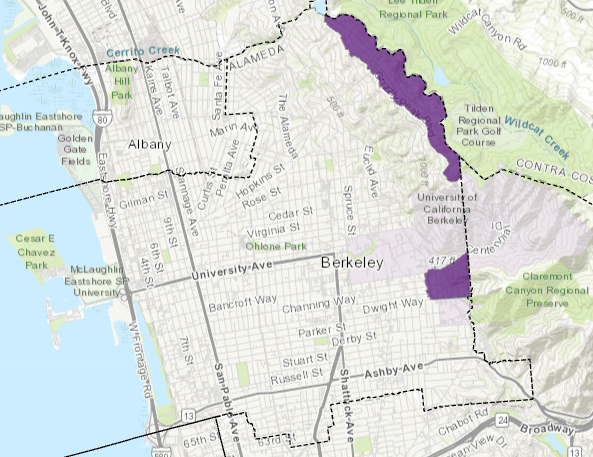 Berkeley will begin to enforce “Zone Zero” defensible space regulations in two sections of the city, pictured in violet, beginning in early 2026. Credit: City of Berkeley
The Grizzly Peak Mitigation Area is a roughly quarter-mile-wide swathe of the northeastern Berkeley Hills that begins just north of the UC Berkeley main campus and extends north-northwest to the Summit Reservoir. Generally speaking it includes all homes on either side of Grizzly Peak and everything to the east and north of the boulevard.
The Panoramic Mitigation Area is shorter but wider. It includes everything on both sides of Piedmont Avenue, from Dwight Way to Bancroft Way, and everything from Piedmont east to the city line.
As Berkeley’s rules are written now, the strictest “Zone Zero” rules will only apply to these two sections of the city. There are other defensible space requirements that other homeowners are also responsible for, but for now at least, BFD’s inspectors are focusing on the two parts of town where Zone Zero will kick in.
BFD has created a mapping tool where you can enter your address to find out your specific defensible space requirements.

What can I keep in ‘Zone Zero’?
Broadly speaking, Berkeleyans in these two sections of city have to get rid of anything combustible from within 5 feet “of any structure, outbuildings, attached deck or stairs and the area under attached decks or stairs,” according to the new rules. That includes shrubs, vines, timbers and boards, debris and garbage, fake turf, mulch, walls, attached window boxes, planters, boats and vehicles and most anything else beside — although there are exceptions:
The city allows potted plants up to 18 inches as long as they are kept away from windows and eaves, in movable, non-combustible vessels of five gallons or less. They must also be kept at a distance of one-and-one-half their heights, or 12 inches, whichever is greater, from each other and from nearby structures.
Hot tubs are allowed in the 5-foot zone “provided they comply with all Zone Zero clearance requirements applicable to structures.”
Existing trees and shrubs can stay where they are, as long as they are free of dead material. There must be 6 vertical feet between roofs and tree canopies, 10 feet in all directions between canopies and chimneys and stovepipes and 5 horizontal feet between canopies and buildings and structures or attached decks, porches, landings, stairs and hot tubs (although where trees are integrated into decks, they must be 5 horizontal feet away from adjacent structures and branches must be 6 vertical feet above the decks). All canopies must be 6 vertical feet from attached decks, landings or stairs or hot tubs.
Homeowners are required to keep roofs and rain gutters clear of leaves, needles and other vegetation, and to ensure that the first 5 feet of fencing, if attached to a building or other structure, be made of metal or another non-combustible material.
You can read the full regulations on the city’s website.
The restrictions inside the 5-foot “Zone Zero” are the most restrictive, but in the larger “Zone One” (up to 30 feet from structures) and “Zone Two” (up to 100 feet) the city has also imposed some rules. These wider zones apply to even more homes in the hills than “Zone Zero,” at least according to the city’s guidelines, but it is unclear when or if BFD will resume inspections outside the two targeted areas.

Within “Zone One,” homeowners are required to remove hazardous vegetation, keep trees and shrubs free from dead or dying wood near decks and structures, clear trees of “ladder fuels” (twigs, foliage, branches) less than 6 feet from the ground, keep shrubs and trees a safe distance from each other, space structures at least 10 feet apart and remove firewood piles unless they are covered in fire-resistant materials approved by the state fire marshal.
Further out, in “Zone Two,” homeowners are required to keep 10-foot non-combustible buffers (bare mineral soil, for example) around any firewood or lumber piles.
In all three zones, homeowners are responsible for safety measures like cutting annual grasses and other plants, limbing trees within 6 feet of the ground, spacing trees and shrubs and making sure woodland detritus like leaves and twigs never piles higher than 3 inches, among other restrictions.
When will enforcement start?
In the most basic sense, nobody will be on the hook for the new rules until May. That said, BFD officials have been working the targeted neighborhoods for months already, educating homeowners on the upcoming rule changes.
“Inspectors are spending up to an hour with each resident discussing compliance, mitigation strategies and upcoming code changes,” Sprague wrote to the council in September. At the time, nobody was beholden to the upcoming, stricter rules, “but many are choosing to move ahead with efforts to begin alignments of their properties with the forthcoming Zone Zero code,” he said.
This month and next, the city has planned to mail brochures and postcards to all the parcels subject to the new regulations and set up workshops and neighborhood question-and-answer meetups. In February and March, BFD will start training interns for the next round of inspections. In March and April the interns will conduct “pilot inspections” so BFD can make final tweaks before full-bore inspections begin in May.
What are the penalties if I don’t comply?
BFD has emphasized that it wants to help homeowners get their parcels into compliance rather than issue citations and fines. After initial inspections, homeowners have 60 days to address any deficiencies before BFD will re-inspect their parcels. If violations persist, BFD could begin to issue citations another two weeks after the re-inspection.
Fines would start at $100 for the first 30 days, but could increase after that or be more severe in cases of egregious violations, according to BFD. Those fines could go as high as $500 a day per violation.
Homeowners have the opportunity to appeal inspectors’ determinations to the City Council, as long as they do so “within 10 calendar days of the date of mailing of the appealable action” and pay an appeals fee and a deposit on any fines or obtain a “hardship waiver,” according to the new regulations.
“*” indicates required fields