
On Tuesday, Fullerton City Council unanimously passed motions to improve pedestrian and bicyclist safety for Associated Road between Yorba Linda Boulevard and Bastanchury Road. This comes after the Public Works Engineering Division presented an assessment and recommendations for Associated Road.
The motion proposed to install a one-foot buffer stripe between the bike lane and #2 travel lane, an enhanced detection system and intersection striping at the Associated Road and Yorba Linda Boulevard intersection. The motion also proposes to install continental crosswalks on the west and east leg of Associated Road at Milton Avenue and North Creek Lane to enhance visibility for both pedestrians and motorists.
Fullerton Public Works Director Stephen Bise said the public works staff was asked to reevaluate implementing protected bike lanes, considering the recent fatal collision involving Cal State Fullerton students Lauren Turner and Ashlyn Gwynn. The Public Works staff also met with CSUF officials on Dec. 1 to discuss active transportation e-bike safety education and Associated Road.
Bise said that after observing pedestrians and cyclists in the field, the Public Works team doesn’t recommend the installation of Class IV protected bike lanes along Associated Road due to the high traffic volumes and the need for a lane reduction to accommodate a Class IV lane properly.
However, Public Works proposed the installation of a buffered Class II bike lane, which places a one-foot buffer stripe between the bike lane and the #2 travel lane, reducing the width of the #2 travel lane from 11 to 10 feet.
Public works also recommended additional intersection modifications at Associated Road and Yorba Linda Boulevard by adding dashed lines that help the left turn movement through an intersection, for the southbound left lane.
Bise also mentioned that public works is looking to enhance the detection system at the intersection by utilizing Artificial Intelligence to identify near misses and provide data that is not in collision reports.
“In the traffic industry, it’s relatively new, but it allows us to capture this data which otherwise wouldn’t be captured. We rely on data to apply for grants, to formulate improvements,” Bise said. “So with this technology, we would be able to assess the intersection once we get more data.”
Bise also outlined various improvements in the project currently underway in partnership with the city of Yorba Linda, focusing on the Associated Road and Yorba Linda Boulevard traffic signal synchronization project, which is anticipated to be completed within the next three to four months.
“It includes radar, video detection systems, bike detection, running red light detection, leading pedestrian interval, updated signal timing to include updated yellow time, red time, bicycle timing and updated pedestrian timing as well,” Bise said.
Anjali Tapadia, a Fullerton resident, believes that the creation of a bike lane buffer would be invaluable since it increases space in the narrow bike lane and also stated that AI cameras ignore the community’s concern to prioritize safety.
“I don’t necessarily support the AI cameras, I get the idea but we don’t need to spend money on AI cameras that will likely only serve to justify doing the bare minimum instead of being used to maximize safety measures,” Tapadia said.
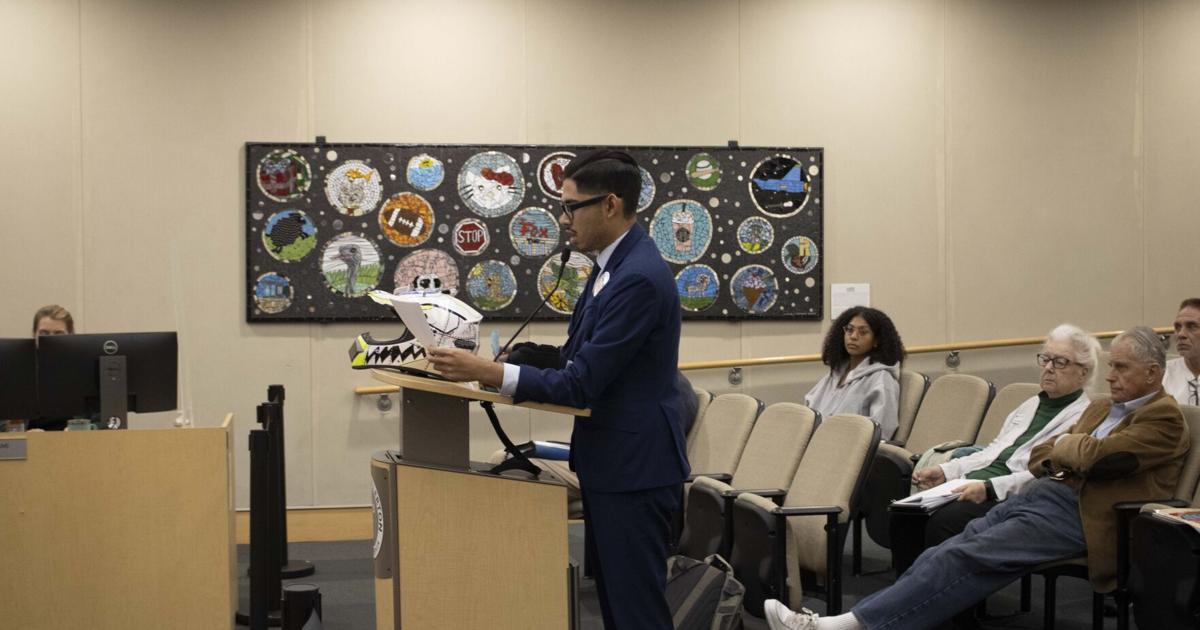
Dominic Moonheart, a Fullerton resident, was involved in a collision after a car was obstructing the bike lane, ejecting him from his bike and through the driver’s windshield, recalling it as a near-death experience. During his public comment, Moonheart displayed the damaged helmet he wore during the accident to remind councilmembers to advocate for the installation of Class IV bike lanes.
“This piece into this helmet is broken. There is blood from the night of my car accident, and the DUI driver was on the bike lane,” Moonheart said. “This helmet, yes, it saved my life, but in a way, it almost didn’t, because of how severe the accident was.”
Elijah Manassero, a fourth-year public administration major, expressed his support for the installation of Class IV intersections to protect CSUF students and to limit the alarmingly high amount of recent collisions in the area.
“The roads around a university should be the safest in the city, yet they continue to put my classmates at risk,” Manassero said. “No group in Fullerton relies on active transportation more than college students, and no group has less experience on the road. Given that reality, it’s hard to understand why the roads around CSUF’s campus are as dangerous as they are.”
During the meeting with CSUF officials, Public Works staff agreed that the City of Fullerton will partner with the university to have a uniform social media campaign on e-bike safety. Staff also shared their draft e-bike ordinance to ensure synergy between CSUF’s developing e-bike policy.
“There was really no specific safety concerns expressed from Cal State Fullerton on Associated Road, and we did explain the proposed improvements we were going to present to you tonight, and they were fully supportive of those recommendations,” Bise said.