
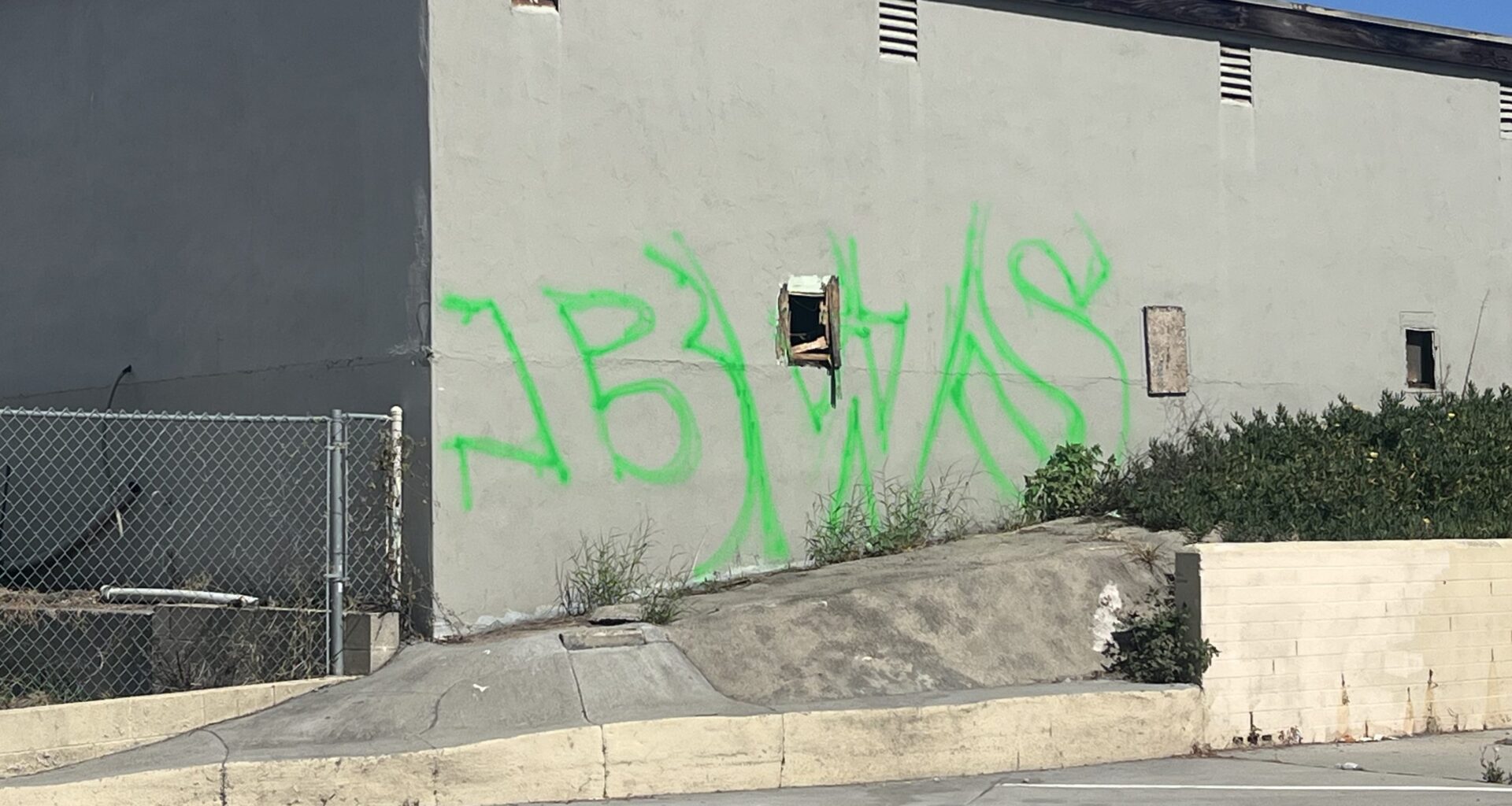
Overview: La Mesa issues
Liquor bottles, vape packages, hand rolls, whip-its, and marijuana packages were among the litter scattered across the street and sidewalks during a community assessment walk. Volunteers documented graffiti, unkempt space between buildings, and damage to utility boxes.
LA MESA – A section of University Avenue going through La Mesa is under the microscope, and whew, does this petri dish contain some stuff.
Liquor bottles, vape packages, hand rolls, whip-its, and marijuana packages were among the litter scattered across the street and sidewalks during a community assessment walk. Volunteers documented graffiti, unkempt space between buildings, and damage to utility boxes.
 An empty liquor bottle. (Photo courtesy of IPS East County)
Beyond the mess, community members are concerned about the density of adult businesses on University between Lee Ave. and Olive Ave., from liquor stores to massage parlors, near Dale Elementary School.
To the Institute for Public Strategies East County, an entity funded by the county’s Health and Human Services Department, the environment around Dale Elementary could lead to substance abuse issues down the road, so to speak.
“If you have a youth-centric area with three liquor stores, two smoke shops, and a dispensary, and that’s all they walk past every day to and from school, what kind of impact is that having?” said Seraphina Eberhardt, director of prevention programs at IPS, during a presentation to La Mesa Collaborative.
She led an assessment walk in June, which included Bonnie Baranoff, leader of the Collaborative and a Dale Elementary parent. The presentation came from the findings of that walk.
“It’s such a small section; it was really eye-opening for us,” Baranoff said.
Stepping into potential issues
 Empty box that had contained a product with nicotine in it. (Photo courtesy of IPS East County)
Baranoff stepped into one of the liquor stores to take pictures of its interior.
She found whip-its, an inhalant drug containing nitrous oxide, and to IPS’s great concern, multiple open tubs full of airplane-size alcohol bottles on the counter above the candy.
The easily-pilfered tubs were at the eye level of children who go into the stores after school for candy and snacks.
“I just think it kind of gets their minds turning with what this is, or maybe just normalizes alcohol use,” said Mia Mora, IPS East County’s prevention specialist.
With advertisements blocking the windows and broken lights inside, Baranoff said the store felt “dangerous” and “creepy.”
“Lots of those liquor stores have been there forever,” noted Reverend Christian DeMent, a life-long La Mesa resident, after the presentation. “But then you squeeze the cannabis dispensaries in between them.”
Something smells around here
Another concern was the odor around Buzz Cannabis.
Under California law, dispensaries do not have to be odor-free, but the odor cannot be a public nuisance. Local ordinances could further restrict the on-site use of marijuana.
 Some worry liquor is accessible to children if not supervised. (Photo courtesy of IPS East County)
IPS can no longer guide communities through policy changes to address environmental issues due to funding, but Eberhardt noted other communities have successfully taken action after similar walks. For example, Lemon Grove formed a community coalition to revitalize Broadway Avenue.
It also required off-sale alcohol retailer employees, like liquor stores, to take annual training on preventing alcohol sales to minors and other regulations from the California Department of Alcoholic Beverage Control.
Some cities outlawed the airplane-size bottles that are easily accessible and frequently littered.
And planning commissions began to look at the over-concentration of adult businesses, not just design aesthetics, when businesses tried to enter the area.
Beyond policy, some improvements can be made through just organizing community cleanups. Other ideas include painting the utility boxes and landscaping efforts.
Certain aspects of the issue, like windows being more than 33% covered by advertisements, are already covered by La Mesa code and California business regulations.
IPS sends letters to educate business owners on those rules and offer help in complying with them. However, Eberhardt said IPS does not want to act as an enforcement agency or cause community conflict by reporting code issues.
“We don’t want to come in and be the bad guy,” Eberhardt said. “We want them to be good business owners and good community partners.”
After the assessment walk, La Mesa has multiple options to move forward, including going to the Dale Elementary PTA, the Planning Commission, and the La Mesa City Council.
“We haven’t heard the end of this,” Baranoff added.
READ NEXT