
Inside the STEM Zone at St. Francis Catholic High School, through trial and error, iteration and adaptation – with equal parts testing, observing and problem solving – a group of students is reaching new heights in their STEM education experiences.Freshman Charlotte Huang and Megan Atkinson, a junior, are part of an elite team of 12 at St. Francis, interviewed and chosen from a pool of over 100 applicants at their school alone to be part of what’s called the International Space Station Program or ISSP.The group has spent the past few months conceptualizing, designing, engineering, coding, and will ultimately send a science experiment into space to be tested by astronauts aboard the International Space Station.St. Francis is one of only 10 high schools out of roughly 35,000 across the United States asked to participate in the ISSP, and it is the only, all-girls high school chosen.“That’s how special it is,” said president of St. Francis High School John Moran. “This is a huge quantum leap, next step in our STEM Zone programming.”In simplified terms, the students are figuring out a way to test yeast growth in space – comparing and contrasting that to how it grows in a controlled environment on Earth.“Everybody’s just so excited and they’re like, energized by what we’re doing,” said Atkinson. “We’re actually growing life in space in a way.”The students are also learning how their experiment has applications in the fields of biomedical engineering and longevity science.“It’s just an amazing opportunity for us to be able to send something into space,” Huang said. “There’s actual scientists who will be able to use our information if this experiment is successful.”The team started working together in September. Final testing on their work and packaging of it for space travel will happen in February.A launch of the experiment in a SpaceX rocket from Cape Canaveral, Florida, is set for early April. Once their experiment is performed by astronauts at the ISS, the students will work to publish results of the project by June.“There’s no cooler way to learn engineering than starting with some kind of experiment that goes into space,” said Atkinson.Project mentors say they’re encouraged by the young minds at work.“To be in a room of 12 young ladies who are passionate, knowledgeable, willing to dive in and tackle anything, it’s an absolute pleasure and excites me for the future of science,” said ISSP project mentor Nicole Weston.It’s an opportunity that’s laying inspirational groundwork so that the students see themselves as tomorrow’s STEM field leaders.“I really do love science itself,” Huang said. “I hope that I’m somehow part of that in the future.”
SACRAMENTO, Calif. —
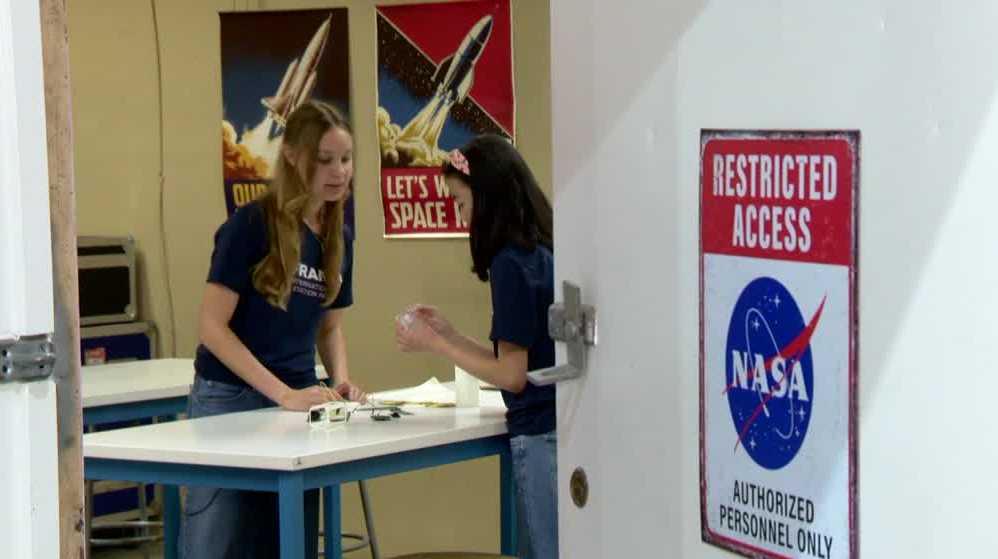
Inside the STEM Zone at St. Francis Catholic High School, through trial and error, iteration and adaptation – with equal parts testing, observing and problem solving – a group of students is reaching new heights in their STEM education experiences.
Freshman Charlotte Huang and Megan Atkinson, a junior, are part of an elite team of 12 at St. Francis, interviewed and chosen from a pool of over 100 applicants at their school alone to be part of what’s called the International Space Station Program or ISSP.
The group has spent the past few months conceptualizing, designing, engineering, coding, and will ultimately send a science experiment into space to be tested by astronauts aboard the International Space Station.
St. Francis is one of only 10 high schools out of roughly 35,000 across the United States asked to participate in the ISSP, and it is the only, all-girls high school chosen.
“That’s how special it is,” said president of St. Francis High School John Moran. “This is a huge quantum leap, next step in our STEM Zone programming.”
In simplified terms, the students are figuring out a way to test yeast growth in space – comparing and contrasting that to how it grows in a controlled environment on Earth.
“Everybody’s just so excited and they’re like, energized by what we’re doing,” said Atkinson. “We’re actually growing life in space in a way.”
The students are also learning how their experiment has applications in the fields of biomedical engineering and longevity science.
“It’s just an amazing opportunity for us to be able to send something into space,” Huang said. “There’s actual scientists who will be able to use our information if this experiment is successful.”
The team started working together in September. Final testing on their work and packaging of it for space travel will happen in February.
A launch of the experiment in a SpaceX rocket from Cape Canaveral, Florida, is set for early April. Once their experiment is performed by astronauts at the ISS, the students will work to publish results of the project by June.
“There’s no cooler way to learn engineering than starting with some kind of experiment that goes into space,” said Atkinson.
Project mentors say they’re encouraged by the young minds at work.
“To be in a room of 12 young ladies who are passionate, knowledgeable, willing to dive in and tackle anything, it’s an absolute pleasure and excites me for the future of science,” said ISSP project mentor Nicole Weston.
It’s an opportunity that’s laying inspirational groundwork so that the students see themselves as tomorrow’s STEM field leaders.
“I really do love science itself,” Huang said. “I hope that I’m somehow part of that in the future.”