
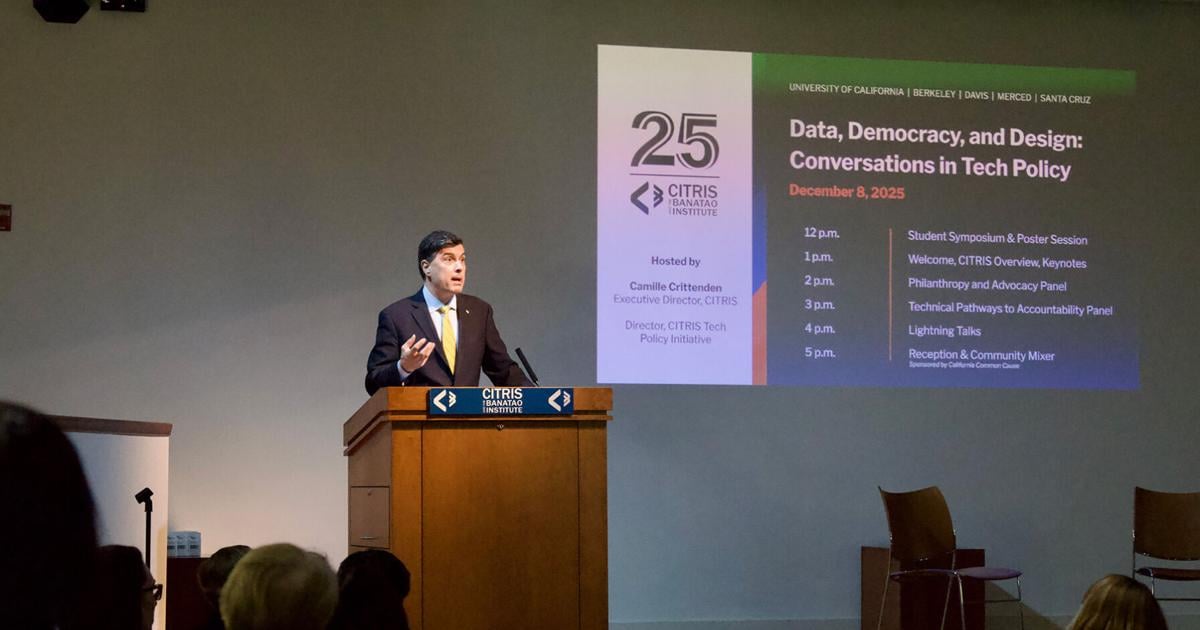
The Center for Information Technology Research in the Interest of Society, or CITRIS, and the Banatao Institute held a “Data, Democracy & Design: Conversations in Tech Policy” symposium Monday.
The symposium took place at the Banatao Auditorium and Kvamme Atrium in Sutardja Dai Hall and was hosted by CITRIS, an interdisciplinary research partnership between UC Berkeley, UC Davis, UC Merced and UC Santa Cruz.
The event featured poster presentations from groups of CITRIS student researchers showcasing novel approaches on ethical technology regulation, followed by discussions with panels of influential figures in technology, industry, academia and government.
“Technology is neither good nor evil. What matters is that it is guided by the right hands,” said former California Gov. Gray Davis in a video address played after the presentations.
Sophomore Aditya Mehta, along with three graduate students, presented their research on how to combat job loss caused by AI.
“Both of my parents lost their jobs to AI in the last year,” Mehta said. “(We’re proposing) a two-pronged policy solution around upskilling people and ensuring that they’re augmented and not automated by AI (through apprenticeships) … and a dividend fund for California, which aims to redistribute the profits from AI (companies) in order to reduce inequality.”
The idea of a dividend fund holds precedent in other states outside of California.
For example, Alaska and Texas each operate one by taking money from industries that consume natural resources, such as oil and mineral extraction, and redistribute the profits to residents.
“Humans will become gradually disempowered as they lose the means of holding others accountable to their own interests,” said Sean Richardson, a first-year statistics Ph.D. student who works in the same group as Mehta. “In the future, where … more of the tax revenue comes from capital, especially … AI companies, human values may cease to be prioritized.”
Mehta and Richardson were inspired by a recent study from Stanford University that revealed employment for software developers aged 22-25 declined by nearly 20% from its peak in late 2022 to September 2025.
For occupations that the researchers designated as “AI-exposed,” workers in the 22-25 age group experienced a 16% relative decline in employment, even after controlling for firm-level economic shocks.
“We need more places for the community to come together … and talk about these important issues that people aren’t really talking about anywhere else,” said Steven Luo, a research assistant for the CITRIS Technology Policy Initiative who helped put together the event. “People are interested in this … you could tell from attendance, the enthusiasm at the reception; people are really interested in tech policy.”