
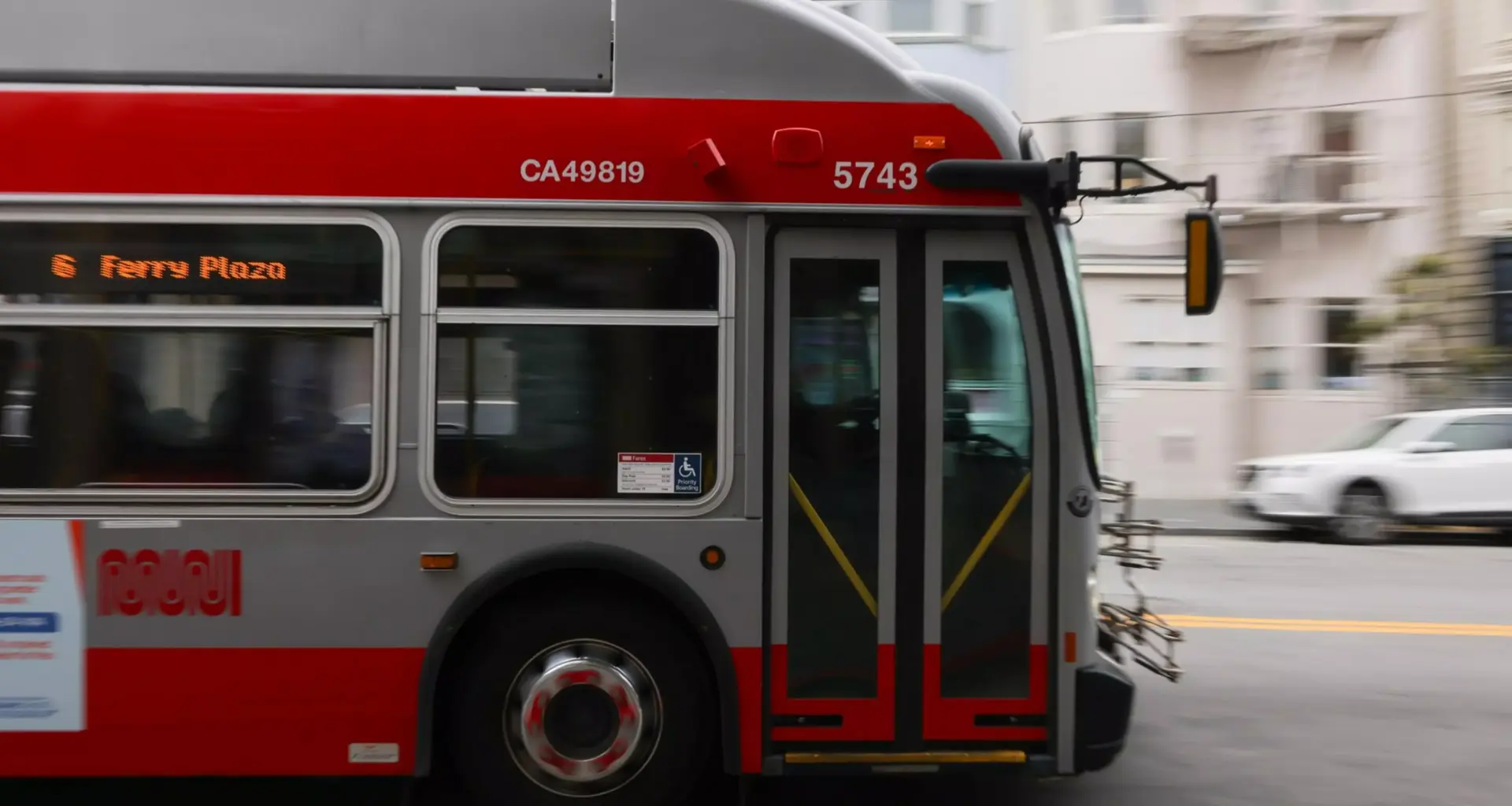
After five years of depressed post-pandemic revenue, Muni is officially and royally screwed. That is, unless San Francisco voters rescue it in November by opening their wallets for a new annual parcel tax.
Mayor Daniel Lurie has thrown his weight behind the plan, arguing that it would be the fairest and most affordable way to fund the San Francisco Municipal Transportation Agency, which has a budget deficit that’s expected to hit $307 million by the next fiscal year. A failure to close the gap means even worse service cuts: killing Muni lines (opens in new tab), halving bus routes, and ending fare discounts for youths, seniors, and people with disabilities.
Here’s everything you need to know about the effort to save San Francisco’s transit system from the perspective of a very tired Muni rider.
You’re interrupting my podcast for this. What’s a parcel tax?
It’s a tax on real estate. Under the tax plan, the city would charge an annual rate based on a parcel of land. Instead of scaling with value like typical property taxes, the tax would be a flat fee depending on the size and type of property.
But parcel taxes actually have a fascinating history in California. They actually originated in response to Prop….
…Okay, I’m gonna have to stop you there. How much will I have to pay?
Under the latest proposal floated by the SFMTA and the mayor’s office, what you would pay depends on what kind of property you or your landlord owns. There are three tiers: single-family homes, apartment and condo buildings, and commercial properties.
Single-family homeowners on parcels smaller than 3,000 square feet would pay a flat tax of $129 per year. Properties up to 5,000 square feet would be charged at 42 cents per square foot, and anything larger would be taxed at $1.99 per square foot.
Owners of apartment buildings would pay a $249 base tax up to 5,000 square feet, and 30 cents per square foot above that, to a maximum of $250,000. Commercial landlords would face a $799 base tax for parcels up to 5,000 square feet, with per-square-foot rates that rise as the property size increases. The tax would be capped at $400,000.
 The SFMTA has threatened to cut transit service if the city can’t close its massive budget deficit. | Source: Jeremy Chen/The Standard
However, the base tax rate, marginal tax rate, and tax cap within each tier are still being negotiated. In particular, other city officials and transit advocates are pushing to reduce the base tax rate, marginal rate, and maximum tax cap for multifamily residential buildings.
Lurie said funding public transit is key to San Francisco’s post-pandemic economic recovery.
Listen toThe Standard Podcasts
Pacific Standard TimeWednesday, Nov. 26

I’m a renter, so does that mean I don’t have to worry about this?
That depends on how negotiations go. Under the latest proposal from the SFMTA and the mayor’s office, there is no prohibition on tenant passthroughs, meaning your landlord could raise your rent to cover the cost. But advocates and officials are pushing for a ban on tenant passthroughs, among other provisions.
Who’s behind this?
Lurie kicked off the process in September, writing a letter to SFMTA leadership urging the creation of a parcel tax measure to fund Muni.
For more than six months, city officials and transit advocates have been meeting with the mayor’s office and SFMTA staff to shape the tax. The likely plan is to conduct a campaign to garner the 10,500 signatures necessary to get the measure on the ballot by July 6. If that happens, the measure would require a simple majority to pass.
If voters pass this, will Muni be saved?
Not exactly, but the measure would generate $187 million every year.
The parcel tax is meant to be passed in tandem with a regional half-cent sales tax measure that will go before voters at the same time. The sales tax would raise $1 billion annually (opens in new tab) for Muni, AC Transit, BART, and Caltrain, among other Bay Area public transit systems.
The failure of either to pass means the major hole in Muni’s budget would remain.
 Without additional funding to close a multi-million dollar budget deficit, the SFMTA may cut Muni service to shore up costs. | Source: Jeremy Chen/The Standard
Will this make the buses run on time?
The tax is mainly meant to staunch the bleeding and keep the same level of service.
Of the $187 million that would be raised each year by the parcel tax, $150 million would go toward closing Muni’s operating deficit, and $22 million would fund service expansion, though the SFMTA hasn’t detailed what that would look like.
This is San Francisco — there must be some kind of beef over this, right?
Spot on. Almost everyone involved agrees that the city should use a parcel tax to fund Muni, but there’s a partisan dispute over the details. Progressive Supervisor Jackie Fielder and her swing-vote colleague Supervisor Myrna Melgar have been pressing the mayor to double the $400,000 cap on commercial properties or remove it completely.
They argue that the change would lead to significantly more money — $260 million per year — and mean that large businesses are paying their fair share. However, Lurie’s moderate allies have been pushing for the city’s downtown recovery, and hitting commercial landlords with higher taxes is not part of the plan.
Okay, my stop is coming up, what are the next steps?
Advocates hope to have an attorney draft the legislation by January, then begin knocking on doors and collecting voter signatures later that month.