

This morning, the city of Oakland announced that it had sold all $285 million of the municipal bonds it issued last week. The bond series was offered last Wednesday after two years of waiting, due to concerns about the city’s downgraded credit rating and overall financial outlook.
They all sold within a week.
The city told The Oaklandside that there was more demand for its bonds than it could actually sell, with $638 million in orders from 26 separate investment firms.
“The oversubscription ultimately allowed the City to lower the final interest rates offered to investors and reduce the City’s borrowing cost,” said Sean Maher, the city’s communications director.
Mayor Barbara Lee called the bond offering a milestone for the city. “Oakland is on the move and building momentum with this bond sale,” she said in a statement shared with The Oaklandside. “We are reviving access to funding for paving our streets, restoring public facilities we all use and depend upon, and investing in affordable housing for our community, all while maintaining transparency and fiscal discipline.”
“Together, we are strengthening our foundation for generations to come,” she said.
At 11:00 a.m. on December 3, the city had 95 separate sales of its Measure U bonds on the open market, the first sales of a multiple-tranche package expected to bring in up to $285 million to pay for affordable housing, roads, libraries, senior centers, and parks, and an additional $49 million for refinancing old loans.
The offerings include several types of general obligation bonds. Interest on series 2025B-2 is tax-exempt because it is for affordable housing, while series 2025B-1 and 2025B-3 are taxable because they are for public works, such as road repairs. Altogether, the city says it issued $143.5 million of tax-exempt bonds at a cost of 3.99% interest, and $191 million of taxable bonds at 5.55% interest. The city is also selling a tax-exempt bond series labeled 2025 REF for refinancing, as listed in its disclosure document; the statement from Lee’s office said they will offer $5.6 million in debt service savings.
Moody’s gave the city an AA2 rating on the bonds, its third-highest rating, one it gives to high-quality investment-grade securities.
According to the disclosure document, the bond sale will raise about $181 million for housing and $104 million for non-housing infrastructure. Projects that will benefit from the sale include libraries and senior centers, stormwater and watershed repair, and many street repair projects, including speed bumps and humps that will help lower speeds on the city’s high-injury network of roads.
Between last Wednesday morning and Monday afternoon, there were 36 separate sales of Oakland Measure U bonds, according to the Electronic Municipal Access Market website.
Jestin Johnson, the city’s administrator, gave kudos to the finance and underwriting team for the bond sale, saying they positioned the town “as a trustworthy investment and vibrant, resilient City.” He singled out Dawn Hort, the city’s assistant treasury administrator; Jan Maczyk, the interim director of finance; David Jones, the treasury administrator, and several others.
The city’s municipal advisors were PFM Financial Advisors LLC, based in Philadelphia, and its managers were Siebert Williams Shank & Co., LLC, Loop Capital Markets, LLC, and BofA Securities, Inc.
According to the transaction records on the bond sale websites, the tranche sales close on December 18, 2025. The delivery of bonds to the investors — and the moment the city gets the cash — comes at the final closing.
A brush with insolvency
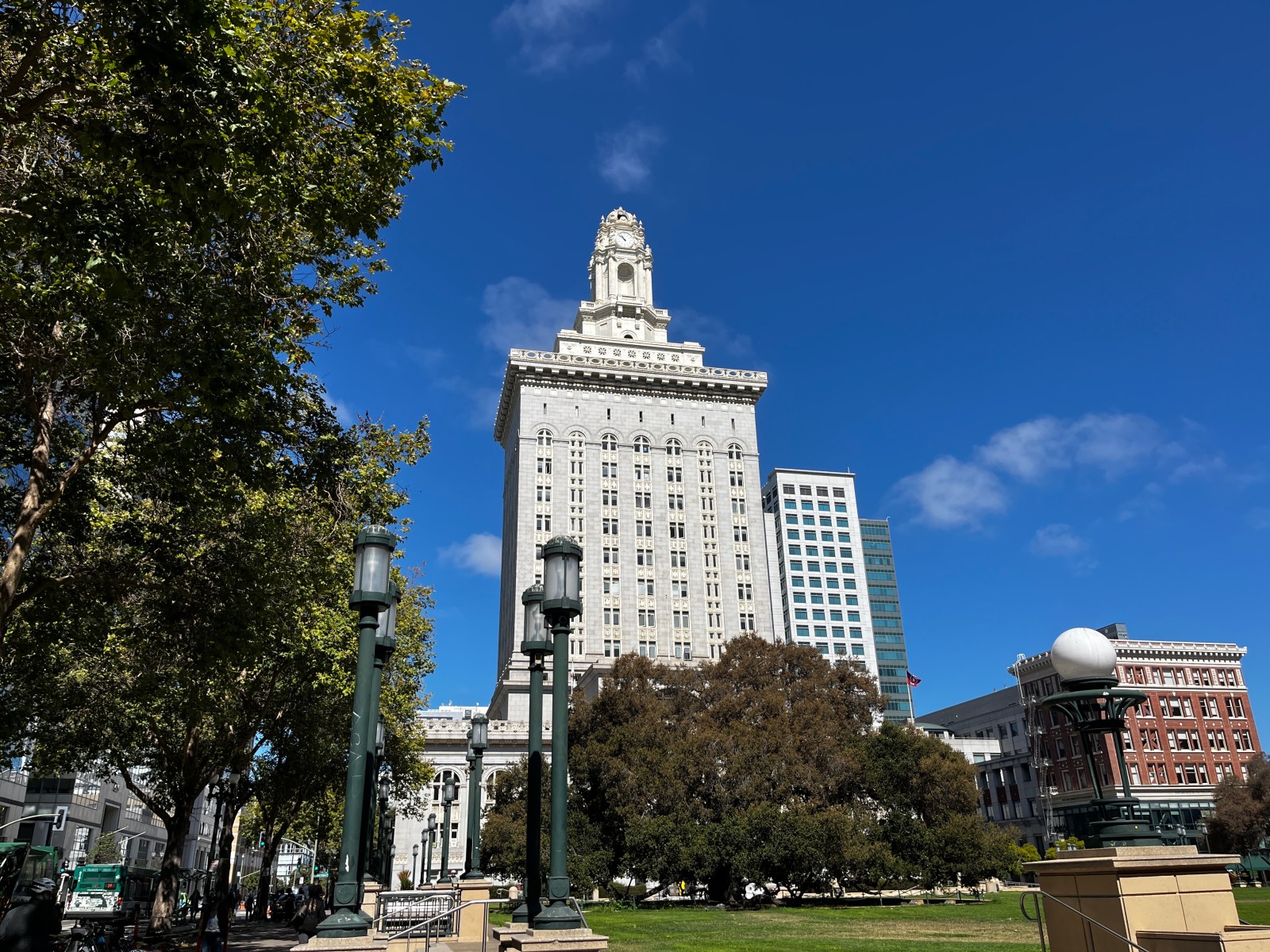 Oakland City Hall. Credit: Eli Wolfe/The Oaklandside
In November 2022, voters approved Measure U for $850 million in bonds for street repairs and affordable housing. Even after last week’s bond issue, the city will still be allowed to borrow about $450 million more thanks to the measure at a later date.
The bond sale is the latest financial move by the city to bring it back from the brink of insolvency and pay for necessary public works. In 2024, the city worked with the City Council to close a general fund deficit, leading to severe cuts to essential departments and hiring freezes.
In 2024, an Alameda County Grand Jury began investigating Oakland’s financial problems after learning the city had stopped issuing bonds due to concerns about its shaky economic condition. The final report issued in June 2024 found that the city’s finance department said the city could go bankrupt “if the city council did not take urgent, drastic budget action.”
The Grand Jury also found a “troubling” disconnect between key government officials, including the City Council, the mayor’s staff, city department heads, and the city’s financial office. Each told them different things.
“Elected officials testified that Oakland is financially sound, with substantial assets and no threat of insolvency,” the Grand Jury wrote. “In contrast, city finance and administrative staff warned that the city faces immediate fiscal risk. Further complicating our investigation was public information that was released and then retracted, in the form of a November 8, 2024, memo expressly warning of insolvency and possible bankruptcy. Elected officials claimed the document’s release as a ‘mistake.’”
But the financial department’s main concern, that Oakland’s credit rating would be downgraded, eventually occurred anyway. The barrel of mistakes that led to the downgrade, according to the report, included poor management by the financial department and an emergency city budget triggered by missed payments from the expected sale of the Oakland Coliseum, all of which highlighted to investors that Oakland was a slightly riskier bet.
Within a few months, three of the major credit agencies in the country downgraded the city’s credit rating, making the finance department hesitant to issue bonds. Moody’s cited Oakland’s “declining revenue and projected deficits” in downgrading the city from AA1 to AA2.
Long-overdue paving projects get a boost
 The bond sale will allow the city to upgrade Liberation Park in East Oakland. Photo by Amir Aziz for The Oaklandside
Selling bonds is essential for cities because they finance nonroutine spending, such as physical infrastructure.
The Oakland Department of Transportation has been pressuring the city’s finance department for the last 16 months to sell bonds to fund road repairs. Minimal paving occurred in 2023 and 2024, primarily using what was left of Measure KK and Measure BB monies, measures passed by Oakland voters in the mid-2010s.
The Oaklandside reported in October 2024 that elected officials, the city council, and the transportation department had all expected bond sales to occur that year. But when the budget was announced in mid-2024, OakDOT was surprised to learn, according to one city staffer, that about $50 million worth of road infrastructure capital projects had been removed to balance the budget.
At that time, OakDOT staff told us that the finance department had not given them a heads-up about postponing the bond issuance. OakDOT had designed projects and budgeted for work to be paid by bond money that year.
OakDOT has used bond capital in the past as leverage to receive competitive grants. Jamie Parks, OakDOT’s assistant director, said at a council meeting last year that the department had received “approximately $300 million in grants in the last five years.”
The money raised by Oakland from this latest bond issuance will help pay for 50 miles of road improvement projects that the financial department’s decisions have held up. According to OakDOT reports, some of those projects included cost-share agreements with local infrastructure partners, including the East Bay Municipal Utility District, or EBMUD.
The city’s list of road projects that will be supported by the bond issuance, includes $50.5 million for street resurfacing, $13 million for the Complete Streets Capital program (which prioritizes the high-injury network and vulnerable users such as seniors and historically disenfranchised communities), and $9.5 million for curb ramps.
Some major streets in need of paving could now receive the go ahead, or at least a construction bid, such as the 4.7-mile-long the Brookfield/Hegenberger Local Streets Rehab project; the EBMUD Cost-Share agreement project at Normandie Avenue; 84th Avenue and B Street; East 16th Street; a 3.7-mile stretch of Magellan Drive; and the 8.8-mile Prescott/Lower Bottoms local streets project.
The bonds will also provide $28 million for the development of Liberation Park in East Oakland, $10 million for the Oakland Ice Center, and $1.5 million for the Oakland Tool Lending Library in Temescal.
“*” indicates required fields