
ORLANDO, Fla. — Coming into the offseason, the Dodgers signaled that they would be conservative when it came to pursuing help in the bullpen.
Turned out, they were quietly plotting one of the most surprising — and influential — signings of the winter.
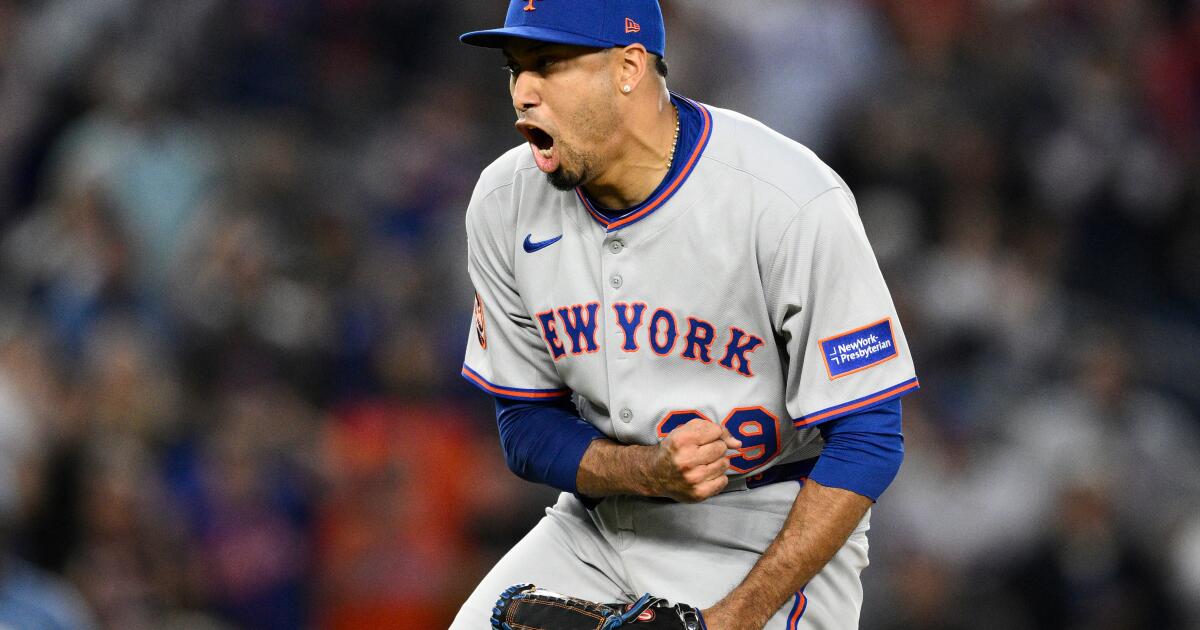
In a blockbuster move on Tuesday, the team agreed to a three-year, $69-million deal with top free-agent closer Edwin Díaz, according to multiple people with knowledge of the situation not authorized to speak publicly, snatching the three-time All-Star and three-time reliever of the year award winner in a move that will transform their previously shaky bullpen.
Díaz, 31, was the consensus best relief pitcher in this year’s free-agent class. Over his nine-year career, he has a 2.82 ERA and 253 saves. In that time, no other MLB reliever tops him in strikeouts (839), while only Kenley Jansen has recorded more saves (334). With the New York Mets this past season — his second since returning from a knee surgery that sidelined him for all of 2023 — Díaz also had one of his best career campaigns, posting a 1.63 ERA with 28 saves in 31 opportunities and 98 strikeouts in 66 ⅓ innings.
He was so good, he elected to opt out of the final two years of the record-setting five-year, $102-million deal he signed with the Mets in 2022.
Thanks to that track record, the hard-throwing right-hander was positioned to be the highest-paid reliever on this year’s market. Most projections pegged him for another four- or five-year deal, making upward of $20 million per season again.
Because of that, the Dodgers appeared to be long shots to sign him, with the club believed to prefer a shorter-term contract after watching their big relief signings last offseason (namely Tanner Scott) struggle in a bullpen that ranked just 21st in ERA.
“We came into [the offseason] wanting to focus on a shorter-term [deal for a reliever],” said president of baseball operations Andrew Friedman, who declined to comment on Díaz specifically since the signing was not yet official. “We had a very few number of guys who would potentially fit.”
All along, Díaz was privately at the top of that list.
And in recent weeks, the Dodgers widened their scope in a way that brought him into play.
The team gave serious consideration to Devin Williams before he signed a three-year deal with Díaz’s old team, the Mets — staying in the running late into Williams’ bidding even as it reached the level of multi-year offers.
They were in talks this week with Robert Suárez, another high-powered arm likely to sign a multiyear contract.
And on Tuesday morning, they emerged as a surprise finalist for Díaz, reportedly along with the incumbent Mets and Toronto Blue Jays.
Up to that point, the belief (even from some around the team until recent days) was that Díaz would ultimately fall out of their comfort zone. After all, the Dodgers had repeatedly downplayed the need for another big-name addition. And they knew signing Díaz would come with the added cost of a draft pick, since he turned down a qualifying offer from the Mets at the start of the offseason.
Share via Close extra sharing options
In years past, such factors might have swayed the club to explore more conservative choices, especially for a role as volatile as closer.
“If we were on a really tight budget,” Friedman said, “we probably wouldn’t allocate in the same way.”
These Dodgers, however, now enjoy a virtually unprecedented level of financial flexibility and freedom.
Their back-to-back World Series titles and Shohei Ohtani-driven revenue boost have put them “in a really strong position right now, financially,” Friedman said. Their ownership group also remains “incredibly supportive of pouring that back into our team,” he added.
Thus, when it comes to pursuing top talent, they hardly seem burdened by monetary restrictions –– especially when they can land a shorter-term, higher annual-average-value deal such as the one Diaz signed, which will set an AAV record for free-agent relief pitchers ($23 million per year) but also reportedly include $13.5 million in deferred money.
“In a world where there are major constraints, that wouldn’t be an area where I personally would allocate versus other areas,” Friedman said when asked generally about making another significant addition in the bullpen. “But we’re in a really fortunate position right now, and we have a really talented team going into 2026. So we’re going to do everything we can to put ourselves in the best position to win a World Series.”
Indeed, Díaz’s arrival, which was first reported by the Athletic, should provide instant fortification to next year’s bullpen.
He will represent the Dodgers’ most clear-cut closer option since Jansen’s departure at the end of 2021. He will lessen their reliance on returning veterans such as Scott (who had a 4.74 ERA and 10 blown saves after signing a four-year, $72-million contract last offseason) and Blake Treinen (who struggled with injuries en route to a 5.40 ERA after re-signing with the team last winter).
Most of all, he will alleviate what was the biggest weakness in the team’s run to back-to-back titles last year, when they had to lean heavily on starting pitchers — even in spot-duty relief appearances — to navigate the postseason.
Díaz’s success is predicated on a heavy fastball that averages 97 mph and netted just a .133 batting average against last season, plus a swing-and-miss slider that helped him rank fourth among big-league relievers in overall whiff rate in 2025.
His aura at the end of games has been amplified during his Mets career, too, thanks to his iconic trumpet entrance out of the bullpen at Citi Field.
He got his start in the majors in Seattle, where he had a breakout 57-save season in 2018 with the Mariners (good for second-most all-time). The following offseason, he was traded to the Mets, where he brushed off a bad 2019 campaign to become a fan favorite in Queens.
Between 2020 and 2022, he had a 2.27 ERA and converted 70 of 83 saves. After missing all of 2023 with a torn patellar tendon in his knee that he suffered during a postgame celebration in that spring’s World Baseball Classic, he overcame an inconsistent regular season in his 2024 return by pitching key innings in the Mets’ run to the National League Championship Series (when they lost to the Dodgers).
This year, Díaz then rediscovered his vintage dominance, trailing only Aroldis Chapman in reliever ERA.
While Díaz might not have received the kind of five-year pact he was projected for this winter — likely thanks in part to the Mets’ earlier pivot to Williams, leading them to reportedly only make Díaz a three-year offer themselves — his new Dodgers deal still guarantees him an extra season and $31 million compared to the contract from which he opted out.
Now, he will join an instant contender in Los Angeles; where his brother, Alexis, spent the majority of last season and appeared to mesh well with the Dodgers’ coaching staff.
Now, he will step into a key role for a team on a quest for a World Series three-peat.
And now, the Dodgers turned what started as a quiet offseason into yet another high-priced winter — reminding the sport that, even when they don’t necessarily feel the need for one, they no longer ever seem afraid of making another lucrative financial splash.