

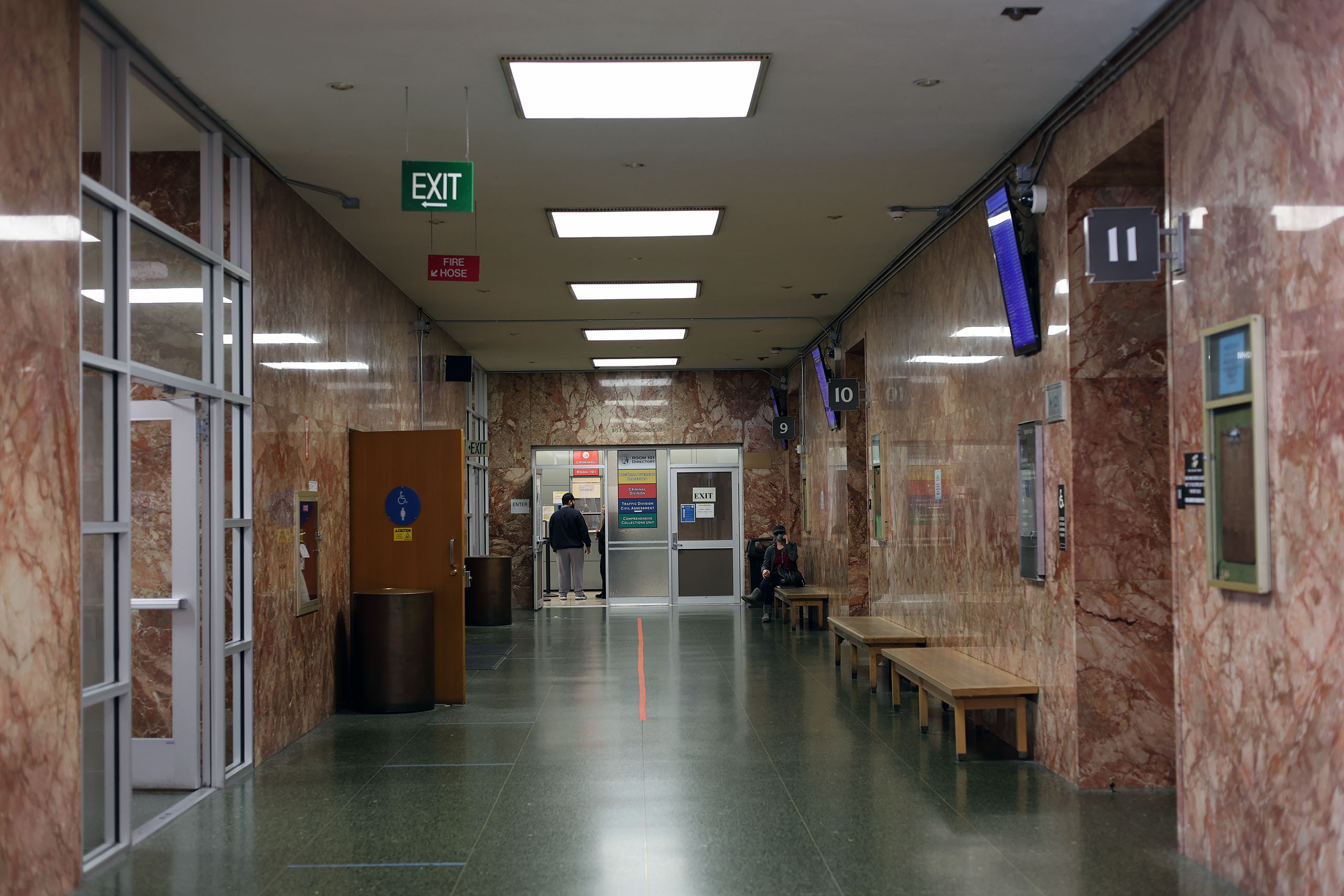
 The ground floor hallway of San Francisco Superior Court at 850 Bryant St. Photo on Jan. 16, 2025 by Abigail Van Neely.
San Francisco’s public defenders say the district attorney’s office is still withholding evidence months after they warned the state bar about an alleged “pattern and practice,” and doing so in nearly half of their misdemeanor trials.
Withholding evidence, the public defenders say, makes it much harder for them to represent their clients, and violates their clients’ constitutional rights.
The allegations come amidst a rise in misdemeanor cases filed by District Attorney Brooke Jenkins as the city has prioritized lower-level crimes for policing and prosecution. The increase in charges has at times overwhelmed the court system.
Eight months ago, the public defender’s office sent a letter to the California bar association alleging the DA had a “pattern and practice” of withholding evidence. The letter said that prosecutors withheld evidence in at least 50 cases between September 2024 and March 2025.
But Jenkins’ office denies the allegations, calling them “bald and unsubstantiated.” In fact, the DA’s office accused the public defender of delaying giving evidence to the prosecution.
Under California law, prosecutors and criminal defense attorneys must each disclose evidence to one another at least 30 days before trial, during a phase known as the “discovery” process. Public defenders claim the DA has been providing evidence after the 30-day window, and in some cases, failing to provide evidence altogether.
Since the initial letter, public defenders claim that the DA’s office has continued to improperly withhold evidence. Their most recent data, which has not yet been publicly released but was shared with Mission Local, shows public defenders reported a violation 76 times in 40 out of their 83 misdemeanor trials — 48 percent.
Among the allegedly withheld evidence: body camera footage, 911 calls and lost or damaged lab samples.
The DA’s office added that 40 cases is a minute percentage of its overall caseload: “If their allegations were in fact true, which they have not provided evidence to support, it would mean that there was late discovery in .01 percent of the 3,637 pending misdemeanor cases, not a pattern,” read a statement from the office.
The data collected by the public defender’s office focused on the 83 cases they have taken to trial, rather than all pending cases. Jacque Wilson, a managing attorney of the public defender’s misdemeanor unit, said this was a conservative estimate that represented only “the tip of the iceberg.”
In mid-November, the public defender’s office did provide the DA with a list of 10 cases where it had concluded evidence was improperly withheld. The DA’s office said it looked into eight of those cases and found that prosecutors had “behaved responsibly and ethically,” turning over evidence as soon as it came into their possession.
The DA’s office also countered that the public defender “routinely” withheld evidence from the prosecution. While the DA’s office said it has not been tracking such incidents formally, it shared five examples with Mission Local.
The evidence allegedly withheld in these cases included documents regarding a defendant’s mental health, and expert witnesses’ resumes and statements.
Defense attorneys and prosecutors have different obligations when it comes to sharing evidence. The prosecution, which has the burden of proof, must share evidence that could exonerate a defendant.
“Only the prosecution has a constitutional duty to search its files and disclose exculpatory and impeachment evidence,” said Wilson. “The defense does not.”
An average public defender in the misdemeanor unit is working on roughly 100 cases at a time, Wilson added. They cannot afford to spend extra time negotiating for the release of evidence in an already overwhelmed court system, he said.
Evidence excluded, cases dismissed ‘in the interest of justice’
The court has taken action in a handful of the trials in which the defense reported evidence being withheld, according to public defenders.
Evidence shared by the DA’s office was excluded in a quarter of the 40 trials that allegedly involved a discovery violation, said Wilson. Two cases were dismissed altogether, he said.
In one case, a judge decided to exclude witnesses that the DA’s office wanted to call to the stand because their involvement in the trial was disclosed to the defense only a couple days before trial was scheduled to begin.
“The judge was wrong,” the DA’s office wrote regarding this exclusion. The prosecutor on the case had only recently been introduced to the witnesses, the DA’s office said.