
Is protest art dead?
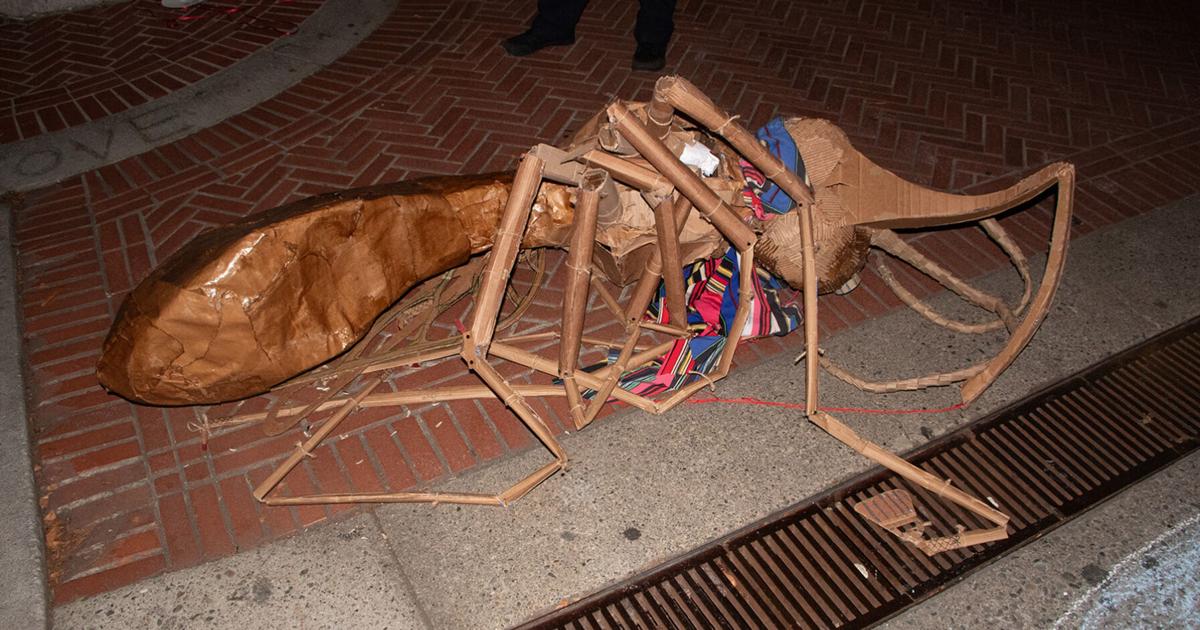
On the morning of Nov. 10, four UC Berkeley students attempted to hang a large cardboard mosquito sculpture from Sather Gate in protest of a Turning Point USA, or TPUSA, event. The sculpture, approximately five feet in height, was reappropriated from a student’s art class assignment. However, the installation was thwarted as UCPD intervened, arresting all four students on suspicion of felony vandalism.
The disproportion between the students’ actions and the severe legal consequences they face is striking. To express dissent through art used to be a cunning, subversive game. Art, in all its humor, transmissibility, euphemism and satire, skirts around censorship and delivers nuanced opinions where direct confrontation fails to reach. But now, a cardboard art project could be treated as a potential felony.
This incident forces a timely reckoning: does protest art still function in an era of real-time surveillance? What can be done when a faint hint of dissent is instantly dismissed as a threat?
From Picasso’s “Guernica,” which explored techniques of abstraction to portray the horrors of fascism, to Banksy’s repeatedly erased graffiti on the West Bank barrier, protest art has always thrived on the blurred line between creation and destruction. Its power is derived from the space it inhabits — ordinary city walls, bright-colored barricades, crowded public squares, enclosed galleries. The list goes on. Nowhere is this clearer than in the case of Asco, an East Los Angeles-based art collective. In 1972, the artists that made up Asco spray-painted their names on the exterior of the Los Angeles County Museum of Art, forcing it to confront its exclusion of Chicano artists. The collective flipped a museum curator’s claim that “Chicanos make graffiti, not art,” on its head, subverting this prejudicial narrative by weaponizing the very medium through which they were marginalized. By embracing “vandalism,” Asco was able to harness the power inherent to the museum.
Likewise, the cardboard mosquito’s potency came not only from its content and materials but also from its placement at Sather Gate, the emblem of the UC Berkeley campus and the symbolic threshold through which nearly every student and visitor passes. Hanging the mosquito from the top of the gate was a blatant gesture of refusal towards the incoming guest: TPUSA and its history of hate speech. The installation imposes itself upon every passerby; in encountering it, spectators are compelled to decipher and interpret its inner qualities and are thereby inscribed into the creative act itself. By inserting itself into the public forum, protest art inevitably draws into conversation, as well as conflict, the very forces that it seeks to challenge.
Nevertheless, when artists respond directly to power, institutions tend to respond in turn, often through censorship, removal or persecution. In the words of German philosopher Theodor W. Adorno, “Every work of art is an uncommitted crime.” Yet, tracing the history of protest art, it’s evident that it is quintessentially the art of offense, and thus, for the ones in power, a crime committed.
It is precisely this reciprocity between artists and institutions that makes protest art so powerful. Art is not solely the object being produced by the artist but an entire process, one that achieves completion once public discourse echoes the work produced. Power and resistance are mutually constitutive: artworks become political, not when they express political content but when they provoke a political reaction. Therefore, dissent will not be killed by censorship, criminalization or suppression. Quite ironically, censorship usually reveals the institution’s insecurity and, by doing so, confirms the true purpose of protest art.
After all, what is a cardboard mosquito capable of on its own? What is toppled by this absurd, inert figure? With its innocence and silence, the installation was less an act of aggression than an invitation to interpret, which renders the arrest preposterous.
The institution, of course, supplies its own rhetoric to justify the intervention: attaching anything to Sather Gate likely violates the university’s Time, Place, and Manner regulations, and California felony vandalism law is triggered by any supposed property damage exceeding $400. But even before debating whether these regulations meaningfully apply in this case, it is telling that the university turns to utilizing evasive language to preserve its neutrality. By punishing not protest, but the medium through which protest occurs, Berkeley feigns impartiality.
Such strategic negligence, this refusal to confront the substance of protest, reveals that the institution operates not through power, but through fear. The cardboard mosquito functioned less as a provocation than as a blank canvas — a blinking mirror. Whatever the university perceived in that reflection, it found intolerable, frightening.
But what, exactly, was the terrifying truth that the university saw?
The threat was not the sculpture itself, but the institution’s projection onto it: the fear that uncontrollable expression, once claiming space, will gather momentum and evolve into counterpower.
So how could protest art die at this moment? If this crackdown of protest art exposes institutional paranoia, it should not persuade us to retreat into caution. If anything, it makes clear that no degree of euphemism will protect dissent from being instantly dismissed as danger. When even an absurd cardboard mosquito can be cast as a felony, self-censorship becomes nothing more than preemptive obedience. We cannot allow life to be saturated with pretense and obscurity, with ever-changing jargons and carefully curated expressions.
As autumn sunlight spills across campus, miniature insect charms appeared along the margins of Sather Gate — little sprinkles of color interlaced with the bronze scrollwork, a subtle yet defiant gesture of support for the mosquito installation that came before. Protest art will persist, and must persist, not in spite of the surveillance, but because surveillance itself confirms its necessity. The task, then, is to never stop creating, to keep crafting art that startles, unsettles, exposes and questions.