
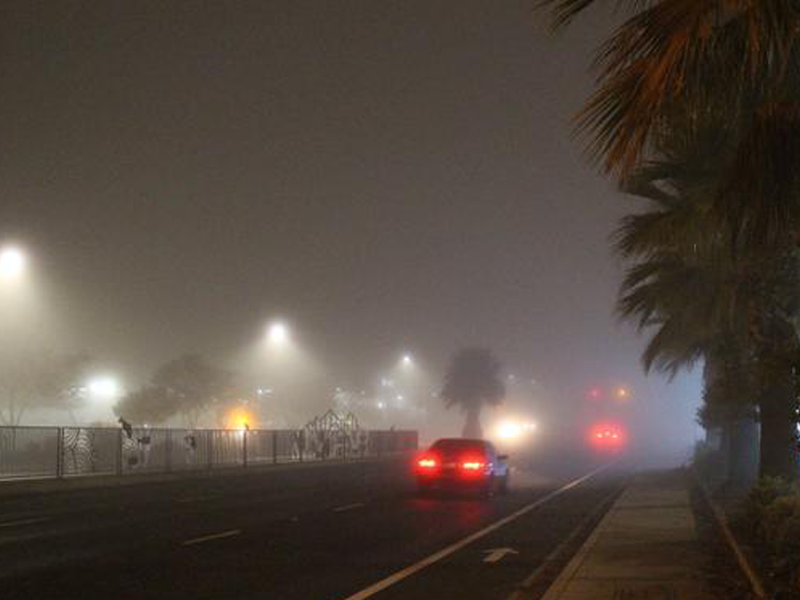
If you’ve been driving through the Central Valley recently, you’ve probably encountered the region’s thick, low-lying tule fog.
This fog, sometimes called radiation fog, can happen when the ground is saturated from previous rainfall and current weather conditions are stagnant. It’s named after a native wetland marsh grass and often appears during California’s colder months.
Ian Faloona, an atmospheric scientist at UC Davis, he’s seen more dense fog this year than he has in a while — which makes sense, as research shows there’s been a decreasing trend in fog in the Central Valley since the eighties.
“It’s been a reduction of almost half,” Faloona said. “So, I think if you ask your parents about it, if they are from the Central Valley, they’ll have a different sort of appreciation. I think it was a lot more common a few decades ago.”
He said researchers aren’t exactly sure why there’s less fog, but there are theories.
“Some people think that it’s because of the air pollution reduction that we’ve been successful at, and regulating air quality in the state,” Faloona said. “That leads to less of these small particles that the fog forms on [but] that’s sort of just a conjecture.”
This year, however, Faloona said a good amount of rainfall early in the fall helped saturate the soil, boosting conditions for tule fog to form.
But thick fog can cause issues — especially for drivers. Megan Reese, a spokesperson for Caltrans, said traffic collisions usually spike when fog rolls in.
“Three out of four fog-related traffic collisions are due to … driving too fast during fog,” she said.
Reese said it’s important for drivers to slow down during foggy conditions so that they can more reliably keep a safe distance from cars ahead of them.
“I know it seems crazy to slow down on a highway, but if you can’t see, you need to make sure that you have time to stop,” Reese said.
She also said drivers should remember to keep their high beams off and use low beams when driving through fog.
CapRadio provides a trusted source of news because of you. As a nonprofit organization, donations from people like you sustain the journalism that allows us to discover stories that are important to our audience. If you believe in what we do and support our mission, please donate today.