
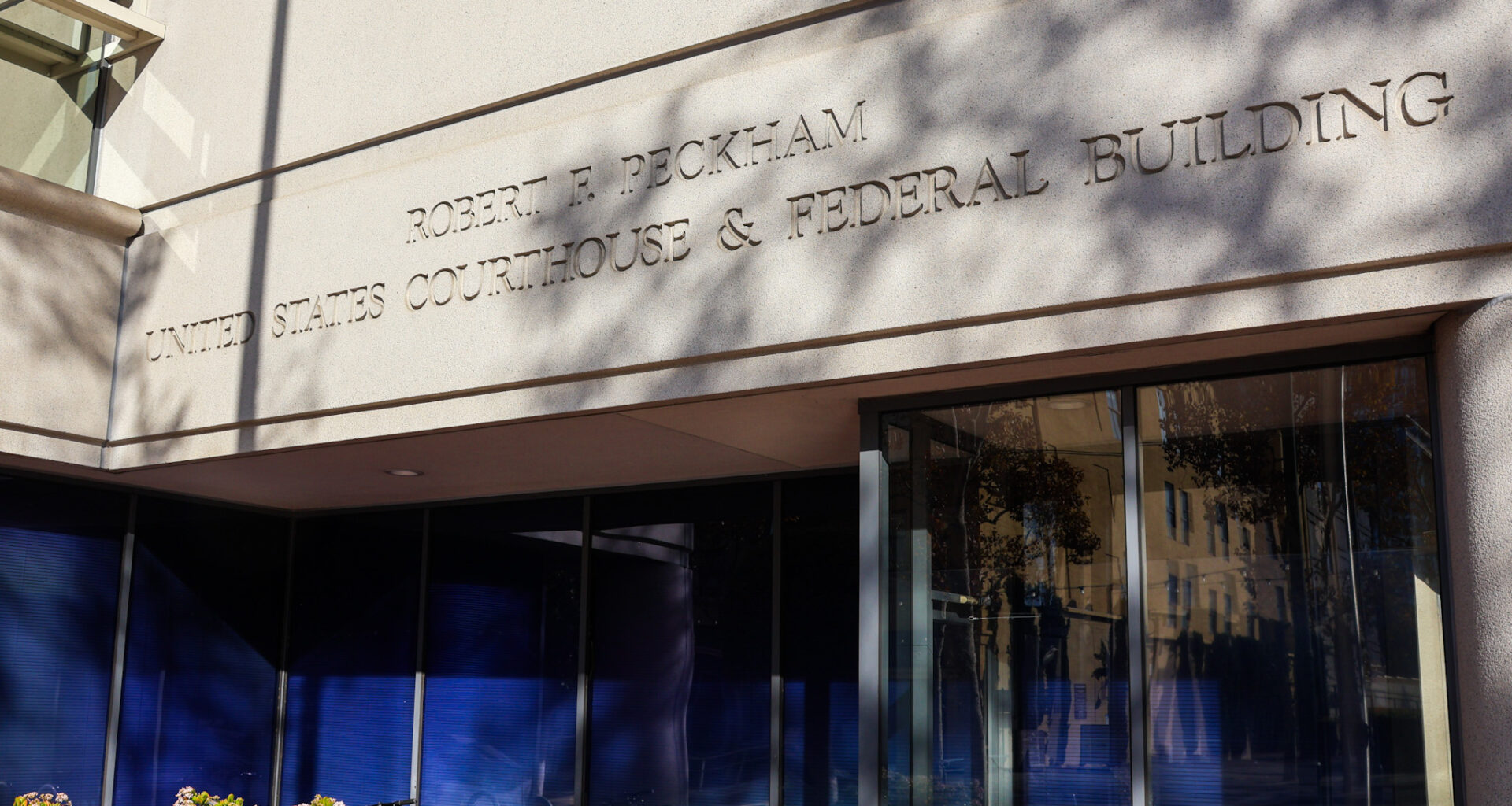
Within weeks, there could be a halt to the Trump administration’s practice of arresting immigrants at court hearings in San Francisco, if a district court judge rules in favor of the American Civil Liberties Union and other Bay Area groups challenging the practice.
Immigration agents have for months arrested immigrants after their asylum hearings, placed them in federal custody, and tried to deport them to the countries they have fled from (and, as of late, to countries they have never been to).
At stake in Carmen Aracely Pablo Sequen et al. v. Sergio Albarran et al. is not whether such a practice is just, but whether it is legal.
The government says yes: A federal attorney argued in front of Judge Casey Pitts of the U.S. District Court for the Northern District of California on Tuesday that there is precedent for arresting and deporting asylum-seekers before their cases have been fully heard.
Not so, argued Jordan Wells, from the Lawyers’ Committee for Civil Rights. These courthouse arrests mark a break from 40 years of practice.
About 15 viewers back the left side of the spacious courtroom in San Jose. Meanwhile, the right side of the courtroom remained largely empty with the exception of a few journalists.
Those in the audience included about 10 attorneys from the ACLU and partnering firms who had entered into the courtroom with towering stacks of legal binders which they made reference to throughout the course of the morning and afternoon arguments.
Before May, a person who had crossed a border into the United States and asked for asylum could not be detained while their case was underway, unless there was a change in circumstance — like that person committing a crime.
Judge Pitts has already ruled on conditions in ICE holding cells in San Francisco. In late November, he issued a preliminary injunction ordering ICE to immediately provide mattresses, blankets, medical care to people detained there, though attorneys say ICE is violating that order. The report in question says the ICE has moved its operations to the fifth floor which is still unfit to hold detainees.
On Tuesday morning, Wells and partnering attorneys argued for Pitts to halt the courthouse arrests altogether, citing “irreparable harms” to those affected. If the pause is granted, appealed by the Trump administration, and taken up by higher courts, it could have national effects.
Wells described the situation playing out at San Francisco’s courts as a “horrendous catch-22” in which immigrants with asylum hearings either “show up to court and face handcuffs, or give up on their American dream.”
Those who do not appear, he noted, are ordered removed in absentia, which ends any hope of legally remaining in the country.
Until May 2025, immigration officials had followed policies that only permitted courthouse arrests where an immigrant posed a clear danger to the public, and arrest elsewhere wasn’t feasible.
But last May, ICE officials issued a memo that opened a legal path for courthouse arrests by granting ICE officers the ability to arrest people at their own discretion.
The new policy catalyzed a shift. Since May, Mission Local has documented more than 120 courthouse arrests between the two immigration courthouses in San Francisco.
Wells told the court on Tuesday that the vast majority of people arrested in immigration court since May have not even been accused of a crime, and the data shows the same.
But, because they are in a federal courthouse, they are much easier to arrest than someone who has committed a crime and is actively fleeing the law. “These people are sitting ducks,” Wells said.
The government’s attorney argued that a past practice of such arrests did exist. The attorney said that the judge must look to the “full scope from the first Trump administration” to find the few examples he claimed.
But when Wells’s co-counsel, Marissa Hatton, took the podium, she noted that past arrests were made during criminal proceedings in state courthouses — not immigration courthouses.
After two hours of arguments, the judge said he would take both sides under consideration and called for a 10-minute recess, before a group of attorneys with the ACLU began a separate, but related case, Garro Pinchi et al. v. Albarran et al. that could also have national impacts.
In Garro Pinchi, the ACLU attorneys are arguing against detaining law-abiding immigrants at any location — whether at home, at immigration court or during a routine check-in with ICE. At around 1 p.m. the court was dismissed and Judge Pitts said that he would take into account all parties’ arguments. An outcome for the cases of Sergio Albarran et al. and Garro Pinchi et al. is expected by the end of the month.