
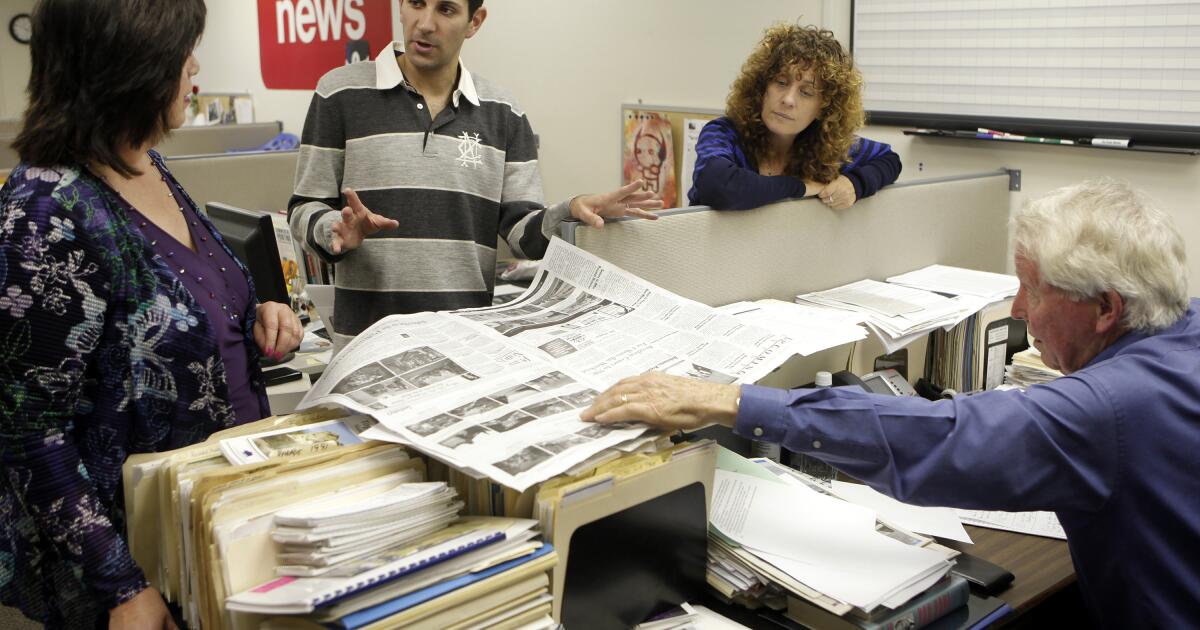
In a year of incalculable loss wrought by fire, Pacific Palisades this week has yet another: Its local newspaper.
The Palisadian-Post published its final edition Thursday. The newspaper was 97 years old.
“Our reporters have chased their last stories. Our presses have printed their last copies. Our corner newsstands have opened for the last time,” owner Alan Smolinisky wrote in the newspaper Thursday. “After the unimaginable sorrow and destruction of the past year, losing this beloved institution feels like a final blow.”
He added: “This time last year, we still had a future. But it burned up in the fire, like most of the town.”
Smolinisky, who bought the struggling newspaper in 2012, wrote that shutting down the Pali Post, as it’s known, was “the hardest decision I’ve ever made.”
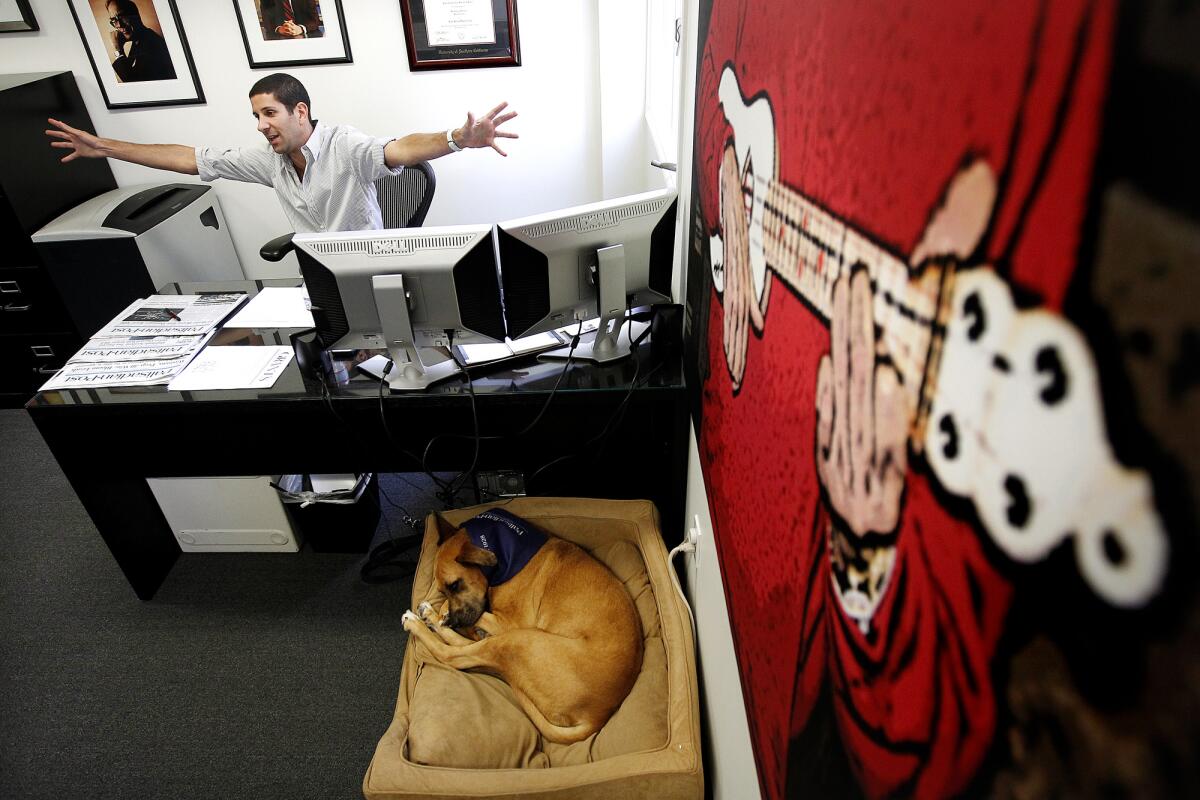
Alan Smolinisky, owner of the Palisadian-Post, at his desk at the community newspaper’s office in November 2013.
(Christina House / For the Times)
After the Jan. 7 fire, local businesses — either physically destroyed or suffering from a lack of customers — stopped purchasing advertisements in the Pali Post, the owner wrote.
And the fire displaced readers themselves.
“The Palisades became a ghost town in the wake of the fire,” Smolinisky wrote. “Subscriptions basically fell to zero. It’s completely understandable. But you can’t print a newspaper nobody reads.”
The Jan. 7 fire destroyed more than 2,600 businesses in Pacific Palisades, according to researchers at the UCLA Latino Policy and Politics Institute and the Center for Neighborhood Knowledge. It partially damaged more than 650 more.
Most, researchers said, were small businesses.
The newspaper started publishing in 1928, a few years after modern-day Pacific Palisades was founded by members of the Methodist Episcopal Church who built an enormous campground in Temescal Canyon for annual gatherings called Chautauquas.
The newspaper started as the Palisadian, an eight-page weekly tabloid that sold for 5 cents per copy.
The lead story in the first edition, according to the newspaper’s website, was about $1 million being spent to pave a stretch of modern-day Chautauqua Boulevard and to plant trees near Santa Monica Canyon.
Over the years, the newspaper endeared itself to residents by recording the community’s marriages, deaths and births (noting the first baby born each year) — as well as Little League games, Fourth of July parades and the Mr. and Miss Palisades contest.
But like many local new outlets, it struggled.
Beset by plummeting circulation and web traffic, advertising losses, ownership consolidation and changing reader habits in the era of smartphones and social media, thousands of U.S. newspapers have closed over the last two decades.
Smolinisky, a real estate entrepreneur who was born and raised in the Palisades, is a part owner of the L.A. Dodgers. He was 33 when he bought the Palisadian Post and its then-office building on Via de la Paz.
In January 2013, The Times reported that the deal “included the Post’s money-losing commercial printing business, which he closed,” and that he told staffers he wanted to make the business profitable so he could restore full-time status to 16 employees, including seven in the newsroom, who had endured years of shortened hours and lesser pay.
In his note to readers on Thursday, Smolinisky said his parents — immigrants from Argentina who moved to the U.S. in 1975 and eventually bought their first home on Seabreeze Drive — read the paper for five decades.
Smolinisky wrote that after he returned to the Palisades after college, “I subscribed immediately.” Later, he and his wife published their wedding announcement in the paper.
“I love the Pali Post because I love the Palisades,” he wrote. “This paper is our town in miniature—committed, conversational and a little bit quirky.”
The newspaper, he wrote, got up to 6,200 subscribers, which he considered a feat.
But the staff continued to shrink. The physical newsroom was recently moved out of Pacific Palisades to an office complex in Canoga Park.
In 2023, the longtime weekly newspaper — whose staff continued to decline — announced that print publication would be reduced to twice a month.
Maryam Zar, chief executive of the Malibu Pacific Palisades Chamber of Commerce, said Thursday that it was no secret the newspaper had struggled for years, but it remained an important communication platform amid the long post-fire recovery.
“I don’t think people will be surprised, but I think people will be devastated,” Zar said of the closure.
“We are going to lose something that’s been a part of Pacific Palisades history for generations,” she said. “There is so much information in those archives that literally tracks the history of the Palisades. We’re all working so hard to preserve what we’ve lost and be able to hand it to future generations … and this is really a loss.”
Steve Galluzzo, the longtime sports editor of the Pali Post, said in an interview Thursday that, more than anything, he was grateful for his 25 years covering everything from Little League baseball to high school volleyball and water polo to the annual Pacific Palisades Turkey Trot 5K and 10K races.
“I’ve had a blast,” he said. “No regrets. It was a joy every day.”
As the only person covering sports for the small paper, Galluzzo did it all, reporting, editing and shooting his own photographs.
Galluzzo, who is also a freelance reporter for The Times, was such a longtime presence on the sidelines in Pacific Palisades that, “literally, some of these kids, I’d watch them grow up,” he said.
“Obviously, it’s very sad,” Galluzzo said of the newspaper’s closure. “There’s something really special about working for a small-town paper. You really become part of the community and get to know generations of families.”
Smolinisky on Thursday wrote that his house did not burn and that he planned to stay in the Palisades, where “people are coming back, slowly but surely.”
“We’ll welcome a new generation of families to town,” he wrote. “And maybe, in time, we’ll restore this treasured institution. A town like ours needs a newspaper.”