
When I look at you, what is it that I see? A face, certainly. Hair, probably. Clothes, hopefully. If I’m observant, I might notice more subtle flourishes — a sense of style, an air of disappointment. But the one thing I won’t ever see is what I’m actually looking for: you, the backstage observer who wishes I would quit staring at you like that.
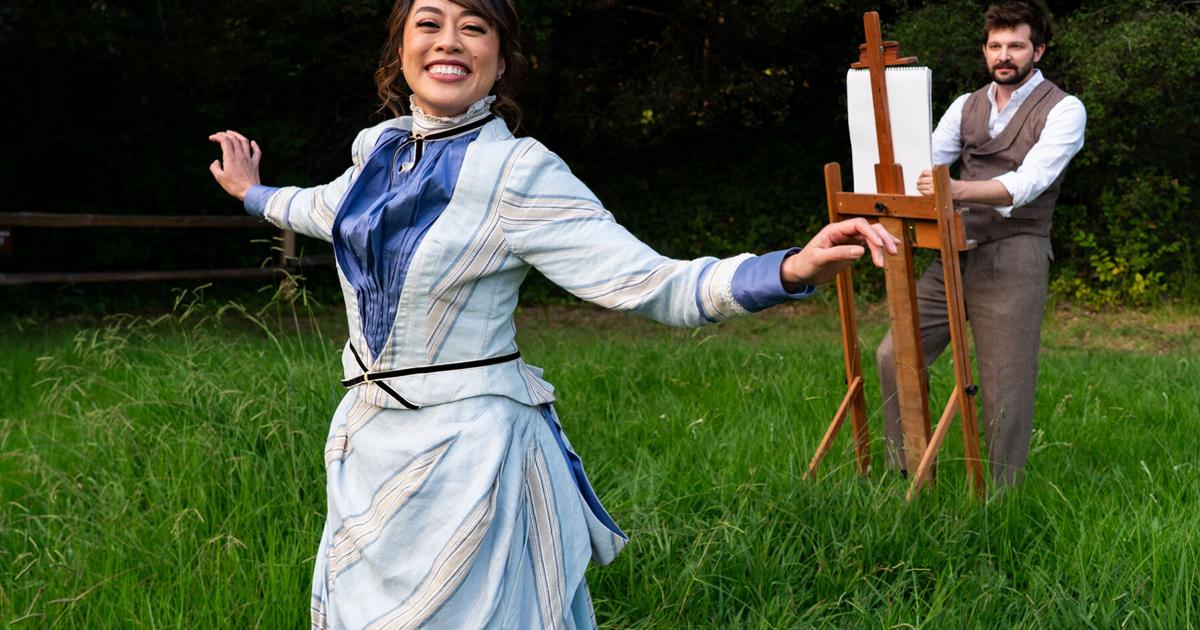
So it goes in “Sunday in the Park with George,” Stephen Sondheim’s 1985 musical based on the life of French artist Georges Seurat. In Susannah Martin’s excellent production, running through Jan. 25 at Shotgun Players’ Ashby Stage, George (Kevin Singer) is hugely likable, even if the stare is a little off-putting.
Seurat, drawing on his era’s advances in vision science, was an early pioneer of pointillism, composing his scenes from arrays of multicolored dots that, at a distance, appear to blend into distinct, luminous shades.
So George lives for “color and light.” That’s the phrase he sings on loop while stabbing his brush at the huge, backlit scrim representing his latest painting, “A Sunday on La Grande Jatte.” Meanwhile, in her room beneath the studio, George’s lover Dot (Marah Sotelo) is feeling snubbed: She angrily blots her cheeks with a powderpuff — dot-dot-dot — in perfect sync with George’s brushstrokes.
The moral here — swipe left for artists — plays out over the show’s first half. We follow George through many Sundays of sketching random Parisians in the park while Dot mopes around nearby. As their relationship disintegrates, George’s masterwork grows into its final form.
A snappy second act follows, leaping forward in time to show us George’s great-grandson — also named George — as he struggles to market his work in the 1980s art scene. Certainly, George’s Cyclotron (designed by Sydney Parnell) wins the prize for coolest prop ever: It spins and sparks like a short-circuiting lunar lander, requires a full-time electrician and is, understandably, a hard sell.
This production pays careful attention to what the two Georges have in common. While both can happily spend hours gazing enraptured at passersby, making contact is another matter. The younger George chants it to himself like a mantra: “Connect! Connect!”
That’s not so easy when your world is populated by cartoon characters. Among the Sunday residents of the park are a pair of giggling shopgirls who think they can catch boyfriends by pretending to fish, an American couple with plans to buy their own pastry chef, and a one-eyed boatman (understudy Nico Jaochico, in a standout performance) who regales George with cynical theories about human nature. “One eye and no illusions,” he boasts, with an unavoidable wink.
It’s good, old-fashioned slapstick and amazing. This ensemble is uniformly talented. They seem to be inventions of George’s relentless mind, which encounters faces and mannerisms and instantly caricatures them.
The effect is intensified by Nina Ball’s clever scenic design, which blurs the lines between people and the places they inhabit. Earnest, if simple-minded, Soldier (William Brosnahan) strolls through the park arm-in-arm with his comrade: a full-sized cutout of a soldier. In one entertaining number, George sketches a dog, clears his throat with a few “woofs,” and begins to romp around narrating its inner life.
Dot is kind of into it. “How George looks!” she gushes, watching him work. The remark is double-edged: the way George peers, the way George appears. And we can’t help but admire him, too. Singer, as George, with his warm basso voice and intense gaze that cuts around the theater like a searchlight, strikes us as someone bothered by beauty and trying very hard to be good.
He also seems to be somewhere on the spectrum, which feels topical. Refracted through George’s eyes, the world looks like nothing we’ve seen before. Late in the show, when a discouraged George wants to quit artmaking for good, Dot reminds him of the value of his singular perspective: “Give us more to see!” she sings. I’d second that — we all benefit from having different kinds of minds around.