
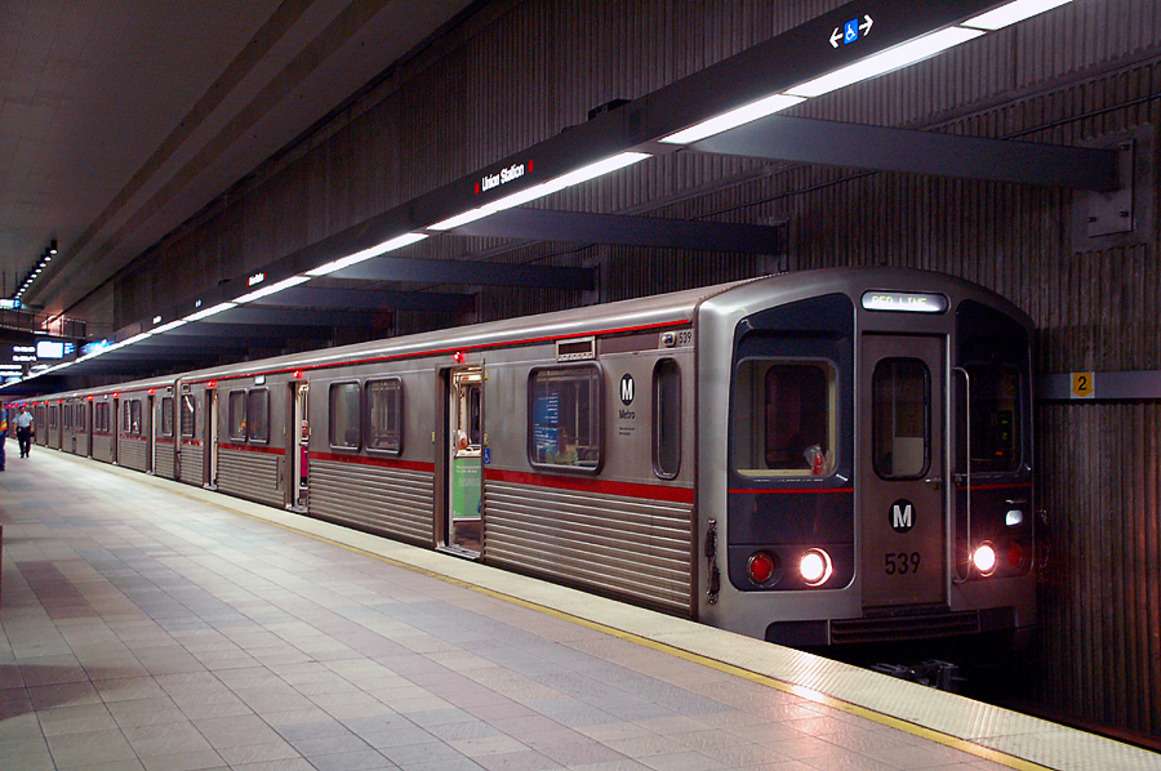
Last month, the Los Angeles Daily News reported that LA Metro, the L.A. area’s mass transit authority, essentially stopped trying to enforce fare collection years ago. The result, unsurprisingly, is mass fare evasion, with almost half of passengers riding for free. That’s bad enough, but a separate report from the Independent Institute describes Los Angeles public transportation as costly to operate and dangerous to use. That led the group to award the system a booby prize for its failures.
You are reading The Rattler from J.D. Tuccille and Reason. Get more of J.D.’s commentary on government overreach and threats to everyday liberty.
On November 16, transit advocate Alex Davis, physician Nimesh Rajakumar, and commuter safety activist Erica Solis summarized their report, A Metro Worth Paying For, in the Los Angeles Daily News. They wrote that “roughly 46% of riders don’t pay, with some routes seeing an evasion rate above 60%. That’s 12 million unpaid boardings each month.”
The fare evasion problem began, they claim, in 2017 when LA Metro took over enforcement duties from the Los Angeles Sheriff’s Department. “Enforcement levels collapsed” even before fares were suspended for two years during the pandemic and never recovered. “Metro’s roughly 200 Transit Security Officers (TSOs) typically issue under ten citations for fare evasion per day system-wide” which obviously isn’t much of a deterrent, given that almost half of riders fail to pay fares. Security officers aren’t doing much else either, given that over the whole of last summer, they “issued only 19 combined citations and written warnings for Code of Conduct violations not related to fares.”
Davis, Rajakumar, and Solis note that “over 90% of those who commit crimes on the system enter without paying,” so there are add-on effects from lax fare enforcement. Unsurprisingly, LA Metro riders have serious concerns about safety and crime on the system. Last year, 84 percent of respondents to a LABarometer survey called riding LA Metro trains “unsafe.” In May 2025, the Boyle Heights Beat reported that for students in Los Angeles, commuting to and from school on public transit “means facing dark train stations, confronting crime, and sometimes carrying self-defense tools.” So, is LA Metro really worth paying for?
Baruch Feigenbaum of the Reason Foundation (which publishes Reason) addresses that question in an October Independent Institute report. After 32 years of LA Metro’s existence in its current form, observes Feigenbaum, “Los Angeles is served by a dangerous and costly public transportation system.”
He continues, “LA Metro performs poorly in even the most basic areas, including safety, cleanliness, and service quality….It is also financially reckless, allocating billions of dollars in countywide taxes to build unneeded rail lines and to mismanage its existing system.”
Among LA Metro’s problems, writes Feigenbaum, is that it’s committed itself to running rail-dependent, fixed-route services for a population that favors the freedom and flexibility of private automobiles. By 1990, 90 percent of American households owned cars. The L.A. public transportation system’s peak ridership year was 1985, when it carried 497 million passengers. That dropped to 370 million in 2019 (and declined further since). “If anything stands out as an LA Metro failure, it is that after developing one of the strongest rail systems in the nation, its ridership fell by nearly a quarter,” comments Feigenbaum.
The report also compares the costs of LA Metro’s projects to other public transit systems in the U.S. and abroad and finds that its efforts “have been plagued with cost overruns and delays.” These are especially pronounced with heavy-rail projects.
Much of LA Metro’s service is unreliable, with buses late 21.5 percent of the time. The rail systems avoid delays by spacing trains out so that they generally arrive on time, but infrequently. Importantly, LA Metro’s own customer surveys highlight “reliability, frequency, safety, cleanliness, and homelessness” as “top concerns among Metro riders.” The major improvements requested by riders are for trains and buses to arrive on time and frequently, to be clean and free of the homeless, and to be safe from crime.
“Unfortunately, the Metro system has not been able to offer riders a safe experience,” comments Feigenbaum. In 2024, “the system averaged three violent crimes a month from January to June.” He adds that “From 2023 to 2024, ‘Crimes Against Persons’ decreased, ‘Crimes Against Property’ increased, and ‘Crimes Against Society’ surged massively, nearly tripling year-over-year.” That last category includes such transgressions as trespassing or the possession of narcotics which aren’t necessarily personally dangerous but can drive regular riders from the system just as readily as the thefts and arson attacks counted as crimes against property or the assaults and murders tallied as crimes against persons.
Feigenbaum recommends reforms which might render Los Angeles transit more rideable and cost-effective. He suggests that LA Metro refocus its efforts to emphasize customer concerns. “Metro’s service must be reliable, clean, and safe or customers will look elsewhere.” He also urges that LA Metro board members be chosen based on transportation backgrounds rather than political connections.
More substantively, the report calls for decreasing and then eliminating government subsidies to LA Metro so that its existence depends on satisfying customers. Relying on revenue from ridership would, of course, require enforcing fare collection.
To improve the viability of existing rail lines, Feigenbaum suggests lifting restrictions on housing density. That would also help to lower housing costs in a famously expensive state while increasing potential ridership. But going forward, buses should be emphasized over rail since bus lines are relatively cheap to establish and easier to reroute to meet the needs of riders instead of planners.
The report celebrates most serious reform that comes to mind—privatization—as applied to cities including Hong Kong and Singapore. But Feigenbaum believes population density is just too low in Los Angeles to make it a viable candidate for full privatization (and probably, though he doesn’t explicitly say so, for really running the system in the black). “Competitive tendering, in which private vendors bid for a contract to operate transit services, is an alternative that could be used more extensively in Los Angeles.”
Until reforms are adopted, LA Metro and its expensive, dangerous, and increasingly unattractive public transit system fully deserve the California Golden Fleece Award it’s been given by the Independent Institute for skinning the taxpayers, proving wasteful, and violating the public trust.
So, is LA Metro worth paying for? At the moment, lots of riders obviously don’t think so. Making the system worthwhile will require a lot of changes.