
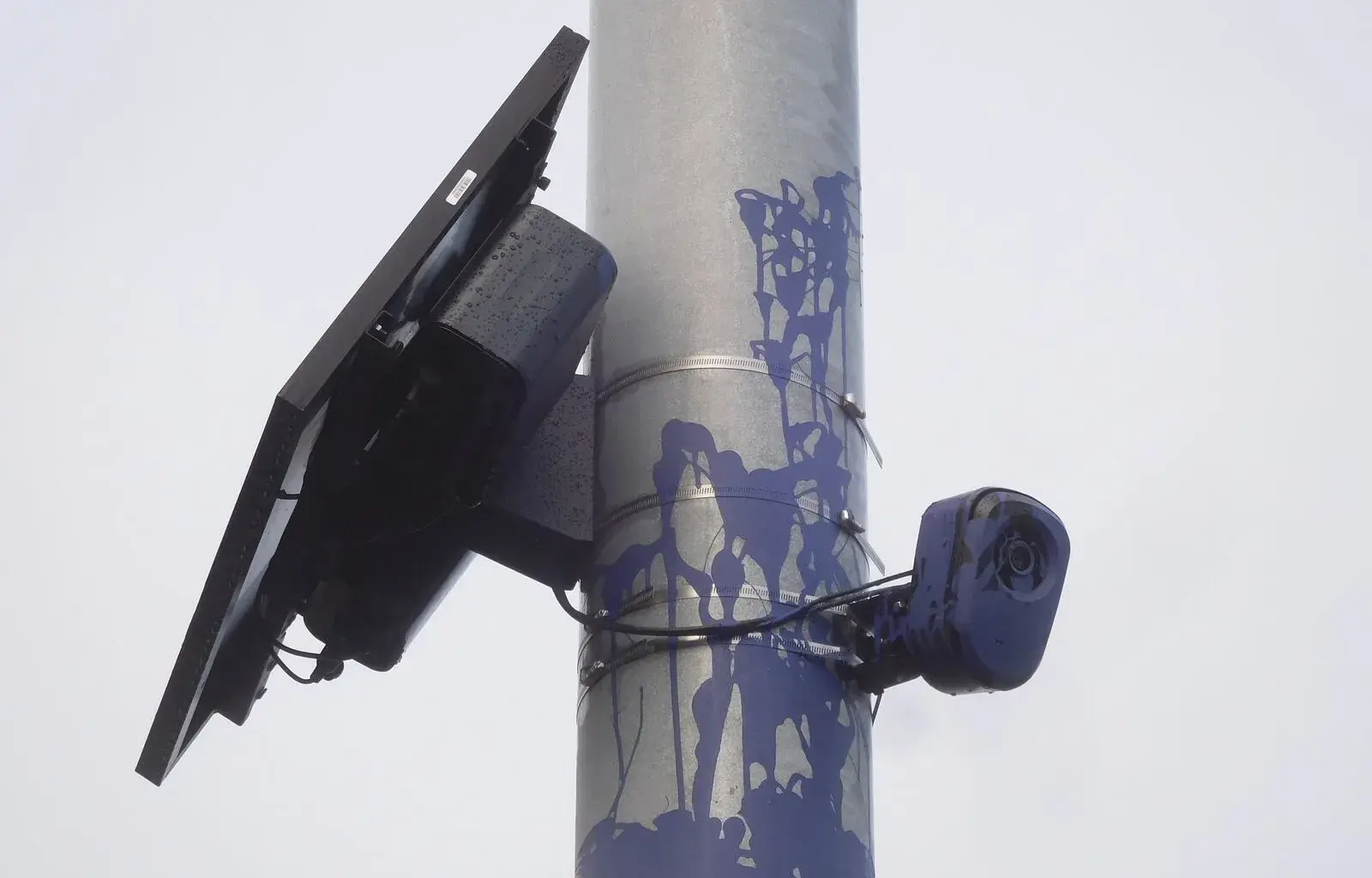
A controversial surveillance camera proposal has returned from the dead.
The Oakland Police Department is again proposing a new $2.25 million, two-year contract with Flock Safety. The Georgia-based company already owns and operates almost 300 license plate reader cameras throughout Oakland. OPD uses data collected from these scans to investigate crimes. Some private neighborhood groups have installed their own Flock cameras, too.
In November, the Oakland City Council’s Public Safety Committee declined to move the contract proposal forward. But the police department brought it back to the council’s Rules and Legislation Committee, which handles scheduling, on Thursday, saying Oakland’s current contract with Flock has expired, so time is of the essence.
City spokesperson Jean Walsh told us Oakland uses Flock cameras through an agreement with the California Highway Patrol. The expectation, she said, was that Oakland would begin its own direct contract with the company in April of this year. We’ve asked for clarification on who’s been paying for the Oakland cameras since then.
After hearing OPD’s recommendation, the Rules committee agreed to place the contract on the agenda for Tuesday’s full City Council meeting, skipping over the Public Safety Committee this time.
The Rules committee includes councilmembers Kevin Jenkins, Rowena Brown, Carroll Fife, and Janani Ramachandran.
Fife voted against the Flock item. “I’m in full support of the community’s desire…to have cameras as a support system for our community safety efforts,” she said. But she said Flock is not the company Oakland should go into business with.
“This vendor has shown time and again that they’ll just thwart the rule of law,” she said.
In Richmond, the new police chief just shut down that city’s Flock-operated license plate readers after the department discovered that a feature allowing national searches of its system was active, despite what the Richmond Police Department had understood from Flock.
Councilmember Ken Houston, a supporter of Flock, came to the chamber Thursday to urge his colleagues to approve the item. “Let’s find out how the full council feels about public safety,” he said. “We need that vote.”
Staff members from the offices of council members Charlene Wang and Zac Unger also urged that the item be placed on next week’s council agenda. (The start time of that council meeting has been moved up to 1 p.m. from its usual 3:30 p.m.)
Several public speakers accused the council and OPD of trying to “sneak” the contract through after it failed in November. “Where’s the transparency?” said one speaker. “It got voted down; go back to the drawing board.”
When the Flock contract came to Oakland’s Public Safety Committee in November, it received a split vote.
Councilmembers Ken Houston and Charlene Wang — who tried unsuccessfully to propose an amendment that would have brought steep fines for Flock if the company shared Oakland data without permission — voted in favor of forwarding it to the full council. Councilmembers Rowena Brown and Carroll Fife voted against it, killing the item.
Flock cameras are widespread but face criticism from privacy advocates
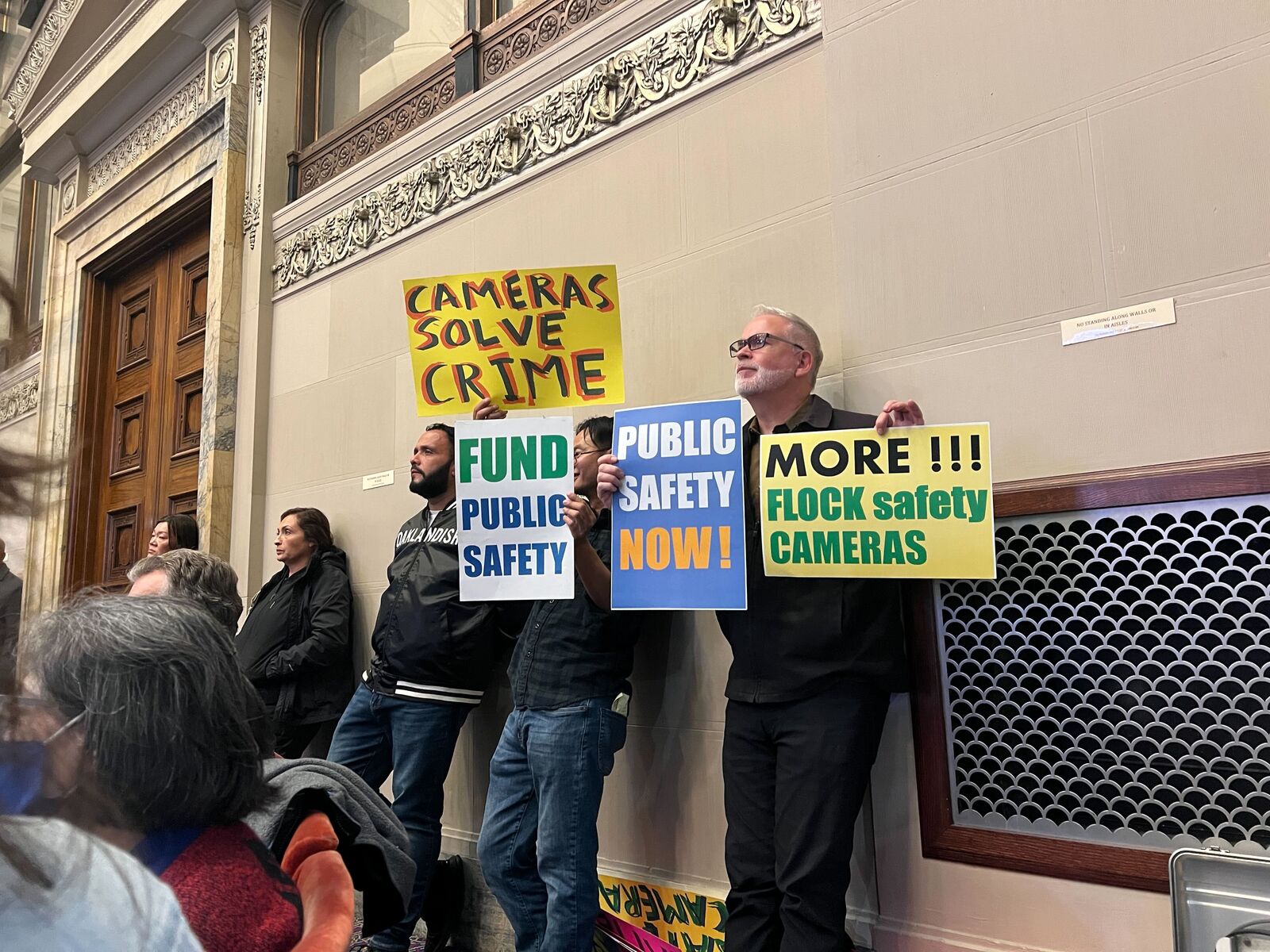 Flock Safety supporters at a November council committee meeting. Credit: Roselyn Romero / The Oaklandside
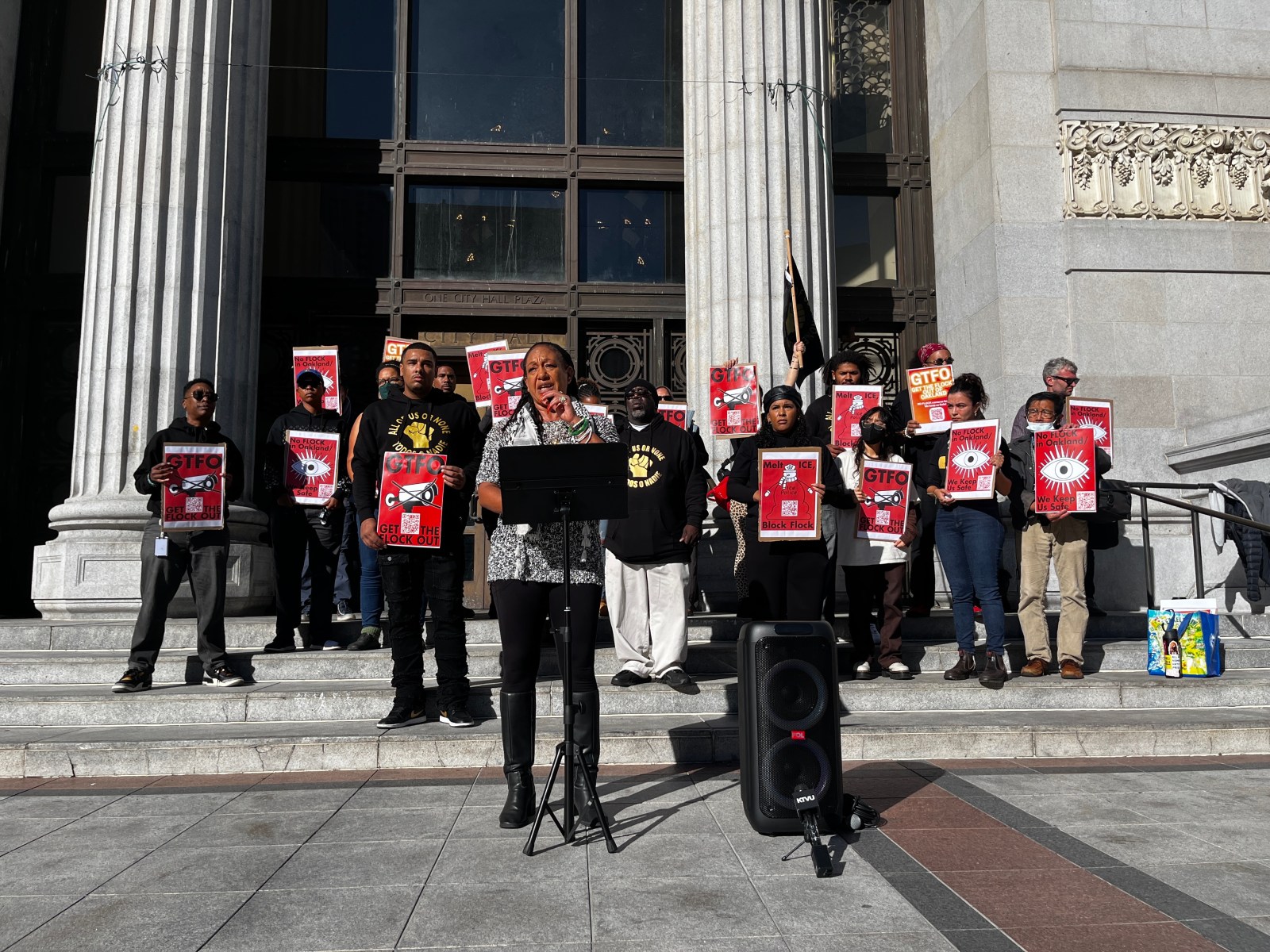 Cat Brooks of the Anti-Police Terror Project speaks at a rally opposing Flock in November. Credit: Eli Wolfe / The Oaklandside
In 2023, the City Council approved a surveillance policy enabling the use of license plate readers like Flock cameras, and the next year approved agreements with Flock and the California Highway Patrol.
Flock has its passionate defenders — a majority of Oakland voters, according to one poll — who say the cameras and data they collect are critical tools for solving crimes like car theft and warding off bad behavior.
They attribute recent declines in certain types of crime in Oakland to the hundreds of cameras affixed to poles in the city, though the link between Flock cameras and crime rates is generally inconclusive.
“Oakland cannot allow critical public safety tools to lapse because a committee got stuck,” said resident Rajni Mandal, speaking in support of the Flock contract at Thursday’s meeting.
Privacy and immigration advocates, including dozens who spoke at the raucous Public Safety Committee meeting in November, have raised concerns about the cameras tracking drivers’ daily movements and amassing data that could fall into the wrong hands.
This year, concerns have heightened with reports of Flock data being used by the federal government and other states to arrest immigrants and people who’ve had abortions.
Oakland is a sanctuary city, so OPD is barred from sharing Flock data with ICE. The department has repeatedly assured elected officials and the public that it doesn’t. And a state law prohibits the sharing of license plate reader data with the federal government.
The San Francisco Standard reported in July, however, that San Francisco’s police department has violated that law multiple times, including by sharing data pulled from Oakland cameras with federal law enforcement.
OPD has a policy outlining steps to follow when an outside agency seeks access to Oakland license plate data. But in a recent lawsuit filed against OPD, privacy advocate Brian Hofer claims the department has violated its own rules, alleging there are records of millions of external searches of Oakland’s system.
“*” indicates required fields