
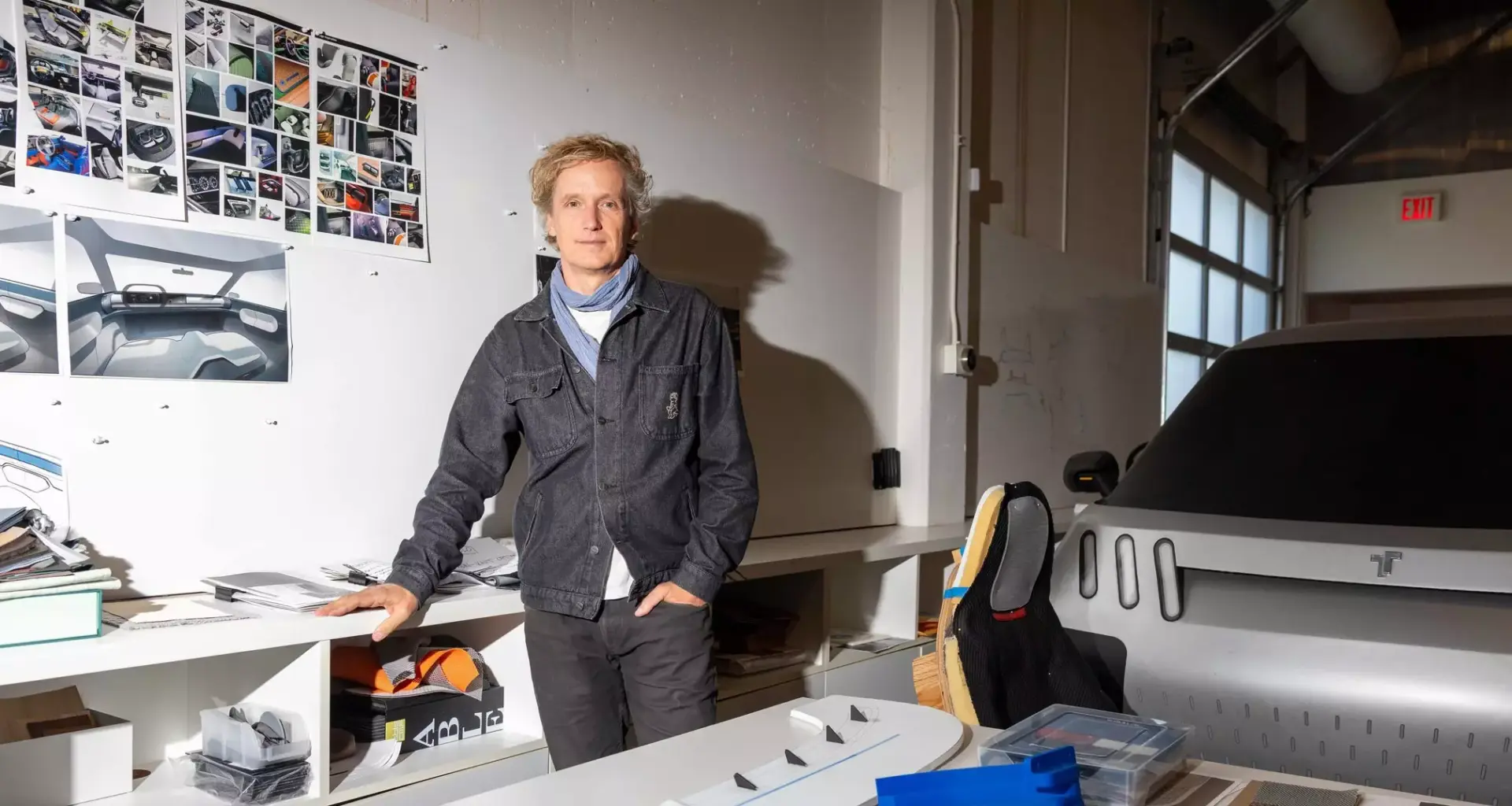
Yves Béhar has spent his career shrinking problems down to size — making laptops lighter, office chairs more ergonomic, and technology more user-friendly. (Just ask customers of Jimmyjane, whose waterproof dildo (opens in new tab) was designed by Béhar.) Now the Swiss-born industrial designer is tackling America’s largest excess of all: the colossal truck.
His latest creation is a petite electric truck called Telo. It presents a bizarre optical illusion. At just 12.5 feet, it is the same length as the standard two-door Mini Cooper but has a truck bed bigger than a Rivian R1T. The five-seat interior has more space than a Toyota Tacoma cab, and Telo has a more efficient battery and lower price than most electric trucks on the market. The only thing it’s missing is a front: If Telo were a dog, it’d be a snub-nosed pug.
 With the Telo truck, Béhar and his team are hoping to attract buyers who are looking for a more city-friendly electric vehicle.
“From a design standpoint, you really need to create iconography,” Béhar said. “My inspiration is always what people need — the idiosyncrasies of modern life.”
With financing from local tech titans Marc Benioff of Salesforce and Tesla cofounder Marc Tarpenning, Telo positions its debut truck as a small yet mighty alternative to electric pickups from Rivian, Tesla, and Ford.
“When you see the car, you can’t help but react in some way,” Tarpenning wrote in a blog post last year, comparing Telo’s rise to that of Tesla, though with far less time, money, and manpower.
But with the EV market colder than an expired lithium battery, Béhar and his team face a precarious time in the industry. We visited Béhar’s design studio to see why he thinks he can make Americans fall in love with small, idiosyncratic electric trucks at a time when they seem to want everything bigger.
 A mockup for Telo’s steering wheel. | Source: Amanda Andrade-Rhoades/The Standard
 A model of the Telo truck inside Fuseprojects, Yves Béhar’s design studio. | Source: Amanda Andrade-Rhoades/The Standard‘I want the truck now’
Three engineers were on their hands and knees, combing over the epoxy floor of Fuseprojects, Béhar’s design firm in the Potrero Flats, searching for a screw that belonged to a motherboard they were tinkering with moments earlier. Dressed in sweatpants and with hay-colored, unkempt hair, Béhar strode beside them to shake my hand.
Charming and a bit of a dude, Béhar grew up in Lausserne, Switzerland in a multicultural home with a German mother and a Turkish Jewish father. Though they visited museums and archeological sites across Europe, where Behar was exposed to different cultures, design was not something he learned about at home. Rather, his design sensibilities were shaped largely by two industrial-era movements: the American modernists Charles and Ray Eames and the Italian modernists the future-forward experimentalists like the Italian visionaries such as Joe Colombo and Achille Castiglioni, celebrated for their future-oriented experiments with how people live and interact., and the American modernists Charles and Ray Eames.
After moving to California in the late 1980s and graduating from ArtCenter College of Design in Pasadena, Béhar went on to create products and companies that helped shape the look and feel of contemporary technology — often with a built-in ethos of sustainability. He would go on to implement his passion for the Eames’ in his Herman Miller Sayl chair, now a fixture of modern workplaces., His and OLPC XO laptop, a Y2K-era device designed to make computers—and thus education — more accessible to low-income students, incorporated mapping the Italians’ idea that objects could be instruments for new ways of living. (The laptop is one of several Béhar-designed pieces in SFMOMA’s permanent collection.)
“I believe in humanistic technologies,” he said. “It’s important for us to show not just where tech can go but should go, because I’m a little puzzled by what some of these tech companies are doing.”
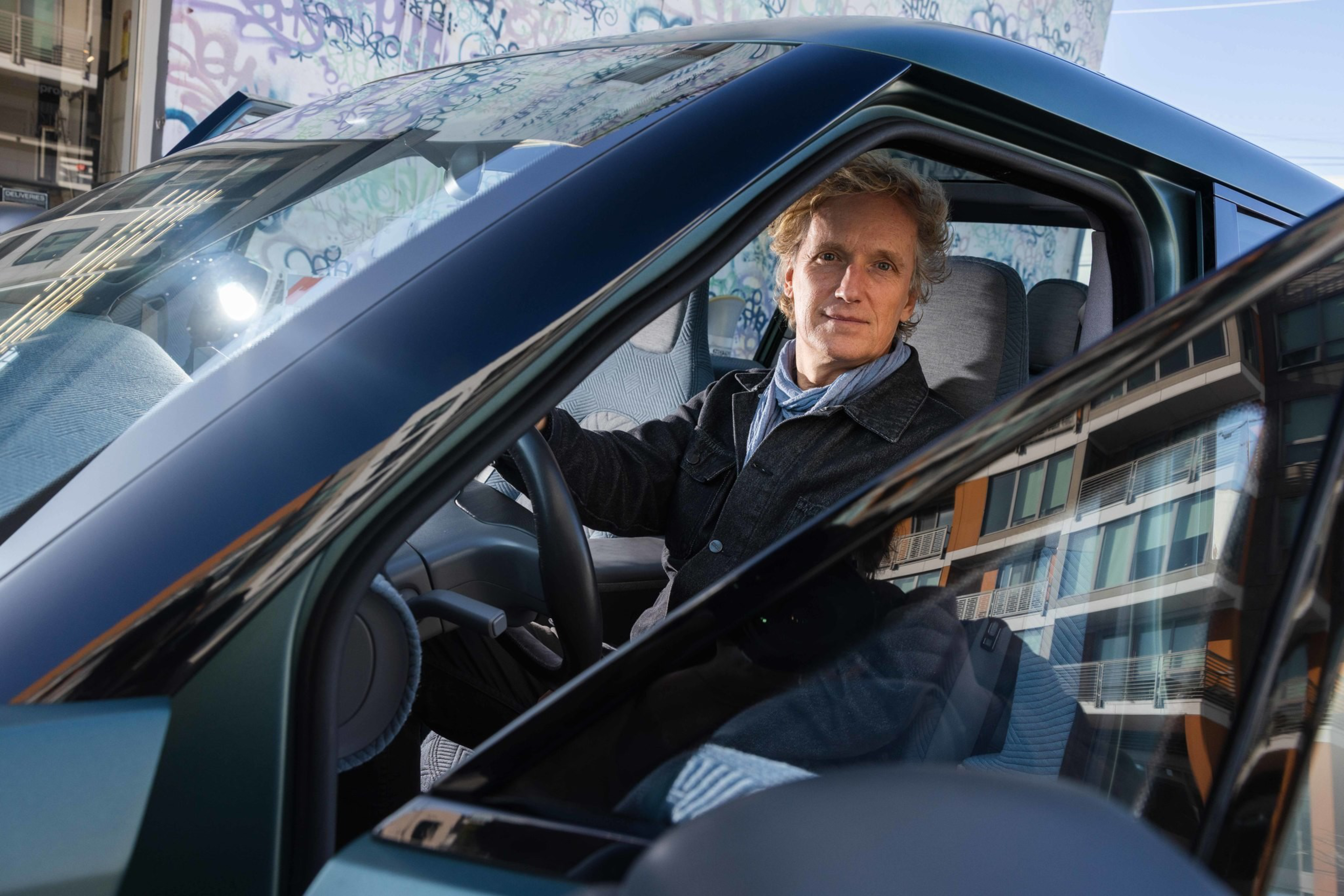 Béhar and Telo’s chief technology officer first worked together on an electric motorcycle. | Source: Amanda Andrade-Rhoades/The Standard
Behar lives in Cow Hollow with his wife, art dealer Sabrina Buell, daughter of Democratic Party mega-donors and San Francisco socialites Susie Thompkins Buell and Mark Buell. Behar and his wife also share a home in Bolinas, beside a large cliff overlooking the Pacific Ocean.
“We have never been fazed by the elements,” Buell told The Nob Hill Gazette in 2018 after she and Behar got married on the alkali floor of Burning Man’s playa.
Three engineers were on their hands and knees, combing over the epoxy floor of Fuseprojects, Béhar’s design firm in the flats of Potrero Hill, searching for a screw. Dressed in sweatpants and with hay-colored, unkempt hair, Béhar strode beside them to shake my hand.
Charming and a bit of a dude, Béhar grew up in Lausanne, Switzerland, with his German mother and Turkish Jewish father. Though the family visited museums and archeological sites across Europe, Béhar didn’t learn about design at home, he said. Rather, his sensibilities were shaped by two industrial-era movements: those of the American modernists Charles and Ray Eames and the Italian modernists Joe Colombo and Achille Castiglioni, celebrated for their future-oriented experiments with how people live among everyday objects.
After moving to California in the late 1980s, Béhar created products and companies that helped shape the look and feel of contemporary technology. He went on to implement his passion for the Eameses in his Herman Miller Sayl chair, now a fixture of modern workplaces. His OLPC XO laptop, a Y2K-era device designed to make computers more accessible to low-income students, incorporated the Italians’ idea that objects could be instruments for new ways of living. (The laptop is one of several Béhar-designed pieces in SFMOMA’s permanent collection.)
“I believe in humanistic technologies,” he said. “It’s important for us to show not just where tech can go but should go, because I’m a little puzzled by what some of these tech companies are doing.”
Béhar lives in Cow Hollow with his wife, the art dealer Sabrina Buell, daughter of Democratic Party megadonors and San Francisco socialites Susie Tompkins Buell and Mark Buell. Béhar and his wife also have a home in Bolinas, beside a cliff overlooking the Pacific.
“We have never been fazed by the elements,” Buell told the Nob Hill Gazette in 2018 after she and Béhar got married on Burning Man’s alkaline playa.
At Fuseprojects, products and design awards are plopped around the foyer. Among these is a cardboard model of the Mission motorcycle, an electric two-wheeler that Béhar and Forrest North, Telo’s chief technology officer, worked on in 2008. It set the land-speed record for electric two-wheelers at the time, reaching 150 mph, but the company folded after years of financial strain, infighting, and the loss of key engineers to Apple (opens in new tab).
In 2022, Béhar and North got together again, this time with Jason Marks, now CEO of Telo, around the idea of making another electric vehicle. They figured they’d try another motorcycle, North said.
“We kept showing the slide to people that showed the motorcycle, a small car, then a small truck, with the whole idea of mobility for the city,” North said. “Every time they would say, ‘Oh, I want the truck now.’”
The group listened, founding Telo in 2022 with the goal of delivering a tiny, electric truck.
A difficult time to come to market
When Telo was founded, the EV market was flying high. While gas-powered car sales plummeted during the pandemic, EV sales skyrocketed at a rapid clip, thanks in large part to the momentous success of Tesla, government incentive programs, and an expansion of charging infrastructure.
In 2021, President Joe Biden clambered into a hulking Ford F-150 Lightning in Dearborn, Michigan. “Anyone want to jump in the back or on the roof?” Biden asked reporters. “These suckers are something else!”
That year, global sales for EVs hit a high point, surging more than 160% from 2020 to roughly 6.5 million vehicles — leading Ford, General Motors, and others to announce that they would phase out gas-powered cars in the coming decades.
But that was then. In the years since, the market has cooled. The cost of EVs continues to rise. President Donald Trump nixed federal credits that offered up to $7,500 in tax breaks for EV buyers. And the AI boom has vacuumed nearly all available funds for startups, making it a difficult time to raise money for hardware.


Ford is reportedly considering halting production (opens in new tab) of the F-150 Lightning, its flagship EV, which Biden so enjoyed.
Still, plenty of people want EVs. “At the end of the day, it’s an affordability issue, not a demand issue,” said Stephanie Valdez, director of industry insights at Cox Automotive. “There’s a market [for Telo], but there’s a lot of headwinds.”
Telo isn’t the only tiny electric truck on the horizon. Slate Auto, which has backing from Amazon CEO Jeff Bezos, made waves this year when it announced an electric truck with a $20,000 price tag. Telo’s truck is priced at $41,000, still well below the roughly $60,000 for EV cars and for conventional trucks. Its 350-mile range is exceptional for an electric pickup, and its positioning as a city-friendly vehicle could prove compelling for urban drivers.
Many high-profile San Franciscans are have shown interest. Last week, Béhar’s friend Mayor Daniel Lurie arrived at Fuseprojects to test-drive the Telo. Lurie climbed into the driver’s seat, his hulking security guard fitting in the back, while the designer hopped up front. The crew sped off up Potrero Hill.
Political stunts, it seems, might not be disappearing from the EV marketing playbook anytime soon.
 Design mockups of the Telo.
  The Telo truck parked outside Fuseprojects.Testing it out
While Béhar’s design team works out of Portrero, Telo is headquartered in a small building in the dusty end of San Carlos, a Peninsula town that has become a breeding ground for EV technology. Across the street is the flying car company Joby, and next door is a former Tesla office where North worked 20 years ago on the frontier of electric vehicles.
It was there that I got to take one of the tiny trucks for a test drive. The first thing I noticed was that despite being 6-foot-2, I had ample space. Telo handled with the responsiveness of the average EV and had a surprisingly sharp turning radius for a truck. When I pulled out of the parking lot, I pushed the pedal to the floor to test the 0-60 capability. Four seconds might not beat a Tesla, but it’s faster than most EVs and was enough to turn my stomach upside down.
As North and I zoomed through the cookie-cutter suburb of San Carlos, electric and gas-powered trucks towered over us. We paused next to a 20-foot-long, 8,500-pound green Rivian, and North scoffed that this was all the auto industry had to offer.
For people who want something smaller, “that’s where we come in,” North said.
Telo considers itself at the vanguard of the third generation of electric vehicles. The first wave was the hybrid era ushered in by the Toyota Priuses in the early 2000s; the second was dominated by Tesla and Rivian; the third, Béhar argues, begins with companies like Telo and Slate, where design is freed from the old constraints of industry-standard EVs.
“In many ways, the designs of the previous generations of EVs are more conventional, because they followed industry standards,” Béhar said. The new generation, he added, lets designers break them.
There is still plenty of engineering work ahead before Telo hits full production. In September, Telo secured a $20 million Series A investment — modest by industrial automotive standards, but notable in a slowing EV market. Thirteen thousand pre-orders suggest at least a sliver of pent-up demand for a truck that doesn’t require its own ZIP Code.
Earlier this year, as Mini Cooper unveiled its latest two-door model, something unexpected happened: The Mini got bigger.
Béhar, back at Fuseprojects, considered that development. In a moment that could read as quiet pride in his tiny outlier of a truck, he raised his eyebrows and let a slow grin spread across his face.
“They actually made it bigger,” he said. “The new Mini — it’s 1 inch longer than us.”