
At San Francisco’s Cartoon Art Museum, the funny papers are a serious business.
Situated a block from Ghirardelli Square, it is one of the few museums in the western United States dedicated to the preservation and exhibition of cartoon art. Step inside, and you’ll find dazzling original artwork that includes Prince Valiant comic strips, Disney animated films, and cartoons by gifted emerging artists.
It’s one of a trio of niche museums that have been surviving for decades in this town of booms and busts. Despite recent challenges such as the COVID-19 pandemic and drastically reduced federal arts funding, the Cartoon Art Museum, the Cable Car Museum and the Musee Mecanique are finding ways to thrive.
“We’ve always run a very lean operation,” said Andrew Farago, the Cartoon Art Museum’s curator and employee since 2001. “We work within our budget. It’s that and adaptability.”
It began in the 1980s as a “museum without walls,” with a group of cartoon art enthusiasts setting up shows in local museums and other spaces. In 1987, a donation from “Peanuts” creator Charles M. Schulz helped establish its first permanent site. It has been in its present location since 2015.
The Cartoon Art Museum today features multiple galleries dedicated to cartooning, a research library, gift shop, screenings, workshops, artist’s receptions and archives holding over 9,000 original pieces.

Cartoons are displayed at the Cartoon Art Museum on Friday, Dec. 12, 2025.
Craig Lee/The Examiner
Financially, the museum is backed by “a combination of grants for the arts, NEA grants, fundraisers and individual donors. We’re a 501(c)(3) nonprofit,” Farago said. “Jean Schulz, the widow of Charles M. Schulz, has been an incredible supporter of ours and the arts through her foundation.”
Museum admissions also bring in funds, and tourists have been a big part of the museum’s survival, Farago said. He noted that at the museum, however, “in the last year, tourism is down 20% to 50%,” pointing to the newly unfriendly environment for international travelers in the U.S.
It all adds up to a tough landscape for a small museum with a specific focus.
“Everybody is running leaner compared to five or two years ago,” Farago said. “Grants are getting scarcer and more competitive.”
Still, the Cartoon Art Museum refuses to raise ticket prices.
“We want to be accessible to all and have participated in SF’s Museums For All program,” he said.
The program offers free or discounted admission to San Francisco residents with EBT, SNAP or Medi-Cal cards, Farago said.
“I’m proud of that,” he said.
The winding machine that powers the underground cables which pulls the cable cars in the streets is seen at the Cable Car Museum in San Francisco on Thursday, Dec. 11, 2025.
Craig Lee/The Examiner
Across town, at the Cable Car Museum, Mike Phipps agrees these are challenging times. A constant problem is that “everything is so expensive in SF” and he believes the effects of the pandemic are still being felt. “It kind of changed things,” he said.
Phipps is a board member of the Friends of the Cable Car Museum, a 501(c)(3) nonprofit which has managed the museum since 1993. “We see it as preserving history,” he said.
The stellar museum — an ode to The City’s most iconic form of public transportation — was founded in 1974 by the Pacific Coast Chapter of the Railway and Locomotive Historical Society. It occupies a corner of the powerhouse and car barn at Washington and Mason streets in Nob Hill, which is where all the cable cars are housed at night. It’s is also where all the cables for the lines are powered, and visitors can view the electric motors and gigantic wheels that drive the cables.
It’s a unique museum that features a collection of historic cable cars, photographs and mechanical displays. Its narratives include a profile of cable car inventor Andrew Hallidie and in-depth descriptions of the technology that powers the cars. (The brilliance of the system is that, with no engines, the cars are relatively lightweight; they simply grab onto the cables that pull them up and down The City’s hills at a steady speed of 9.5 mph.)
Also deeply explored is the episode that almost led to the cable cars’ demise. When The City in 1947 decided to replace the cable cars in favor of modern transportation, Friedel Klussmann, a private citizen, led a public campaign that ultimately saved the cars and lines we ride today.
The museum gift shop, which offers books, souvenirs — and, notably, genuine pieces of track, cable and bells — is a major source of income.
This week’s highlights include pop-up marketplaces, concerts, tree-lighting ceremonies and block parties
Terrasol, which first opened in 2004 and moved to Noe Valley last year, keeps familiar and fresh customers stocked with seasonal knickknacks
The state senator representing The City has authored strong measures that please development advocates but anger defenders of local control
“The gift shop is the only thing that keeps the museum going,” said Phipps. “That and donations from companies and individuals.”
An on-site donation box does well. Phipps said the museum has in the past received grants from businesses such as California Bank, but not recently. Admission is free, which is unusual in San Francisco.
Phipps said tourists are important, “but we do get locals,” pointing out that a lot of San Franciscans like to ride cable cars. He said that while museum attendance can be inconsistent, there are more organized groups coming in than before and someone is always visiting the exhibits.
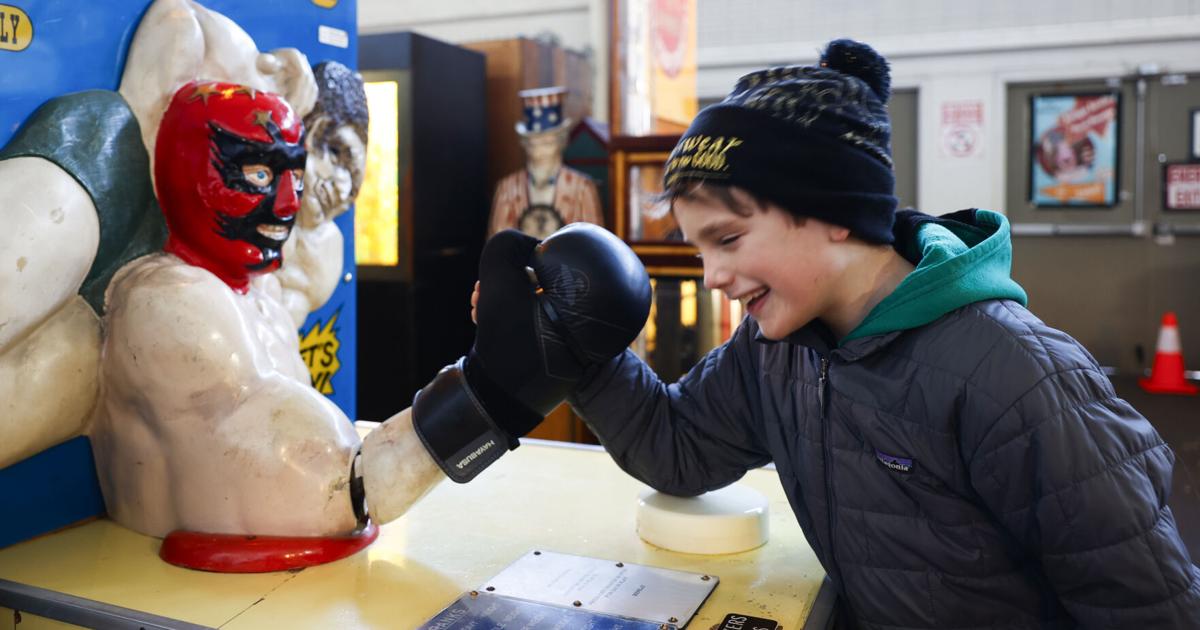
The Musee Mecanique at Fisherman’s Wharf is also supported both by tourists and locals alike.
It features close to 300 arcade games from different eras, with most costing one or two quarters to operate. You name it, the Musee has it: Player pianos, test-your-love machines, coin-operated fortune tellers, animated dioramas, air hockey, pinball machines, video games — and, of course, Laffing Sal, the 6-foot tall animatronic doll that is one of two that used to scare children at the old Playland at the Beach amusement park. She now greets visitors near the museum’s entrance with her hearty laughter.
“I wanted to show the evolution of the coin-operated industry from the late 1800s to the present,” said Dan Zelinksy, the owner of the Musee Mecanique. The oldest artifact is an 1884 Praxinoscope, the first motion-picture machine.
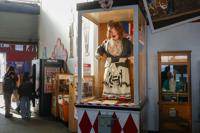
Laffing Sal at Musée Mécanique at Pier 45, Fisherman’s Wharf in San Francisco on Friday, Dec. 12, 2025.
Craig Lee/The Examiner
The Musee was housed for many years beneath the Cliff House, where Zelinksy’s father, Edward, installed his own collection, combined with machines acquired from nearby Playland. It moved to its current site in 2002.
“It’s possibly the nostalgic aspect of it,” Zelinksy said, when asked how the Musée has been able to survive all these years. People bring in family members to show machines they knew as a child.
“That happens a lot,” he said.
Zelinsky also credited the museum’s lack of admission charge and policy of remaining open seven days a week, 365 days a year.
“You don’t have to spend a penny to have a good time,” he said. “You can just watch.”
Business has not fully recovered from the pandemic, he said, but “it has been coming back lately.” While tourists certainly come through, it’s not just for out-of-towners.
“It’s a good local hangout,” he said.
The Musee’s sole source of income is money from the machines themselves. It is a for-profit business and, as such, is not eligible for a lot of outside funding.
“I’ve had to turn down grants,” Zelinsky said.
How does Zelinsky characterize the environment for museums nowadays?
“I know people are coming in here, and I’m able to pay my bills,” he said.
“The Port of SF has done quite a bit to help,” Zelinksy said, noting it has made improvements to the surrounding area.
“The ferris wheel is spectacular,” he said, and increases foot traffic.
San Francisco will probably always be a tourist destination, which should continue to support these successful specialized museums into the future. But some common themes emerge beyond tourism. They share a solid understanding of the economics of their organizations, dedicated and hard-working staffs, local support and a generosity of spirit: Admissions are either free or reduced.
Farago said he considers cartoons an accessible art form.
“And anything we can do to make it accessible to the general public is a good thing,” he said.