
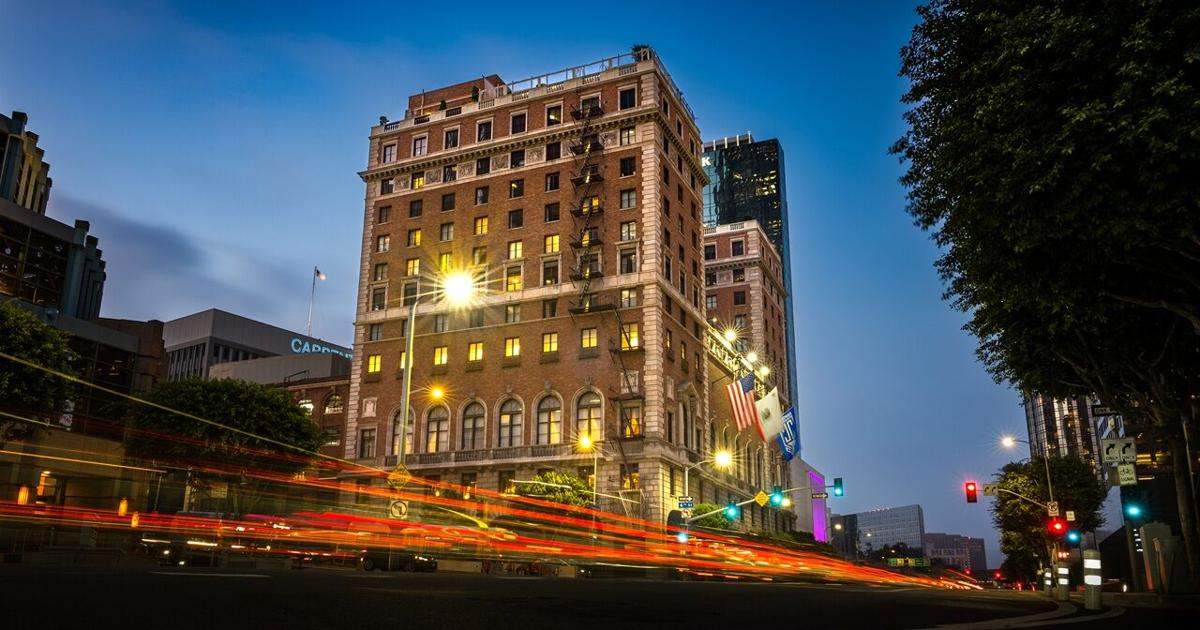
This December, Los Angeles’ historic Jonathan Club is celebrating the 100 year anniversary of its landmark Town Club building in the heart of Downtown Los Angeles.
This pioneering organization is one of the oldest social clubs in the region, one that has played an integral role in the evolution of Los Angeles for more than a century. When the Club began building its permanent home in 1925, Figueroa was little more than a corridor at the edge of a young metropolis. When completed, it was the tallest building in Downtown Los Angeles and today remains one of the most enduring icons in the heart of the city.
The renaissance-revival style building features hand-painted ceilings by a Vatican-trained painter, intricate wood carvings by early Hollywood set designers and a 5000-volume library untouched since the 1920s. With 100 years of Los Angeles history contained within its walls, it is a story of architectural beauty, civic leadership and a community that has helped shape the city’s collective story for generations.
Founded in 1895, Jonathan Club began as a modest social club in the heart of Los Angeles. From 1896 to 1905 the Club was located on Spring Street above a tailor and a sporting goods store, then going on to occupy the top two floors of the Pacific Electric Building (built by the Club’s then-President Henry Huntington), before breaking ground on its own dedicated headquarters in 1924.
The Italianate building was designed by Schultze & Weaver, distinguished hotel architects of the 1920s responsible for the Waldorf-Astoria in New York and the Biltmore in Los Angeles, who conceived an elegant headquarters for the Club down to the finest detail. They hired a leading Italian artisan, the Vatican-trained Giovanni Smeraldi, to hand-paint intricate designs on the ceilings of its major public rooms.
Smeraldi also painted Caltech’s Atheneum, the Blue Room at the White House and New York’s Grand Central Terminal. Ornate wood carvings found throughout the building were crafted by set designers working in the city’s growing film industry, lobby floors were laid with pink Tennessee marble — seamlessly restored in 1981 with marble from the same quarry as the original — and the entire fifth floor was dedicated to health and wellness facilities with everything from basketball courts to Turkish Baths and a dazzling tiled swimming pool.
Though in 1925 one of the most impressive features of the new headquarters was its private 450 vehicle automobile garage, a first of its kind at the time.
Built before TV and popular radio, games were originally at the heart of the building’s leisure spaces. Carved wooden gargoyles depicted playing cards, holding dice or simply watching on in amusement can still be found in the Club’s main restaurant, where they used to watch over members playing dominoes, billiards and other parlor games. The building houses a functioning library and reading room unaltered since the building first opened a century ago, and a barbershop that still uses chairs from the 1950s. By all official accounts in 1925, the Jonathan Town Club was a 12 story building, precisely capped at 150ft, the maximum height permitted by the city at the time. However, during the Prohibition era members recall the rooftop being far more than just a scenic outlook.
Legend has it the room, now known as the Sky Bar, could be sealed off at a moment’s notice. Schultze & Weaver were no strangers to intrigue, having designed the Biltmore just a year earlier that featured its own false walls, secret passages and hideouts.
The roster of past members ranges from celebrities to railroad tycoons to Supreme Court justices and beyond. Countless consequential moments in the city’s history took place in the Town Club building over the years from the first seeds of California’s avocado industry and the deal to bring the Dodgers from Brooklyn to LA to the founding of UCLA and the LA Philharmonic.
Ernest Batchelder, decorative artist and pioneer of the California Arts and Crafts movement was a member and in 2023, when renovating the Sun Room, the team uncovered original Batchelder tiles, handcrafted in Pasadena at the turn of the 20th century, hidden for decades under layers of drywall.
The building is also home to an extensive collection of plein air paintings of the California Impressionist School dating back to the 1860s including rare works by Guy Rose and Joseph Kleitsch, hundreds of historical photographs that are exhibited throughout the Club’s main restaurant and Peter O’Malley’s personal collection of Dodger memorabilia, photographs and books that are on display in the aptly named Dodger Room.
Sensitive restorations have taken place throughout the years to steward the landmark into the next century as well as servicing the changing needs of new generations of members. In 1925 the Town Club was the first social club in the west to incorporate all the elements of an athletic club into its home, providing wellness offerings to members since long before it was buzzworthy. Today those facilities have evolved to include a pilates studio, personal trainers, nutritionists, the only doubles squash court in the city and a cutting-edge Med Spa offering LED light therapy, cryotherapy and a hyperbaric chamber. In 2010, the rooftop running track was replaced with a 2800-sq-ft urban garden that produces more than 30 varieties of fruit and vegetables, all of which are used at the diverse Jonathan Club dining concepts.
This one-of-a-kind resource in the dense urban center, is also used as a teaching garden for up and coming culinary students. The 12th floor Sun Room underwent a redesign in 2023 helmed by Studio Savant, and a renovation of the building’s third floor will be unveiled this Fall in time to celebrate the building’s milestone birthday.
Los Angeles has gone through many transformations over the past 100 years, and through all the booms, busts and metamorphoses, the Town Club building has endured. It demonstrates the organization’s commitment to preserving the building’s storied history and cultural relevance whilst also adapting to meet the needs of the next generation of Angelenos.
As the city moves through another moment of change that will shape its collective future, from wildfire recovery to Olympic preparations, the story of the Town Club building and its community of members is one of creativity, leadership, preservation and evolution.