
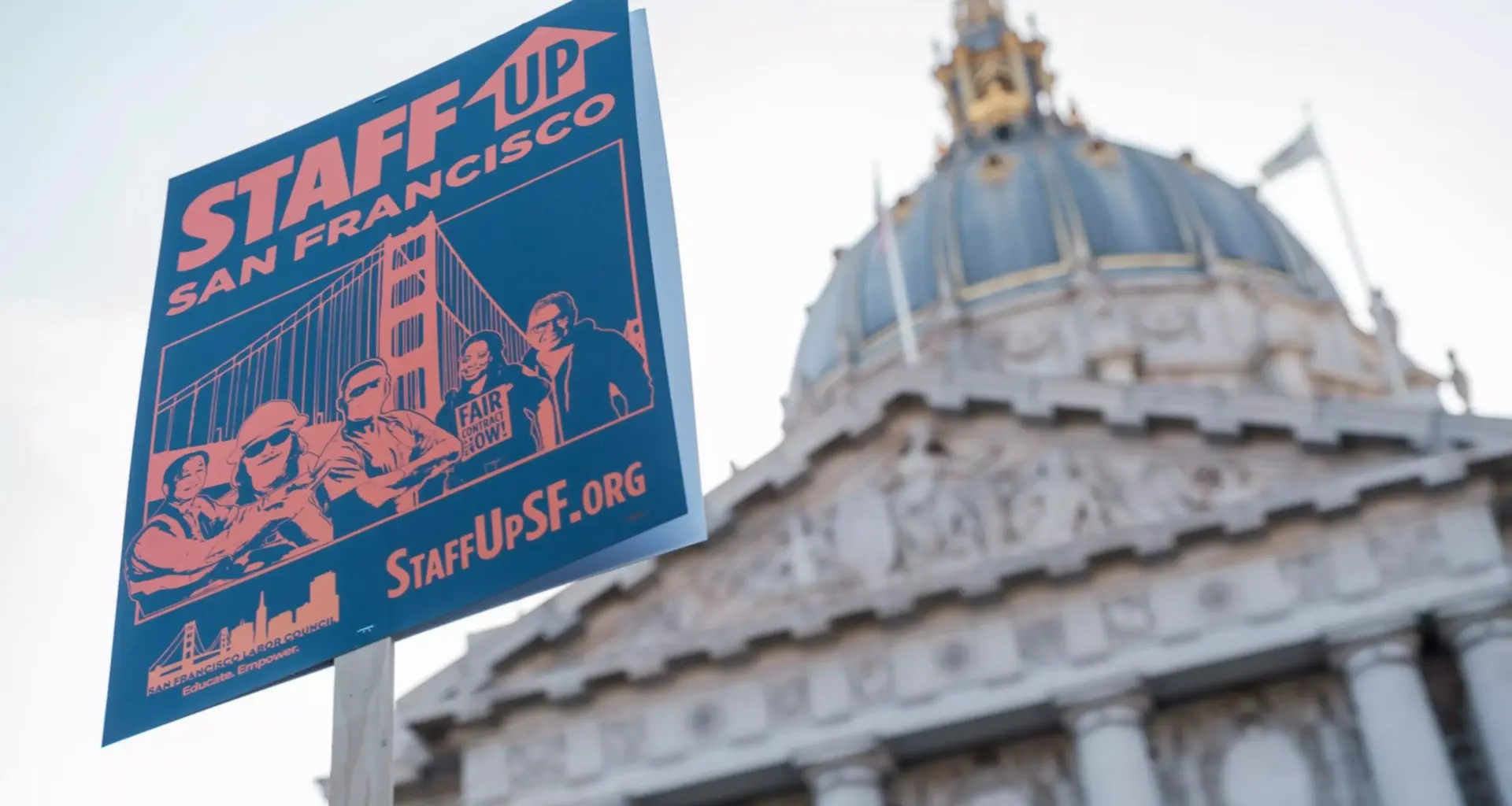
On the last day of October, organized labor launched a surprise attack on San Francisco’s business community by offering a voter measure for next year’s ballot that would raise taxes on big corporations. The move violated a compromise that last year was painstakingly negotiated between labor and business, then approved by voters.
This week, in a tit-for-tat escalation of the drama, the city’s commercial interests are punching back. As early as Tuesday, a coalition of business groups, led by the San Francisco Chamber of Commerce, plans to submit a competing ballot initiative for June, one that also reneges on last year’s Proposition M business-tax agreement. It will ask voters to cancel planned across-the-board tax increases while lowering taxes and fees on small and medium-size businesses.
The business-labor spat comes at a perilous time. The city announced Friday that its two-year budget deficit has increased to $936 million, despite $277 million in increased tax revenues attributed to a fledgling economic recovery. Mayor Daniel Lurie instructed city agencies to slice $400 million in spending next year.
Both sides in this sordid process are engaged in gamesmanship. Unions are counterproductively deploying a soak-the-rich strategy to add money to government coffers so city employees can keep their jobs. Business lobbyists are joining labor leaders in the gutter by going back on agreed-upon tax hikes.
All in all, it’s a horrible way to conduct tax policy. The best outcome would be for labor and business to stand down and remove their dueling ballot measures. If that doesn’t happen, the second-best result would be for business to prevail in stopping a foolishly populist effort by organized labor.
“It is not our intention to blow a hole in the city budget,” Rodney Fong, the chamber’s CEO, told me in an interview Friday, suggesting that the business groups would be pleased to see both initiatives go away. (Another plausible scenario Fong envisions is the passage of both measures, with the tax-cutting business proposition effectively canceling out the tax-raising labor initiative.)
The business coalition will need to gather signatures to place its measure on the ballot, just as labor is doing. On its own, the business measure is breathtaking in its scope, rolling back nearly every deal point in the Prop. M compromise and costing the city as much as $300 million in lost tax revenue. By contrast, labor has said its measure could add $200 million in annual revenues. Each effort will cost around $500,000 — just imagine how that million bucks could be better spent.
The business measure would cancel a planned 4% tax increase on businesses scheduled for 2027 and another 3% increase in 2028. It would reduce by 10% taxes on businesses that have annual sales between $10 million and $50 million — a group that took the brunt of increases in the Prop. M compromise. It would redefine the top level of annual sales below which companies would pay no business sales tax, from $5 million to $10 million. It would slash the business registration fee to $25 for all companies with fewer than $50 million in sales. (This is no small change. Registration fees (opens in new tab)for these companies top out at $15,000 and are scheduled to jump to a high of $20,000.) And to complicate matters further, business also plans to offer a separate “spoiler” measure that would kill’s labor’s initiative, a common tactic in San Francisco’s FUBAR-ed ballot process.
If the business coalition’s move seems audacious, and it is, it comes in response to an equally brazen move by labor. Fong likened labor’s tax-increase measure to pulling an apple pie out of the oven too soon. “It may start to smell really good, and it may start to look good and browning on top,” he said, likening that golden pie to the city’s nascent economic recovery, “but that apple is still raw in the center.”
The measure focuses on a particularly punitive levy called the Overpaid Executive Tax, popularly known as the CEO Tax. It came into being after a 2020 ballot measure by then-supervisor Matt Haney, now a member of the state assembly. It taxes companies that pay their CEO a certain multiple more than their average San Francisco employee. It does not, contrary to popular belief, tax CEOs directly, and so it is in no way a tax on plutocrats — despite what labor leaders might tell you. Prop. M cut the CEO tax by 80%; labor’s measure would double it from its previous level.
Labor got sneakier still with its new measure. Rather than tabulating the tax based on the average salary of employees in San Francisco, where workers make relatively higher wages, it calculates the tax based on a company’s average pay for employees around the world. This sets an even lower bar for punitively taxing companies and runs the risk of ensnaring firms that have business activities, but no employees, in San Francisco.
These sorts of shenanigans put into perspective the business community’s willingness to up the ante with its cancellation of taxes. It’s a version of they-started-it playground taunts — though the facts actually favor business in this case.
Labor, unsurprisingly, denies starting anything at all. “We were lied to by the corporations and public officials over Prop. M,” Kim Tavaglione, executive director of the San Francisco Labor Council, told me recently.
She was referring to the tax-refund lawsuits being litigated against the city by Airbnb, General Motors, and other corporations, which labor has used as a pretense to accuse the companies of not “paying their fair share.” But the Prop. M deal was intended to prevent those kinds of suits in the future, not to adjudicate them retroactively. (The San Francisco Chronicle editorial board (opens in new tab)explained it nicely here (opens in new tab).)
So where is the mayor in all of this? So far, he has remained on the sidelines, even though his administration obviously wouldn’t support labor’s proposal. I am told his team has concluded that the labor measure is not worth fighting, in part because it is polling well with voters. A poll commissioned by the Chamber of Commerce, conducted in late November, showed 59% support for the labor ballot initiative.
That’s a weak argument for a mayor with 73% approval ratings. But it is consistent for Lurie. He tends to take sides publicly only in policy battles he initiates, his recent rezoning plan being a prime example.
Then again, it’s altogether possible Lurie hopes to facilitate a truce along the lines that the business community is openly seeking. In a statement, his office signaled a desire for labor-business peace. “The mayor is focused on what best serves San Franciscans and strengthens our city’s future, and that means business and labor must come together, as they have before,” it said, referring to the success of the Prop M compromise.
Either camp could abandon its project before Feb. 2, the deadline for submitting initiatives for the June ballot.
The ballot battle, whatever course it takes, serves as a reminder of a befuddling contradiction in the San Francisco electorate. In most citywide elections, a majority of voters lean centrist and pragmatic. They elect moderate mayors. They recall school board members and district attorneys who stray from commonsense policies. They express broad support for plans that ensure San Francisco is “open for business.”
Yet those same voters sometimes fall for the malarkey of special-interest groups like labor unions, especially when it comes to taxing fat cats. Never mind that those measures don’t even tax the fat cats themselves — just the companies that employ tens of thousands of fellow San Franciscans.
As a year of change draws to a close, the city faces a new year of political tumult. Either the economic recovery will continue as the government gets spending under control, or the city will revert to the counterproductive policies that have served it poorly for years.