
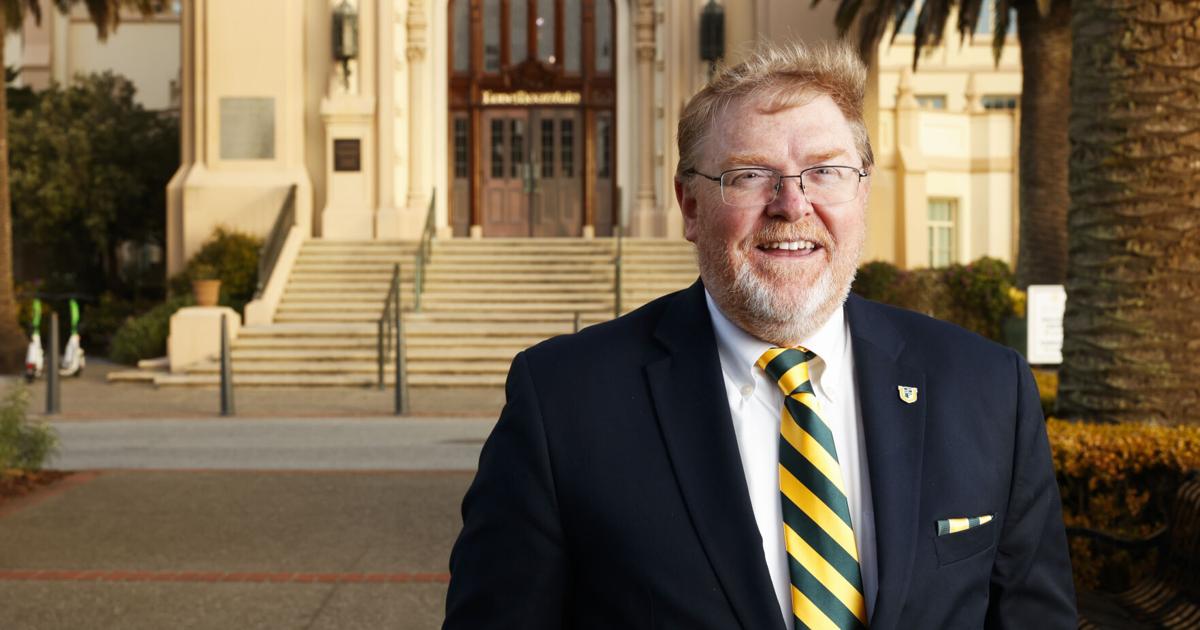
If your kid is applying to the University of San Francisco next academic year, their application will be scrutinized by a new set of virtual eyes.
Late last month, the Catholic institution signed a contract with CollegeVine to use the latter’s artificial-intelligence-powered software to summarize prospective students’ applications and essays and flag potential holes in their transcripts.
The AI system won’t be making decisions or even recommendations about who gets admitted, and it won’t be replacing the school’s 15 admissions counselors, said Eric Groves, USF’s vice president for strategic enrollment management. Instead, the institution’s goal is to lighten the load for those counselors — who have to review 20,000-25,000 applications a year — and speed admissions decisions, Groves said.
It’s too late in the admissions process for the high-school class of 2026 to put the system to work with this school year’s applicants, and USF wants to test it anyway to see how well the system performs at the various tasks the school wants it to take on, he said.
“We will learn a lot in the coming months, as we see how accurate and efficient these AI Agents can help us to be in the future,” Groves said in an email.
Since OpenAI’s launch of ChatGPT three years ago sparked the ongoing boom, San Francisco and the wider Bay Area have been the epicenter of AI development, funding and ferment. The City is home to the two most valuable AI startups — OpenAI and Anthropic — and to numerous smaller companies in the sector.
Amid the fervor, many older technology startups and companies have sought to remake themselves as AI businesses, and a growing number of corporations and other organizations outside of tech have pushed to adopt — or at least experiment with — the technology.
Among those organizations are a growing number of colleges and universities around the nation. Virginia Tech is using AI software to read applicants’ essays, and the California Institute of Technology is developing an AI chatbot to interview prospective students about their research projects to try to verify the students did the work, according to Fortune magazine.
How to incorporate AI into the admissions process and use it ethically are big topics of conversation in the profession right now, said Joseph Miller, the chair-elect of the National Association for College Admission Counseling’s Admissions Practices Committee.
Nationwide, perhaps the most popular use of AI in the admissions process is for screening essays, said Miller, who is also an independent education consultant. Two other “great” ways institutions are making use of the technology is to review transcripts and to figure out which prospective students it makes the most sense to market to, he said.
While the committee offers best-practices guidelines for admissions counselors, its guidance for AI is basically that it should be used ethically — although it doesn’t offer any particular examples of what would or wouldn’t be inbounds, he said.
“That would be a question for the universities, because … everybody at the university has their own specific admissions guidelines that they follow,” Miller said.

Out of the 11 Bay Area higher-education institutions contacted by The Examiner, USF is one of only two that said they’re using AI in their admissions processes.
Craig Lee/The Examiner
Despite the Bay Area’s general embrace of AI, USF appears to be near the cutting edge when it comes to local higher-education institutions using the technology in admissions. Of the 11 San Francisco and Bay Area colleges and universities The Examiner reached out to, San Jose State was the only other school that said it was incorporating the technology into its admissions processes.
SJSU is using AI for scanning in transcripts from transfer students and to power a chatbot that interacts with prospective students and answers their questions, said Andrew Wright, the school’s senior associate vice president for enrollment management. For the former, it’s using a product called Raptor from Smart Panda Tools, said Wright, who brought in the system after joining SJSU last year.
Transcripts can be difficult to process automatically because their formats vary from institution to institution, and even from student to student at the same school, he said. In the past, to make sense of the data on transcripts, SJSU would have to create a template for each school that produced one and then manually ensure that the data were scanned in correctly and assigned to the right fields in a database, he said. And because schools frequently change their transcript formats, SJSU would frequently have to update its templates, he said.
Raptor uses AI to automatically build transcript templates, Wright said. Thanks to that system, the accuracy of scanning in transcript data has gone from 80% to 98%, meaning the school’s staff had far less data it had to enter manually, he said. That’s a big deal considering how many transfer applications SJSU receives — more than 12,500 this fall alone — and only a handful of its 30 admissions staffers focus on processing transcripts, he said.
“When you have a small team managing thousands and thousands of transcripts, it just makes it so that they are not overwhelmed,” he said.
Wright has spoken with CollegeVine about using its system in much the way USF plans to — evaluating transcripts, looking for missing elements and assigning credits. But he said he’s dubious it will work well because of the wide variation in transcripts and because every school has its own idiosyncratic rules about what credits it will accept from other institutions.
He also said the software costs hundreds of thousands of dollars per year, which is something he doesn’t necessarily have the budget for.
“The cost of the tool is incredibly expensive,” Wright said.

During his first year in office, the mayor has unveiled several new programs aimed at families living in vehicles
Two dozen Bay Area transit agencies join to offer simple tap-to-pay fare system

If The City doesn’t hold the record for most tree-lighting ceremonies, it should
“That funding has to come from somewhere,” he said.
Representatives of Stanford University, UC Berkeley, UC Law San Francisco and St. Mary’s College of California all said their schools were not using AI in admissions or to review applications.
“Every application is carefully reviewed by multiple people as part of our holistic approach to admission,” Stanford spokeswoman Angie Davis said in an email.
Similarly, St. Mary’s relies on its admissions counselors and staff to evaluate applications and handle other processes, said school spokesman Steven Saum.
“SMC definitely leans in on the personal, individualized approach,” he said.
Admissions officials at Santa Clara University and UCSF were not available for comment on whether their institutions are using AI in admissions. Representatives of San Francisco State University, Academy of Art College and Golden Gate University did not respond to similar inquiries.
Students enrolling in the University of San Francisco for the 2027-28 semester could have their applications subject to scrutiny from a new set of virtual eyes.
Craig Lee/The Examiner
USF plans to use CollegeVine’s AI system to essentially take a first pass at student applications, Groves said. The system will go through applications, transcripts and essays and summarize the information they contain, he said.
He said the school also expects to have the system identify any missing materials or documents in students’ submissions and alert counselors if their transcripts lack particular courses.
Additionally, USF plans to use CollegeVine’s system to import data from the transcripts to the student-information system used by its registrar, he said. For transfers, they plan to use the system to identify and assign credit for the college courses on their transcripts, he said.
USF expects the technology will make the admissions process — including sending decisions out to applicants — move more quickly, he said. It should allow counselors to reach out to students in a more timely fashion to have them provide any missing information, he said. And it should allow them to more readily comb through applications by identifying which students don’t meet USF’s qualifications, he said.
“The hope is that we’re a little bit faster,” Groves said.
CollegeVine representatives did not respond to a request for comment.
Groves said USF has no plans to replace its admissions staff with AI, but the technology might allow it to be less reliant on the 10 outside readers it hires each year to help go through applications. But the school is taking things slowly for now, he said, sharing the concerns expressed by schools such as Stanford and St. Mary’s that each application is reviewed by people.
As such, USF sees it more as a tool to help its admissions staff, Groves said. The system will be used to basically go through a checklist on each application to make sure everything is there before human admissions counselors review it, he said.
“We’re certainly not going to let it read applications alone without human intervention,” Groves said. “That’s not what we want to do. As a private institution, holistic review is still important to us.”
The CollegeVine system is just one of several AI tools Groves — who joined the school eight months ago from education-technology company Liaison International — has been helping USF incorporate into its recruitment and admissions processes lately.
Over the summer, USF teamed up with CollegeVine on an AI-powered recruiting agent that will text and email prospective students and field calls from them during off hours. The school recently signed up with DegreeSight, which taps the technology to examine unofficial transcripts submitted by potential transfer students to give them a sense of whether their previous college credits will transfer.
And the university is just seeing the first fruits of a deal it signed this summer with Liaison for its Othot product. Othot uses machine learning to scrutinize schools’ admissions and enrollment data to help them identify which prospective students are most likely to attend and on which the school should concentrate its marketing efforts.
USF wanted to be able to interact with more students more quickly but in a “personalized” way, Groves said. He said his background in education technology allowed him to see how other institutions were incorporating AI effectively and ethically to engage with students.
“Using AI allows us to expand our reach, authentically, and move in more efficient ways,” Groves said.
“I’m taking what works and solving business problems in the enrollment office, where appropriate,” he said.