
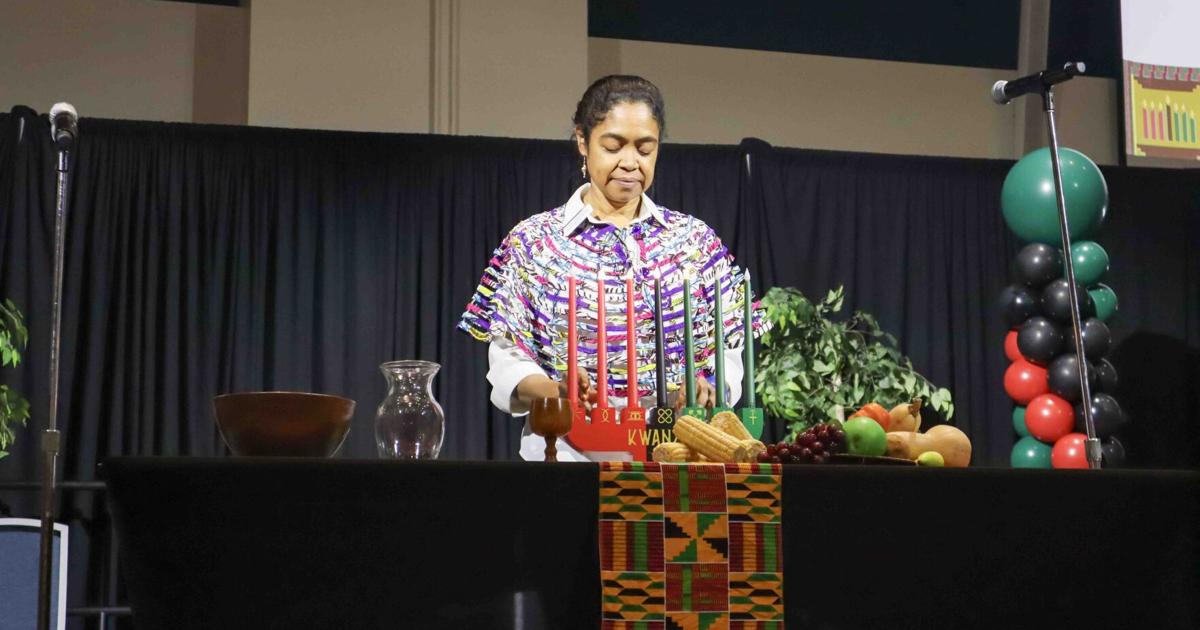
Cal State Fullerton’s Institute of Black Intellectual Innovation invited guests to delve into African American history and community at their fifth annual Kwanzaa Brunch in the Titan Student Union Pavilions on Friday.
Kwanzaa is celebrated from Dec. 26 to Jan. 1 every year. The name comes from the Swahili phrase ‘matunda ya kwanza,’ which translates to “first fruits.”
While the audience enjoyed their meals, the IBII team orchestrated performances, speeches and ceremonies, including the lighting of the Kinara. Each of these helped explain the celebration of Kwanzaa and protect its cultural and historic roots.
Marie Nubia-Feliciano, IBII director and a lecturer of ethnic studies at CSUF, shared the importance of this event and the history that it represents.
“The Kwanzaa Brunch itself is a way of educating people about a very uniquely African American tradition that grew out of folks being brought here against their will, making the best of things and then growing this tradition to sort of honor the legacy — reconnecting with the legacy that they came from — and then folding in the new reality that they created in the United States,” Nubia-Feliciano said.
Asya Harrison, assistant director of IBII and an assistant professor of psychology at CSUF, introduced newcomers by sharing historical information about the origins of the celebration.
“The holiday is rooted within the harvest of celebrations found throughout Africa in both ancient and modern times,” Harrison said. “The ideas and concepts of Kwanzaa are expressed in Swahili, one of the most widely spoken languages on the continent.”
She also shared about the seven principles of Kwanzaa created by Maulana Karenga, an activist, author and professor. These are a communitarian set of values and traditions that are found across Africa and the diaspora, with each having their own candle and significant meaning on the Kinara.
This year’s Kwanzaa Brunch is the biggest IBII has held so far and the first to actually feature a lighting of the Kinara, with electronic candles. Kaitlyn Keys, a research psychology graduate student and student assistant of IBII, attended last year and wanted to expand upon the previous festivities.
“Last year, we had somebody talk a little bit about Kwanzaa, but they didn’t really go in depth on how to celebrate it, and they also didn’t light the candles and explain what each of them meant,” Keys said. “We wanted to make sure that we highlighted that for people that didn’t know what Kwanzaa was, so they would be like, ‘Oh, I wanted to celebrate this at home.’”
The entertainment from the event also was gripping as OC Sole, a CSUF musical theatre tap dance ensemble, took the stage and showed off their skills. Tianna Wilson, a second-year musical theater major and dancer for OC Sole, explained tap’s origins as an act of resistance in the 18th and 19th centuries.
“Enslaved West Africans were denied the rights to use any of their traditional drums, because their enslavers feared that they were using them as secret code, so that they could eventually unify and revolt,” Wilson said. “However, they found that they could use their bodies and footwear to mimic the complex rhythms of sounds and their instruments.”
CSUF President Ronald Rochon also made an appearance and spoke to the audience about the importance of protecting and preserving important historical facts through the continued celebration of Black history.
“I will tell you all without a question in my heart that without my ancestors, I would not be able to stand before you all today,” Rochon said. “We did not arrive here by happenstance or by accident. It was discipline. It was strategic. It was intentional. Every time I’m reading about the history of Black struggle it gives me pride, it gives me greater purpose and understanding of how we have served the world.”