
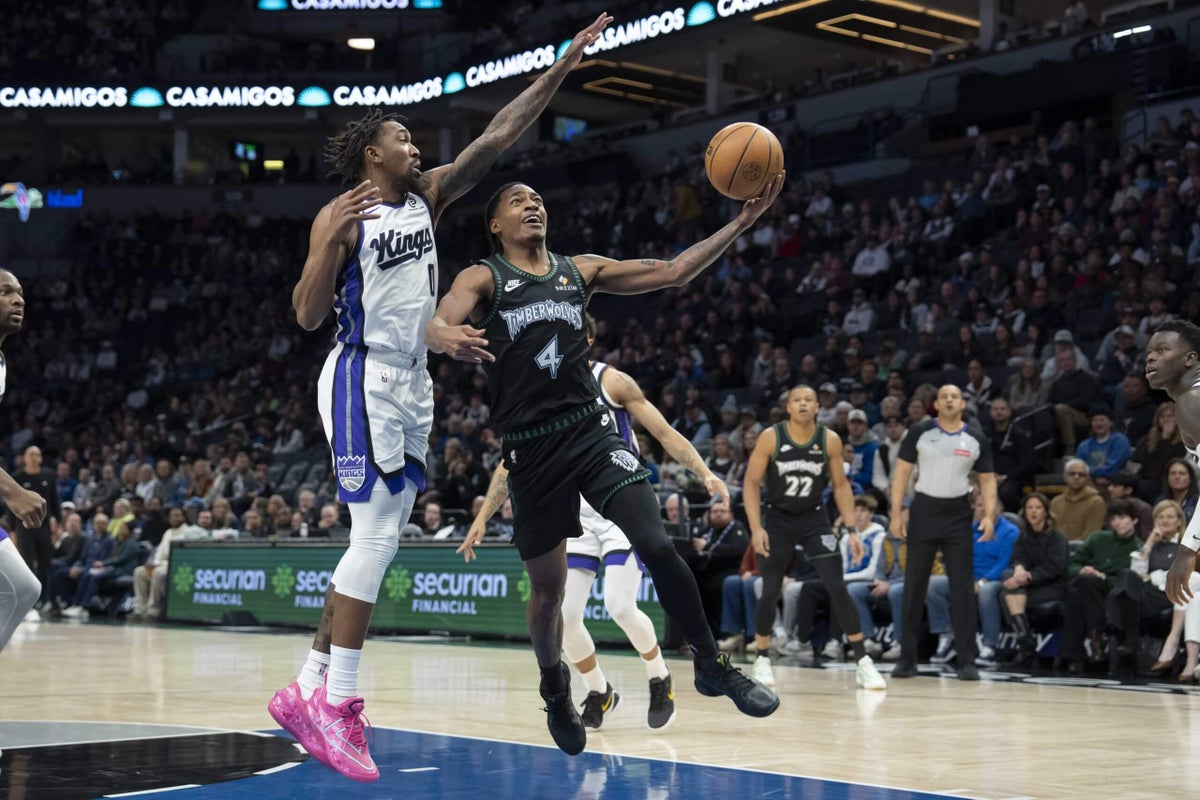
MINNEAPOLIS — As immersed as he is in the day-to-day grind of the NBA season, of searching for the right buttons to push on a Minnesota Timberwolves team whose record (17-9) has yet to match the eye test, and juggling the lineups with injuries starting to crop up, Chris Finch has a keen understanding of the conversations that surround his team.
The Timberwolves’ latest victory, a 117-103 win over the Sacramento Kings, was as nondescript as one could get. It happened on a bitterly cold night in the middle of December, with a light crowd thanks in part to the fact that it was not on the schedule until the NBA Cup field was solidified earlier this month. But Finch has long been one of the more candid coaches in postgame interviews, and his answer to one question at the end of his eight-minute news conference shed a lot of light on how he has handled his rotations this season.
The Timberwolves played without Anthony Edwards (sore right foot) and Mike Conley (right Achilles tendinopathy) for the second straight game, injuries that have opened up more playing time for young players Terrence Shannon Jr., Rob Dillingham and Jaylen Clark. All three figured to be counted on a great deal when the season opened, and all three have been in and out of the rotation. Their minutes have been sporadic, which has drawn scrutiny from a Wolves fan base that has been hungry for a bigger glimpse of young guys.
Finch was asked about the theory that giving those players longer runs would aid their development. Given the depth on the roster, and the Timberwolves’ aspirations to advance to a third straight Western Conference finals and beyond, players at the back end of the rotation — Dillingham in particular — may find trouble getting into a rhythm with a single eight-minute shift.
“Well, I’m glad you asked that question,” Finch began.
Finch has coached 395 regular-season games and 42 playoff games. Coaches are required to talk twice on game days, once before and once after the game. That means that he has spoken to the media 874 times on game days alone. That does not account for the practice sessions and occasional shootaround availabilities that he conducted earlier in his career. All told, he has spoken to the media well over 1,000 times since he was hired by the Timberwolves in 2021, a sample size large enough to know that when he begins an answer with a statement like that, it’s time to get the popcorn ready.
He began by pointing out that Shannon played 30 minutes in Friday night’s win over the Golden State Warriors — “And he earned all 30 minutes,” Finch added — a pull that indicated he was ready for a discussion like this.
“Much has been said about the 10-minute roles that these guys have, but with the way that we’re constructed, we don’t have anyone near the top of the league in minutes led,” he said.
Fact check: He is correct. Edwards is averaging 34.4 minutes per game this season, good for 22nd in the league. Julius Randle is 30th at 33.8, and there isn’t another Wolves player in the top 50. But, with a roster that includes former Sixth Man of the Year Naz Reid and Conley as the veteran ballhandler at a position of need, Finch has seven players averaging at least 19 minutes per game.
That makes it more difficult to find extended minutes for players eight-to-10 in the rotation.
“We have a deep six, seven guys who can all play upwards of the high 20s and low 30s or mid 30s, and sometimes it just doesn’t leave this 20-minute role for these guys,” Finch said.
Finch drew some criticism last year for not playing Dillingham and Shannon more, instead preferring to ride a top eight that included backup guard Nickeil Alexander-Walker, who is thriving for the Atlanta Hawks this season. Conley averaged 24.7 minutes per game last season, the lowest number in the top eight.
Shannon and Dillingham were both under 11 minutes per game when they played. This season, Shannon is averaging 14.1 minutes in his 16 games. Dillingham is at 10.5 minutes and was removed from the rotation last week before Edwards’ injury opened the door for him to come back against the Warriors and Kings.
Expanding the rotation to 10 players has resulted in those minutes falling pretty significantly through the first 28 games of the regular season. Shannon played 13 minutes against the Kings but managed just two points and was a minus-11. Dillingham had five points, three assists and a steal and was a plus-six in 12 minutes.
At least for now, in Finch’s eyes, that is going to have to be OK until they show they’re ready for greater responsibility within the team. That is a non-negotiable for the coach.
“What if the role is only 10 minutes? Shouldn’t you go out and crush those 10 minutes and then be ready to go back if we need you more, or maybe we run with you a little bit longer?” he said. “But not everyone’s going to play their best basketball every night. But the reality is that’s the role right now, and they got to nail it.”
As they are wont to do, the Wolves struggled to get rolling on Sunday night against the woeful Kings (6-20). They trailed 27-20 after the first quarter and led by only four points when the fourth quarter started. But Minnesota outscored Sacramento 29-19 in the final quarter to win for the seventh time in eight games.
Randle had 24 points, nine rebounds and three steals, Jaden McDaniels scored 21 points, Reid had 20 points and 11 rebounds, Donte DiVincenzo had 18 points, six rebounds and six assists and Bones Hyland had 18 points and five boards.
no seriously look at this pass pic.twitter.com/xZ74Hp3Vau
— Minnesota Timberwolves (@Timberwolves) December 15, 2025
Dillingham, the eighth pick in the 2024 draft, has frequently been given fewer than 10 minutes in a game, sometimes only getting one shift in the first half and sitting for the entire second. He struggled mightily in the first three quarters against the Warriors on Friday but hit a couple of important buckets in the fourth quarter to help rally the Wolves to victory. Shannon played well in the preseason but has struggled for much of the regular season while dealing with a foot injury.
“We expect that there’s going to be good days and bad days, because they’re second-year players, and that’s what second-year players do,” Finch said. “They have inconsistencies. If you play three games, you hope that you get one good, one not so good, and one maybe stinker. And you got to turn that into two positives and maybe one negative. Once we get there, then things start to go.”
In an ideal world, Shannon, Clark and Dillingham would play more than 20 minutes per game for a struggling team, allowing them to acclimate fully to the NBA. But the league is far from perfect. Hyland has supplanted Dillingham in the rotation, enough so that Finch started him for Edwards in the last two games.
Dillingham is averaging 3.8 points and shooting 38 percent from 2-point range and 27 percent from deep. Shannon is averaging 4.9 points. For two players who were supposed to give the Wolves a big pop off the bench, the lack of scoring punch has been difficult.
“Just stick with it,” Reid said earlier this season. “I was taught you’re gonna have moments where you’re not the best, and that’s part of life. That’s part of basketball. You’re gonna have bad days and have good days. Stick with it.”
Hyland’s locker is right next to Dillingham’s. The two have similar games, and Hyland emphasizes to Dillingham the importance of maximizing every opportunity he is given.
“You have to be ready to provide for the team, stay warm on the bench, stay engaged,” Hyland said.
Edwards is not going to be out for terribly long, per Finch. When he and Conley return, the minutes will be even harder to come by. Earning consistent and bigger minutes will not be easy. But none of it has been for Shannon, Dillingham and Clark. The way Finch sees it, it is not supposed to be easy.
He believes that, in the long run, this will make all three of those players better.