
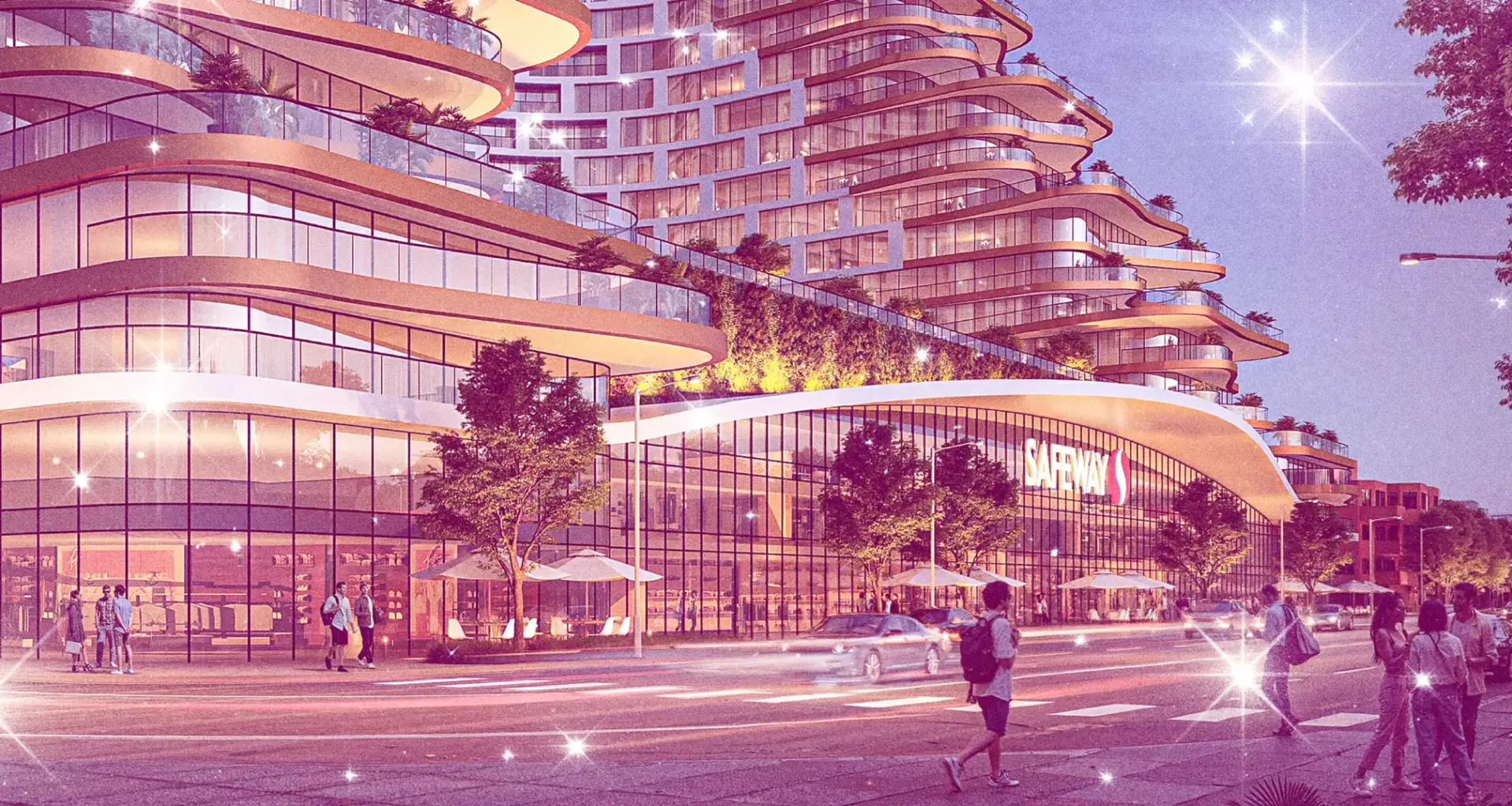
Once upon a time in San Francisco, the gravest fears of preservationists could be summed up in one word: Manhattanization. From the late 1970s through the early 2000s, the city’s powerful neighborhood blocs fought off high-rises and towers that they warned would turn our cool, gray city into a graffiti-strewn Gotham.
Now we have a new boogeyman: Miamification. Think of it as Manhattanization, but by the water. And everyone from the old NIMBY crowd to our otherwise growth- and density-friendly mayor has railed against the possibility of tall, shiny, gentrifying, Miami Beach-style towers lining our coast from Ocean Beach to Marina Green.
Which is too bad, because we could really use some more Miamification around here. And at least one local developer seems to agree.
That developer, Align Real Estate, is working with Safeway to reenvision several supermarkets as anchors to new multi-family housing. This is a fantastic move and long overdue. Safeway stores in Bernal Heights, the outer Richmond, and the Fillmore could potentially see 2,696 units built if Align’s proposals become reality. No timelines have been attached to these projects, and they’re all likely to face some level of local opposition.
 Source: Courtesy Arquitectonica
By far the most controversial is Align’s proposal to transform the Marina Safeway into a 25-story complex with 790 housing units, 86 of which would be affordable. The newly released renderings (opens in new tab) are the developer equivalent of a middle finger to Miamification alarmists. To create them, Align hired none other than Arquitectonica (opens in new tab), a firm whose aesthetic is synonymous with Miami, having designed close to 200 projects there, including the Dolphins stadium, the Heat arena, the federal courthouse, and perhaps most significantly, 14 of the city’s tallest buildings.
It’s a bold move to tap the firm that defined the look of Miami to design a significant coastline project for a city that lives in fear of becoming Miami. Clearly, Align isn’t messing around, and the process that led to its proposal underscores that point.
Mayor Daniel Lurie’s new Family Zoning Plan should have made the Marina Safeway project impossible. But by submitting its plans before the upzoning was signed into law, Align was able to lock in development rights to the site at the eleventh hour, taking advantage of a suite of state density, streamlining, and vesting laws.
Opposition was immediate and vehement, including from District 2 Supervisor Stephen Sherrill and Lurie. “We will work with anybody to do the right kind of building,” the mayor told the Chronicle on Tuesday, “and that one is just not in line with what we are doing here in San Francisco.”
But why isn’t it in line?
Opponents will say the building is too tall. Or too wide. That it should be 100% affordable (which will never happen). That it’s not “a good fit” for the neighborhood. That it’s environmentally irresponsible. Or that it will somehow cast shadows on the Marina Green, even though it doesn’t overlook it. I am even anticipating the argument that the Safeway lot is “historic,” perhaps because it has been considered a place to hit on singles since its opening in 1959 and has long been referred to as “Dateway.” (opens in new tab)
Projects like this will be fought tooth and nail throughout the city, but projects like this are the only way we’re going to get out of our housing crisis.
 Source: Courtesy Arquitectonica
To wit: Just a mile from the Marina is another Safeway with high-rise housing on top. The Safeway at Golden Gateway on Jackson Street is tucked under a 25-story building where a studio apartment rents for around $4,000 a month. There was little, if any, opposition and lots of funding for this sort of development when it was built in 1965. And from the mid-’50s to the early ’70s, about 40 towers of this size were built around the city.
But then people began to rally against shadows, loss of views, and the dreaded Manhattanization — fears catalyzed by the Transamerica Tower, much hated upon its completion in 1972. It’s worth noting that nearly everyone loves Transamerica now — but that will do little to dissuade the Marina Safeway naysayers.
I reached out to several urban-planning experts to ask if there is a way this project survives the inevitable fierce blowback. I thought a ballot measure might be a surefire path for opponents, as there is nothing SF loves more than ballot-box planning (RIP 8 Washington (opens in new tab)). Architect Mark Hogan of OpenScope Studio (opens in new tab) doesn’t think that’s possible, as the Housing Accountability Act prohibits cities from retroactively changing zoning rules. But he doesn’t love the project and will be surprised if it gets built.
“I am very skeptical the developer is actually planning on building this,” he told me via email. “I can’t imagine how it would pencil out. It’s the worst soil in the city” — the Marina is built on a seismically vulnerable liquefaction zone — “and the design is insanely complicated. My guess is there is some alternative strategy where they are using this to bargain over something else.”
Matthew Lewis of California YIMBY believes the state’s Housing Crisis Act of 2019 makes the project invincible to ballot measures — but that doesn’t mean opponents won’t try to put it on the ballot anyway. He loves the renderings. “I think it looks spectacular,” he said. “We have to get past ‘I think it’s ugly,’ and [the project] stops. I want to live in a city where architects can dream. If you don’t let that happen, you end up with lowest-common-denominator buildings.”
 Source: Courtesy Arquitectonica
Align and Arquitectonica undoubtedly view this as the beginning of a negotiation. Not happy with 25 stories? How about 20? Maybe all sides can agree on, I don’t know, 12. Creators of projects like these have to plan for pushback; there is no other path to residential building in San Francisco. That’s why we end up with bland and tentative architecture, buildings that are shorter and less dense than they need to be, and housing goals that are eternally unmet. I am guessing the project still pencils out at a reduced scale.
But not too reduced, I hope. What we need now is audacity and risk-taking. We also need leadership that offers the public a clear-eyed understanding that more housing is not a “nice to have,” it’s an urgent imperative. Even if some of it looks like Miami.
Allison Arieff is a former columnist for the New York Times Opinion section, editor-in-chief of Dwell magazine, and editorial director at MIT Technology Review and the urban planning and policy think tank SPUR.