
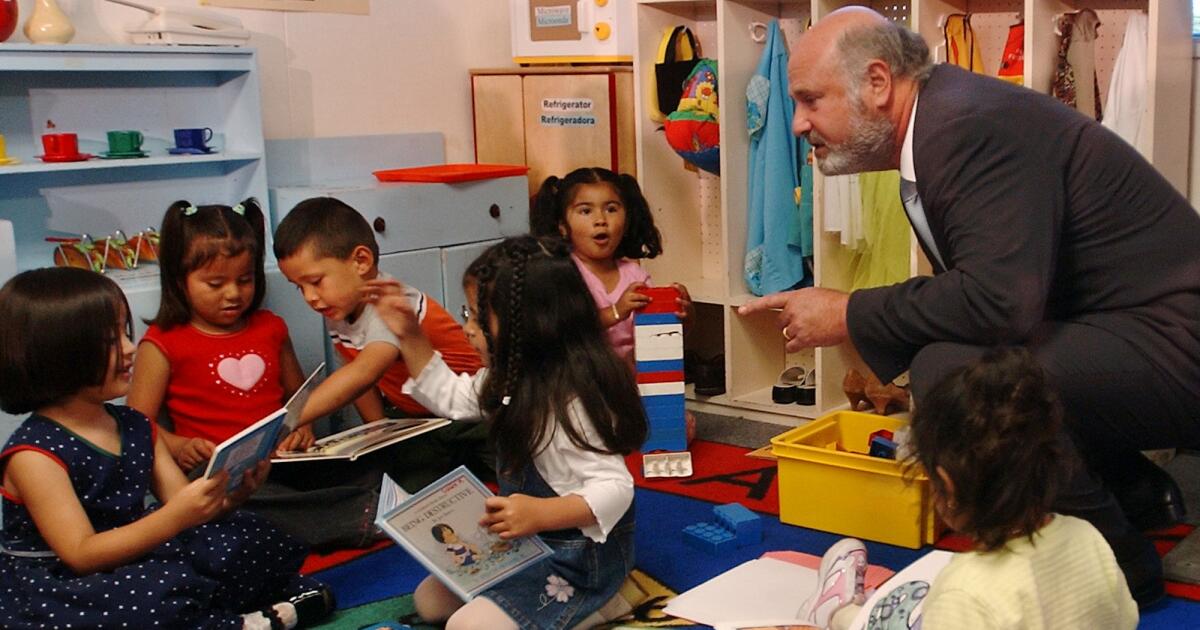
Actor and director Rob Reiner felt so passionately that every child deserves a rich education from an early age that he mused nearly three decades ago that he might be happy giving up filmmaking to devote the rest of his life to the cause of early childhood development.
You’re reading the Essential California newsletter
He never left entertainment, but Reiner’s drive and political activism changed the lives of an untold number of young Californians. The 1998 ballot measure he championed, Proposition 10, put a tax on tobacco to pump more than $11 billion into preschools, teacher training and support for families struggling to raise their kids.
Friends and supporters recalled that work Monday, the day after Reiner and his wife, Michele, died in their Brentwood home, allegedly after an attack by their son Nick. Reiner’s allies wanted to make sure that work is not forgotten.
”What I keep coming back to is that Rob was a generational artist, a brilliant political strategist and a courageous leader,” said Ben Austin, a political strategist hired by Reiner to promote the implementation of the First 5 initiative. “Rob didn’t get enough credit for seeing around the corner on what would become a major issue for American progressive policy … the importance of nurturing early brain development and programs to support it.”
Why Reiner felt strongly about this cause
Reiner told the New York Times in 1997 that, though he grew up in privilege — the son of actor and comedian Carl Reiner — “I can trace my struggles, and the difficulties I’ve had in functioning and fitting in, to early influences.’’ He asked people to ponder how that would impact children who grew up with much less.
Once he and Michele Singer Reiner learned the science of early brain development, they felt they had to act, said Michael Trujillo, another political consultant who worked with Reiner on First 5, which refers to the first five years of life.
“He knew that the things you experience as a young kid, when your brain was being developed … helped dictate the current of your entire life,” Trujillo said. “There are kids who may never know his name who benefited from that.” His voice choked with emotion, Trujillo added: “And he just did it because it was the right thing to do.”
Reiner, who died at 78, brought more than passion to the cause. He produced a TV special, “ I Am Your Child,” hosted by actor Tom Hanks and supported by Hollywood potentates Billy Crystal, Michael J. Fox, Rosie O’Donnell and Robin Williams. It highlighted a Virginia community that promoted better outcomes for kids with increased support for kids and their families. The actor-director also had political connections from L.A. City Hall and then-Mayor Antonio Villaraigosa all the way up to the Clinton White House.
“He articulated, clearly and persuasively, that investing early was not charity, but a proven way to reduce crime, mitigate poverty and strengthen families and communities,” wrote Mark Friedman, the chief executive of Bay Area hospital district and former chief executive of First 5 in Alameda County, in an essay about Reiner’s activism.
A setback for early childhood funding
Reiner’s work suffered a setback in 2006, when voters rejected a measure to tax the wealthy (individuals earning more than $400,000 and couples earning more than $800,000 annually) to pay for preschool for all 4-year-olds. And the tobacco tax revenue from the earlier childhood measure dropped substantially as smoking in California declined.
It was a sad irony that 32-year-old Nick Reiner’s reported mental health demons proved far beyond the reach of the kind of interventions that the Reiners promoted for the masses. Rob Reiner and his wife struggled for years to help their second son. A family friend told The Times about years of treatment and therapy that couldn’t stanch the addiction and pain.
After Reiner and his son teamed on a semiautobiographical film about Nick’s life, his parents told a Times reporter they wondered if the end of his odyssey would be “the tragic one that a voice in the back of their heads kept telling them was coming,” the article said.
Today’s top stories 
Law enforcement gathers at Rob Reiner’s Brentwood home Sunday night after he and his wife were found slain.
(Eric Thayer/Los Angeles Times)
Rob and Michele Reiner slayingsRob’s legacyCalifornia’s Prop. 50A new California-led public health initiativeGov. Gavin Newsom announced the initiative Monday and tapped former CDC leaders who have been critical of the Trump administration’s health policies to lead it.The Public Health Network Innovation Exchange is poised to“modernize public health infrastructure and maintain trust in science-driven decision-making,” according to the governor’s office.What else is going onCommentary and opinionsThis morning’s must readOther must readsFor your downtime 
The production company Spesh films comedian Ahmed Bharoocha at the Lyric Hyperion in Los Angeles on Nov. 22.
(Karla Gachet/For The Times)
Going outStaying inA question for you: What is the best Christmas gift you received?
Michelle McDonald said, “The best Christmas gift I ever received was actually homemade … our son was born on Christmas Eve. This year my husband and I will celebrate with him the 25 years of joy and delight that he has brought into our lives.”
Email us at essentialcalifornia@latimes.com, and your response might appear in the newsletter this week.
And finally … your photo of the day 
Len Kendall stands on the lot where his family’s Pacific Palisades home burned down during the January wildfires. His wife, Sharlot Kendall, holds hands with the couple’s 3-year-old daughter.
(Kayla Bartkowski/Los Angeles Times)
Today’s great photo is from staff photographer Kayla Bartkowski of Len Kendall, along with his wife, Sharlot and the couple’s 3-year-old daughter. The couple, standing on the lot where their Pacific Palisades home burned down during the January fires, are among dozens of homeowners who were victims of the Palisades and Eaton fires who have found it hard to get mortgage relief.
Have a great day, from the Essential California team
Jim Rainey, staff reporter
Hugo Martín, assistant editor, Fast Break desk
Kevinisha Walker, multiplatform editor
Andrew Campa, Sunday writer
June Hsu, editorial fellow
Karim Doumar, head of newsletters
How can we make this newsletter more useful? Send comments to essentialcalifornia@latimes.com. Check our top stories, topics and the latest articles on latimes.com.