
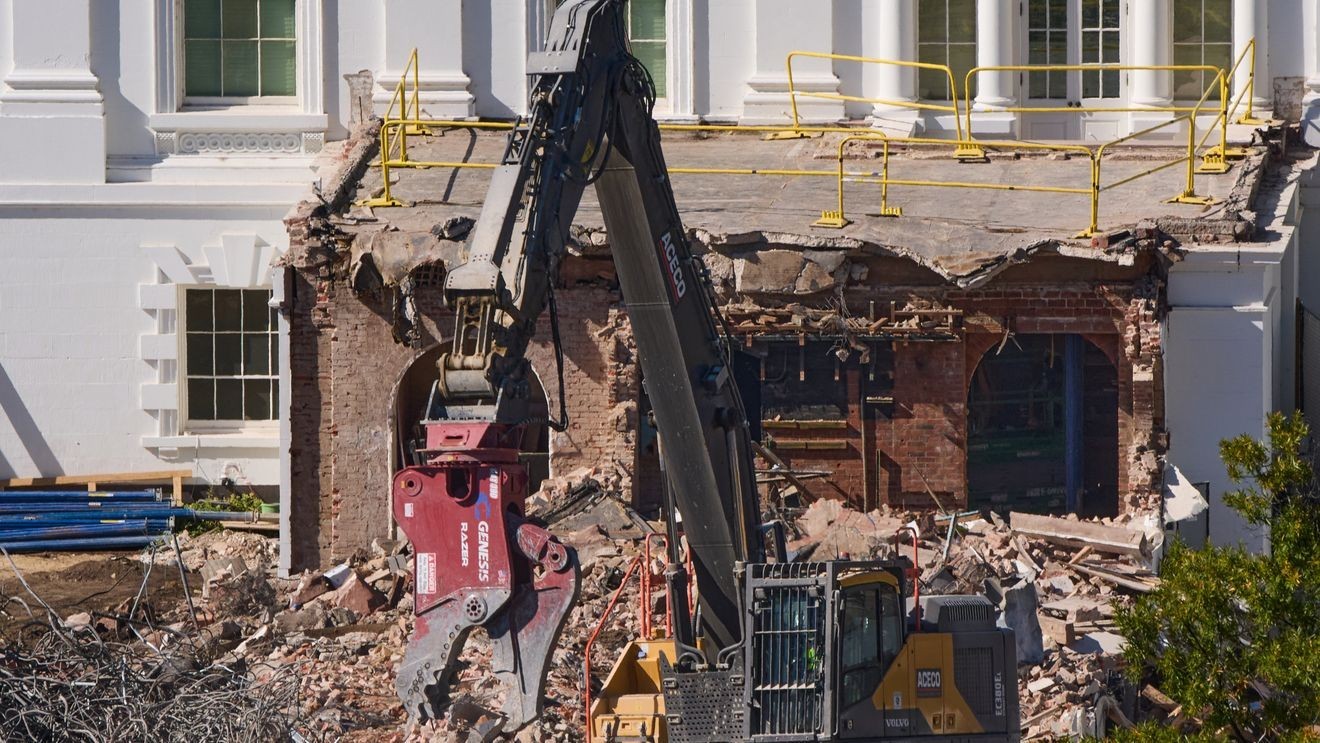
WASHINGTON (7News) — A judge says he is inclined to reject an attempt to block the construction of the White House ballroom. An official order is expected in the next day.
Judge Richard Leon made the ruling after an emergency hearing lasting about an hour on Tuesday afternoon.
The National Trust for Historic Preservation is the organization suing the President to try to halt the construction of the White House ballroom.
The group asked the judge to immediately halt the construction of the 90,000-square-foot ballroom, arguing The White House started construction without submitting its plans for the project to the two federal commissions that are required by federal statute and regulations, and without approval from Congress.
Tad Heuer, the lawyer representing the preservationist group, insisted to the judge the below-ground construction slated to begin in January will cause permanent harm, and the court needed to step in because construction is ongoing and will add to this damage.
Principal Deputy Assistant Attorney General Adam Gustafson, who represented The White House, countered these arguments by stating the plans for the ballroom are not finalized and, therefore, it cannot be known if there will be irreversible harm.
He also argued the president is not subject to the same approval process as federal agencies.
WJLA
Judge Leon, ultimately, said lawyers for the preservationist group did not prove there would be irreparable harm.
However, he also stated the courts could act if the below-ground construction beginning in January materially changes the above-ground construction set to begin in April, and The White House could be ordered to take down such alterations.
SEE ALSO | DC Councilmember Kenyan McDuffie announces resignation
In new court papers, the Trump administration stressed that the plans for the ballroom are not final and claimed the project would cause no significant impact to the surrounding environment.
“We are very proud of it,” President Donald Trump has said. “It has gotten great reviews. It’s gotten really great reviews.”
In court filings, the White House mentioned that beginning with President Dwight Eisenhower, presidents have been forced to host state dinners in temporary tents pitched on the White House grounds, and the ballroom will rectify that untenable situation.
In those same documents, the DOJ also insisted this is a national security matter, and construction must continue to meet Secret Service requirements.
“They’ve wanted a ballroom for 150 years,” Trump said. “And I’m giving that honor to this wonderful place.”
On Tuesday, Congressman Jaime Raskin, D-Md., spoke to 7News about the lawsuit seeking to halt the ballroom.
SEE ALSO | Hyundai & Kia owners entitled to free ignition protectors after car theft settlement
“Right now, it’s not clear that the White House has got to go through the general historical and Architectural Review that any other federal building would have to go through,” Raskin said.
WJLA
Raskin introduced a bill to change that.
“So this closes that loophole and guarantees that before this president, or any president in the future, decides to take a bulldozer to a federal building and just renovate it according to his or her own specifications, that it’s got to go through the general process that we accept for all federal buildings,” Raskin said. “What this president has done has been, essentially, to exploit some ambiguity in what the law is today, and we need to clarify that and specify it going forward because the bottom line is it’s not the president’s house. It’s the people’s house. It’s not private property. It’s public property, and it should be governed by public law and regulatory process.”
The White House agues the ballroom follows in a long line of major presidential renovations —pointing to President Monroe’s South Portico, President Jackson’s North Portico, President Theodore Roosevelt’s West Wing, President Taft’s Oval Office, President Wilson’s Rose Garden, President Franklin D. Roosevelt’s East Wing and bomb shelter, President Truman’s balcony, and President Nixon’s briefing room.
The White House said none were restricted by Congress or constrained in the manner the National Trust for Historic Preservation was seeking, adding that the most significant White House renovation happened under President Truman, with a complete gutting of the White House interior.
The ballroom is estimated to cost $300 million. Trump said the project will be financed entirely through private donations.
The next hearing, a preliminary injunction hearing, will take place the second week of January.