
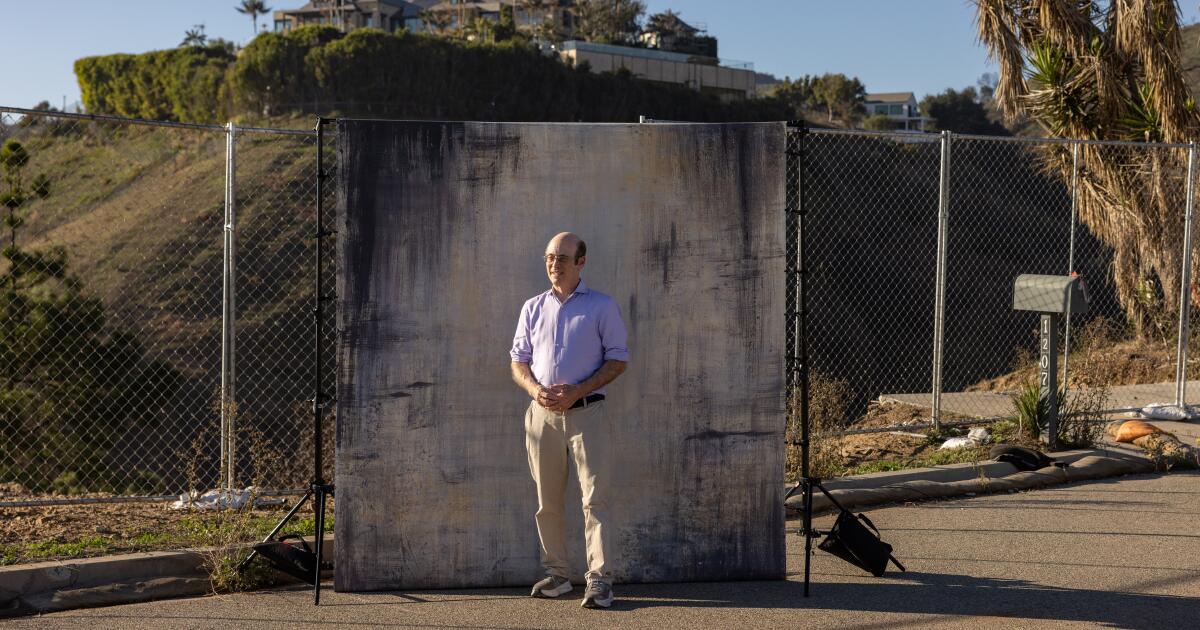
In what used to be a dry cleaner’s on Sunset Boulevard, Robert Lempert listened, hands clasped behind his back, as his neighbors finally took a moment to step away from recovery’s endless stream of paperwork, permits, bills and bureaucracy to, instead, envision a fire-resilient Pacific Palisades in 2035.
As a researcher at RAND, Lempert has spent decades studying how communities, corporations and governments can use computer simulations to understand complex problems with huge uncertainties — from how an Alaska town can better warn its residents about landslides to how climate change is worsening disasters and what strategies the United Nations can support to address them.
In January, one such complex problem ran straight through his neighborhood and burned down his house.
As Lempert and his wife process their own trauma forged by flames, Lempert has become fixated on capturing the flickers of insights from fellow survivors and, hopefully, eventually, transforming them into computer programs that could help the community rebuild the Palisades into a global leader in wildfire resilience.
“Otherwise, we won’t end up with a functional community that anybody wants to — or can — live in,” he said. “You can spin out all sorts of disaster scenarios” for the Pacific Palisades of 2035. If the community fails to confront them in rebuilding, “you make them a hell of a lot more likely.”
Lempert doesn’t see a mass exodus from high-fire-hazard areas as a viable solution. Out of the more than 12 million buildings the climate risk modeling company First Street studies in California, 4 in 10 have at least a 5% chance of facing a wildfire in the next 30 years. (Out of the nearly 10,000 buildings First Street studies in the Palisades, 82% carry that level of risk.) And the areas without significant fire risk have their own environmental challenges: flooding, earthquakes, landslides, hurricanes, tornadoes, droughts. Learning to live with these risks, consequently, is part of the practice of living in California — and really, in most of the places humans have settled on Earth.
So, Lempert has taken to the modus operandi he helped develop at RAND:
Identify the problem. In this case, living in Pacific Palisades carries a nonzero risk you lose your house or life to fire.
Define the goals. Perhaps it is that, in the next fire, the Palisades doesn’t lose any homes or lives (and, ideally, accomplishes this without spending billions).
Then, the real work: Code up a bunch of proposed solutions from all of the groups with wildly disparate views on how the system (i.e., Southern California wildfires) works.
Stress-test those solutions against a wide range of environmental conditions in the computer. Extreme winds, downed communication systems, closed evacuation routes — the list goes on.
Finally, sit back, and see what insights the computer spits out.
It’s easy enough to agree on the problem, goals and environmental factors. For the proposed solutions, Lempert set out to collect data.
Poster paper with residents’ handwritten ideas now fills the walls of the former dry cleaner’s, now the headquarters of the grassroots organization Palisades Recovery Coalition. It’s through these “visioning charrettes” that Lempert hopes his community can develop a magic solution capable of beating the computer’s trials.
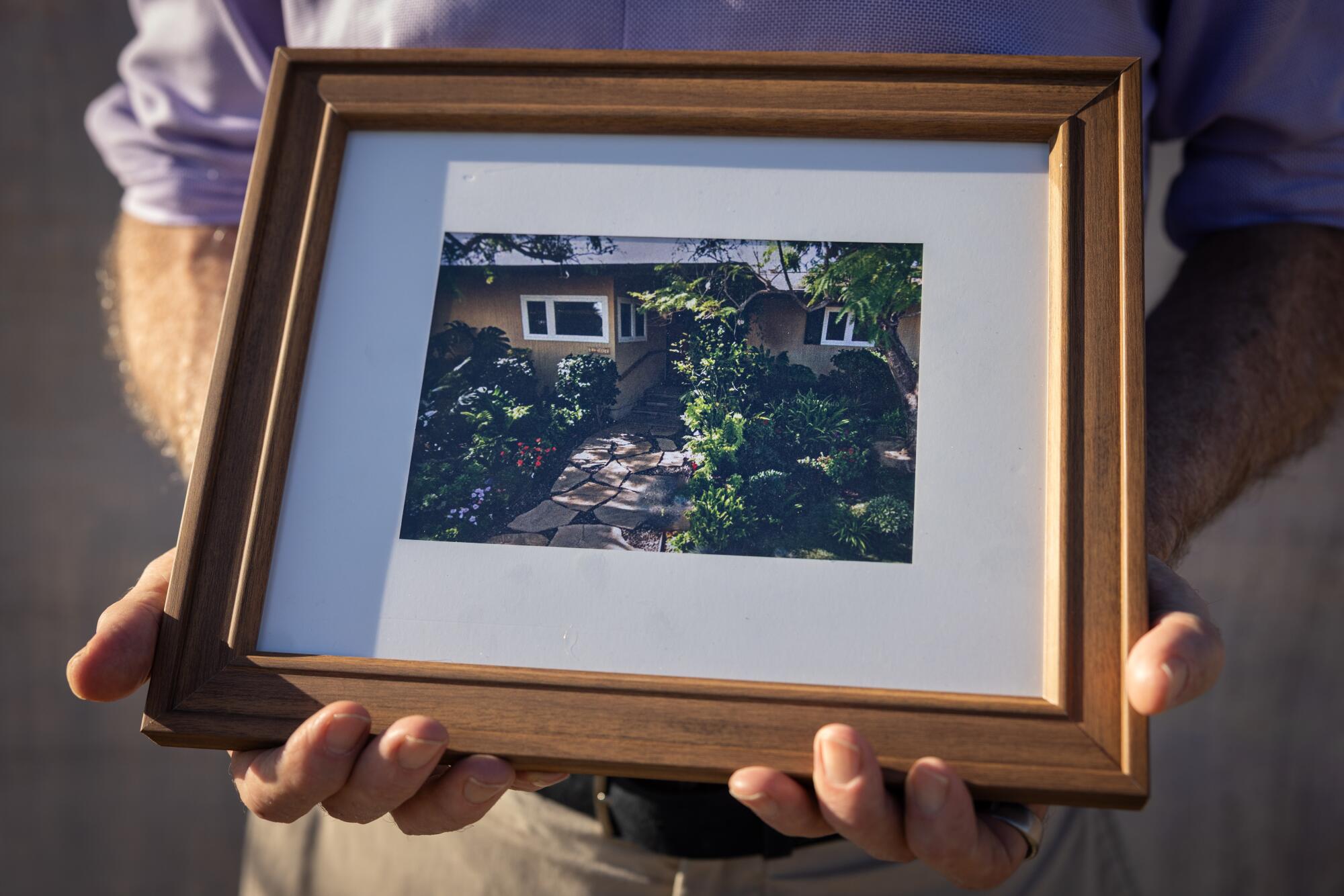
Lempert holds a photo of his home as it looked before it was destroyed by the Palisades fire.
The streets could be lined with next-generation homes of concrete and steel where even the tiniest gaps are meticulously sealed up to keep embers from breaching the exterior. Each home could be equipped with rain-capture cisterns, hooked up to a neighborhood-wide system of sensors and autonomous fire hoses that intelligently target blazes in real time. One or two shiny new fire stations — maybe even serving as full-blown fire shelters for residents, equipped with food and oxygen to combat the smoke — might sit atop one of the neighborhood’s main thoroughfares, Palisades Drive. The street, formerly a bottleneck during evacuations, might now have a dedicated emergency lane.
Every year, the community could practice a Palisades-wide evacuation drill so the procedures are fresh in the mind. Community brigades might even train with the local fire departments so, during emergencies, they can effectively put out spot fires and ensure their elderly neighbors get out safely.
Lempert, who now lives in a Santa Monica apartment with his wife, doesn’t entertain speculation about whether the Palisades will ever reach this optimistic vision — even though his own decision to move back someday, in part, hinges on the answer.
Right now, all that matters is that change is possible.
He pointed to an anecdote he heard once from the fire historian Stephen Pyne: American cities used to burn down — from within — all the time in the 19th century. Portland, Maine, burned in 1866 thanks to a Fourth of July firecracker. Chicago in 1871, after a blaze somehow broke out in a barn. Boston the following year, this time starting in a warehouse basement. Eventually, we got fed up with our cities burning down, so we created professional fire departments, stopped building downtowns out of wood and bolstered public water systems with larger water mains and standardized fire hydrants. Then, it stopped happening.
Now we face a new fire threat — this time, from the outside. Maybe we’re fed up enough to do something about it.
“Cities shouldn’t burn down,” Lempert said with a chuckle, amused by the simplicity of his own words. “So let’s just design them so they don’t.”