
For The Union-Tribune
Mention the Feast of the Seven Fishes, or La Vigilia di Natale, and you might flash to the chaotically intense “Fishes” episode of the comedy-drama series “The Bear,” in which Carmy’s family is preparing — or trying to prepare — the traditional Italian American Christmas Eve feast for a gathering of family and friends.
Hopefully, the Feast of the Seven Fishes in your home is far more tranquil and celebratory than the Bersattos’, and no cars come crashing into the house during the meal. To help ensure the tastiness of the meal, I recruited chef Accursio Lota of Cori Trattoria Pastificio and his new restaurant Dora near the La Jolla Playhouse on UCSD’s campus.
Lota is Sicilian. While the holiday is billed as Italian American, he said that Italians have long had a similar meal on Christmas Eve, but it wasn’t necessarily “seven fish.” It was a meatless meal, hence the fish, because observant Catholics don’t traditionally eat meat on Christmas Eve. So Lota grew up eating expansive seafood dinners on Christmas Eve before arriving in the U.S. But the meal didn’t have a name. It was just Christmas Eve.
“The first time I heard ‘Feast of Seven Fishes,’ I didn’t know what it was,” he said with a laugh.
“It turned into a seven-fish tradition,” Lota said. “When people left Italy and came here, it was so multicultural they missed their traditions, and it evolved into a meal with seven fishes. Honestly, there are a lot of different versions.”
This makes sense, of course. Italy has so many micro culinary regions, Lota explained. So some of the traditions depended on how close to the ocean you were. The Little Italy Association of San Diego explains on its website that the origins of what is now the Feast of Seven Fishes is unknown. It popularized in the U.S. with the immigration of Southern Italian immigrants in New York’s Little Italy in the late 1800s.
Why seven? Actually, some celebrate with even more, but the number is commonly believed to represent the seven Sacraments of the Catholic Church.
Lota also noted that for the Feast of the Seven Fishes, you can interpret the meal to mean seven dishes with seven different types of fish/seafood or seven dishes focused on one type of seafood or some mix of the two.
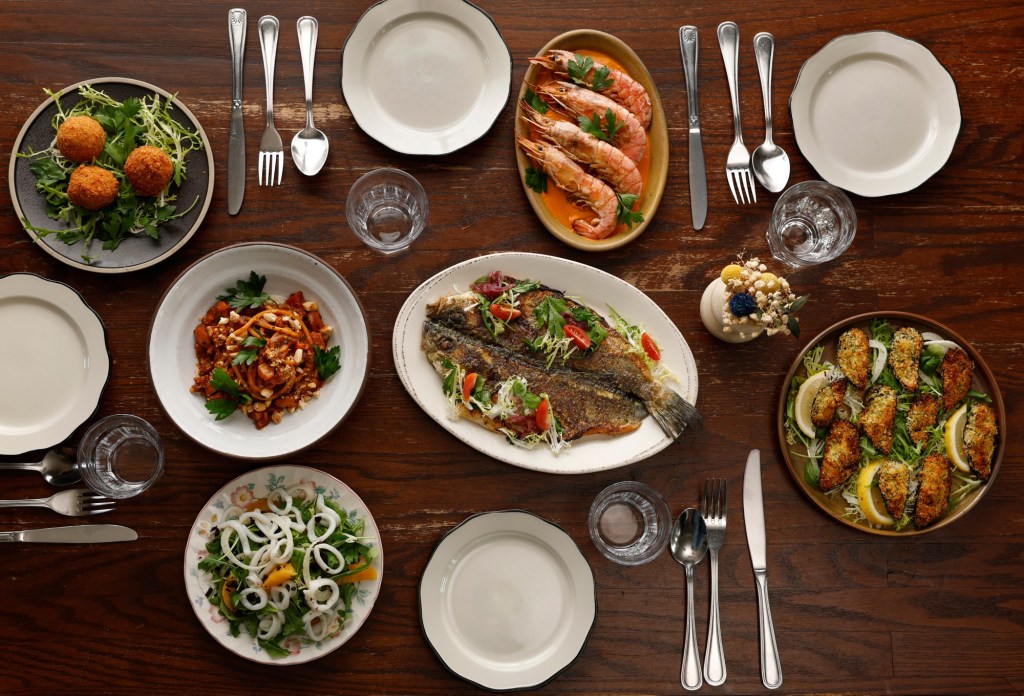
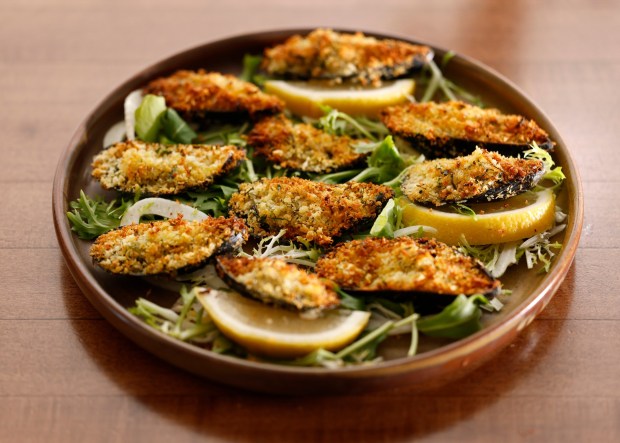
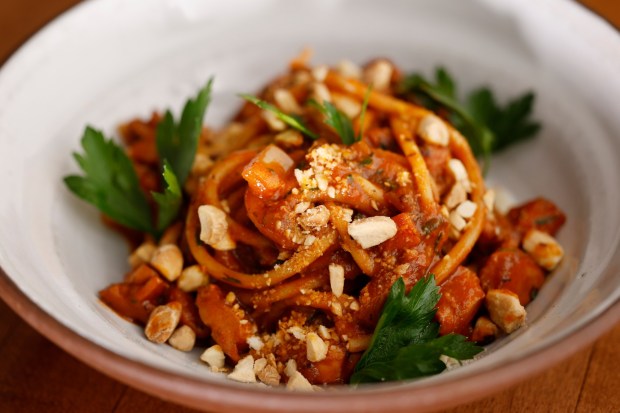
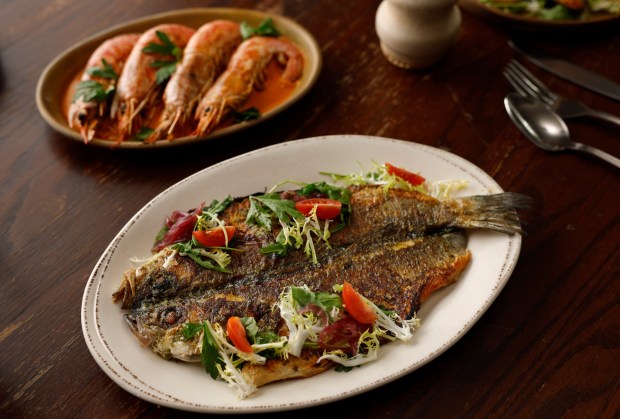
For this meal, Lota has chosen three of the dishes that he plans to serve at Cori for the holidays: Cozze Gratinate (Mussels with Orange Zest and Bread Crumbs), Bigoli al Sugo di Polipo (House-Made Bigoli Pasta, Sauteed with Braised Octopus “Bolognese Style,” Pecorino, Lemon Zest, and Toasted Almonds) and Branzino e Gamberoni (Pan-Seared Mediterranean Branzino Fillet, Roasted Wild Red Prawn, Mint Ammoglio). And while these are big names that sound intimidating to prepare, in fact, all three are very approachable and will be delicious for your holiday meal.
The mussels dish makes for a gorgeous appetizer or part of a family meal. You pan cook the fresh mussels, remove the top shell and fill the shell with the meat with a citrusy breadcrumb mixture before placing it under the broiler to crisp up. The recipe serves four to six people, but Lota said it’s easy to scale up for a larger group.
If you haven’t cooked mussels before, it’s very easy, but as Lota emphasized, you need to make sure first that they’re alive.
“Put them in a bowl and give it a shake,” he explained. “Wait a couple of minutes. If the mussels open, they’ll close naturally. You’ll know they’re alive. Remove the beard and if they came pre-cleaned, they’re ready to be cooked. If you have any that started closed and never changed, throw them out.”
Lota gets his mussels from a supplier that delivers them already cleaned. I suggest you buy them from a fishmonger or trustworthy market. They should have no cracks and smell mild and sweet. Once home, don’t store them in water; place them in a bowl under a cool damp kitchen towel.
Market mussels may not come cleaned. No problem: Once you’re ready to cook them, first remove the “beard” by pulling those strands together toward the tip of the mussel and give a gentle yank. Then just rinse the mussels in a colander under cold water and scrub off any dirt with a vegetable brush.
To put together the dish, add olive oil to a large pan over medium heat and heat up a smashed garlic clove, parsley stems and a very thinly sliced shallot. Then add the mussels and cover the pan, cooking up to 4 minutes until they all open. Let them cool in a tray, then remove that half shell.
While they cool, mix together breadcrumbs or panko with aromatics like parsley, basil, lemon and orange zest, and chopped garlic and Parmigiano. The key here is to rub the ingredients with your fingertips to release the essential oils in the herbs and zests. Then add olive oil and salt and pepper. You’ll no doubt have leftovers, which is perfect for roasted veggies or crusting fish, chicken or pork.
When the mussel halves are ready to be stuffed, push the breadcrumb mix firmly into the shell and over the mussels and run the tray of mussels under the broiler until browned for up to 7 minutes. You can serve them hot or at room temperature.
For the Bigoli al Sugo di Polipo, look for baby octopus or tentacles to keep the cooking time down. You can even sub out octopus for calamari if you prefer. To make the Bolognese, you’ll first cook down celery, carrot, thyme, bay leaves and shallot, then add the octopus meat. Once it sweats down, add red wine, then tomato paste and water. Simmer for up to 90 minutes, until the octopus is tender, and the sauce is rich. You can add water if it gets too dense or thick while cooking. Feel free to make this a day ahead of serving.
While Lota makes his own pasta, he said using dry pasta is fine and recommended Assenti’s Pasta shop in Little Italy for their thick spaghetti. Once the pasta is cooked, add it to the sauced octopus and let simmer for a few minutes (add pasta water if it’s too thick), then finish with lemon zest, chopped parsley and chopped roasted almonds. It’s a rich dish with a fresh finish from the zest and just a touch of crunch from the almonds.
Finally, there’s the Branzino e Gamberoni. You can use any kind of firm white fish (skin on), including cod — and use either fillets or butterflied fish. How you cook the fish is up to you. It can go skin down in a frying pan or cast-iron pan, grilled outside on stovetop or even broiled. Use the same technique for the prawns. If you find the fish curling as it cooks, press it down with a spatula or even place a ceramic or glass plate on it to weigh it down.
Lota’s mint ammoglio is a play on Sicilian pestolike sauce. It’s quite vibrant. You can make it using a mortar and pestle, but the easiest way is to make it in a blender, starting with oil, salt and garlic, then add the mint and lemon juice once the garlic is pulverized.
To serve, layer the fish and prawns on a platter. Scatter some arugula or endive for a little bitterness and texture, then finish with the ammoglio.
What about sides? Lota recommended grilled vegetables, rustic boiled potatoes smashed with minced parsley and Parmigiano, a salad and sourdough bread.
 (K.C. Alfred / The San Diego Union-Tribune)
Cozze Gratinate (Mussels With Orange Zest and Bread Crumbs)
Makes 4 to 6 servings
INGREDIENTS
1 pound mussels (15 to 20 pieces)
1 clove of garlic, smashed
2 parsley stems
1/4 shallot, sliced thin
1/4 cup extra-virgin olive oil
For the breadcrumb condiment:
2 1/2 cups unseasoned breadcrumbs or panko
1 tablespoon chopped parsley
1 tablespoon basil, sliced julienne
1 teaspoon lemon zest
1 teaspoon orange zest
2 tablespoons grated Parmigiano (or pecorino)
1/2 teaspoon finely chopped garlic
3 tablespoons extra virgin olive oil
Salt and ground pepper to taste
DIRECTIONS
1: Cook the mussels: Bring a large pan to medium heat, add the extra-virgin olive oil, one smashed clove of garlic, the parsley and the shallot. When translucent, add the mussels and cover with a lid. Let them cook between 2 and 4 minutes, or until they start to slightly open. When open, place them in a tray and let them cool down as fast as you can. When cold, clean the mussels one at a time and remove half the shell (keep the mussels in the other half shell). Place in the refrigerator.
2: Prepare the breadcrumbs: In a bowl, mix the breadcrumbs with chopped parsley, basil, lemon zest, orange zest, Parmigiano and finely chopped garlic. Rub together all the ingredients with your fingers so that the herbs and citrus release their essential oils into the breadcrumbs. Then add the extra-virgin olive oil and make sure it’s fully blended into the breadcrumb mixture. Mix in salt and pepper.
3: Complete the dish: Set the oven to broil. Place the mussels in a baking dish with the shell down and meat up. Fill one mussel shell at a time with the breadcrumb mixture on top of the mussel. The breadcrumb layer should be well compacted and between 1/3 inch and 1/8 inch thick with the mussel meat covered. Return to the baking dish. When all the mussels are filled, place under the oven broiler at medium-high setting and cook between 3 and 7 minutes, or until golden. Serve hot or warm.
 (K.C. Alfred / The San Diego Union-Tribune)
Bigoli al Sugo di Polipo (House-Made Bigoli Pasta, Sauteed With Braised Octopus “Bolognese Style,” Pecorino, Lemon Zest and Toasted Almonds)
Makes 4 to 6 servings
INGREDIENTS
For the Octopus Bolognese:
1/3 cup extra-virgin olive oil
1/4 cup diced celery
1/4 cup diced carrots
1 shallot, diced
2 bay leaves
2 thyme stems
1 pound raw octopus meat (diced or in large pieces that are cut into bite-sized pieces once cooked)
1/2 cup red wine
1/2 cup tomato paste
1 quart water (more will be used during the cooking)
Salt and ground black pepper to taste
1 pound thick spaghetti ( I like to use the fresh extruded, but dry pasta works well. I recommend using dry pasta; thick or medium spaghetti will work very well.)
For finishing:
Zest of half a lemon
2 tablespoons chopped parsley
1/2 cup pecorino, finely grated
1/3 cup chopped roasted almonds
DIRECTIONS:
1: Make the Octopus Bolognese: Heat a saucepan over medium heat. Add the extra-virgin olive oil, diced celery, diced carrot, and diced shallot, thyme and bay leaves. Cook them gently until translucent, then add the octopus meat (octopus can be diced or in big pieces and then cut once fully cooked). Let sweat a little bit, then add the red wine. When evaporated, add the tomato paste and water. Add salt and pepper. Let it simmer until the octopus is tender, about 60 to 90 minutes depending on the size of the octopus pieces. If during cooking the sauce gets too dense, add some water so it doesn’t burn at the bottom of the pan. When ready, adjust salt and pepper and set aside.
2: Cook the pasta: Place a big pot filled with about 1 gallon of water on the stove and bring to a boil. Add salt, then cook the pasta following the cooking time on the package label. When the pasta is cooked, remove it from the water and toss it into the saucepan with the Octopus Bolognese. Add some cooking water if the sauce is too dry. Let the pasta and sauce simmer for about 2 to 3 minutes. Remove from the heat and finish with the lemon zest and chopped parsley.
3: Plate the pasta on a large serving plate with the sauce on top, then garnish with finely grated pecorino and roasted shaved almonds.
 (K.C. Alfred / The San Diego Union-Tribune)
Branzino e Gamberoni (Pan-Seared Mediterranean Branzino Fillet, Roasted Wild Red Prawn, Mint Ammoglio)
Makes 6 to 8 servings
INGREDIENTS
For the fish:
Neutral cooking oil for searing the fish
2 to 3 pounds skin-on branzino fillet (or butterflied whole fish) (1/2 inch to 1 inch thick) or skin-on seabass fillet (or butterflied whole fish)
6 head-on red prawns
2 tablespoons olive oil
Leaves from 2 sprigs of thyme
Salt and ground black pepper to taste
For the mint ammoglio:
1 clove garlic
1/2 cup mint leaves
Pinch of salt
1/4 cup lemon juice
1 cup extra-virgin olive oil
Garnish:Arugula or endive
DIRECTIONS
1: Cook the fish: Place a large nonstick pan (if not available, use a large fry pan or cast iron) over high heat. Add the oil and then place the branzino skin-side down (for best crispy skin, make sure that the skin is very dry). If the branzino curves and tends to change shape, press lightly to make sure it stays flat and the skin crisps evenly. Reduce the heat to medium so as not to burn the skin and cook skin-side down for about 4 to 5 minutes, then flip until fully cooked (2 to 3 minutes).
2: Apply the same technique in a different pan for the prawns. When cooked, set both aside.
3: Make the mint ammoglio: In a mortar, crush the garlic, mint, and salt until very fine ( 2 to 3 minutes). When finely crushed, add the lemon juice and extra-virgin olive oil and stir together. Alternately, you can use your blender. Start with the oil, salt and garlic. Once the garlic is pulverized, add the mint and lemon juice. Keep the mixture coarse. Set aside.
4: To serve, layer alternating fillets of branzino with prawns on a large platter. Scatter some arugula or endive for garnish, then finish with the mint sauce drizzled around or brushed lightly on fish.
Recipes by Accursio Lota.