

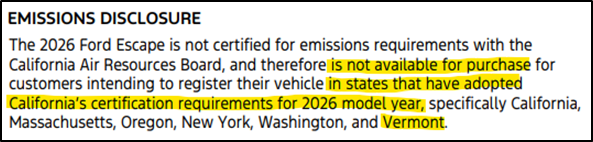
Beginning in 2026, Vermont car buyers will be unable to purchase new model Ford Escape due to the state’s adoption of California’s Advanced Clean Cars II Rule. Also known as the California Cars Mandate, the rule requires automakers and car dealers to meet emissions standards for new vehicle sales that exceed federal requirements.
While Ford intends to discontinue all sales of the Escape after 2026, it has remained one of the more popular compact SUV models since its debut in 2001. The 2025 model averaged a combined 30 mpg local/highway.
Missing out on the last model year of one compact SUV may have a minimal impact on Vermonters, but it’s a sign of things to come so long as auto sales in the state remain subject to California emissions standards.
Are the California Cars and Trucks Mandates realistic for Vermont? No. In the second quarter of 2025, electric vehicles represented just under 9% of new light duty car and truck sales in Vermont. That was a 25% decline in the EV share of all passenger vehicle sales in the state compared to 2024 Q2.
The California Cars Mandate requires that auto makers deliver an increasingly unrealistic volume of passenger electric vehicles as a percentage of all vehicles for sale in Vermont:
– 2026: 35%
– 2029: 58%
– 2032: 82%
– 2035: 100%
While not technically a mandate that car buyers purchase an electric vehicle, California Cars effectively leaves people with fewer and eventually no gas or diesel powered options. Absent radical improvements in technology, Vermonters’ only choice for a new car or light-duty truck will be electric starting in 2035.
The California Trucks Mandate follows a similarly aggressive schedule without reaching a requirement that 100% of medium and heavy duty trucks be electric.
With federal EV tax credits for buyers ending on September 30, 2025, it is even less likely that Vermont could meet the California Car delivery requirements without major disruption or disconnect between what is offered for sale and what car buyers are willing to purchase.
In December 2024, the Alliance for Automotive Innovation warned Vermont Lawmakers that further sales restrictions are likely as the California Cars Mandate ramps up, and that new passenger vehicle prices will continue to rise as a result.
Moreover, automakers are increasingly pulling back on plans to make more or transition completely to electric vehicles and instead focusing on increased production of more affordable hybrid vehicles.
In December 2025, Ford announced the discontinuation of the highly vaunted electric F-150 as part of a larger shift toward hybrid vehicles instead of an all-electric future. Some estimates peg Ford’s electric vehicle losses at more than $35 billion since 2022.
Several other major automakers have signaled a similar shift away from all-electric promises toward a more practical hybrid future.
What’s Happening at the State Level? In May 2025, Governor Scott issued an executive order pausing full implementation of the California Cars and Trucks Mandates until January 1, 2027. The governor cited many of the concerns above as the basis for his action, which NFIB VT applauded.
Read more about Governor Scott’s executive order and NFIB VT’s support for legislative repeal of the California Cars and Trucks mandates here: NFIB Applauds Gov. Scott’s Action to Pause California Cars and Trucks Mandates.
However, the mandate’s vehicle delivery schedule would kick in if the legislature does not repeal the mandates or the governor does not extend the executive action.
What’s Happening on the Federal Level?
Earlier this year, Congress rescinded federal approval for a suite of California regulations that impose stricter emissions standards than what the federal government requires. That revocation would impact states that have adopted the California rules, like Vermont.
However, the federal revocation remains subject to ongoing court challenges that may take years to reach a conclusion.
The California Trucks Mandate was also part of the Congressional action. The Congressional repeal and the mandates are the subject of ongoing litigation between California, the federal government, and auto makers.