
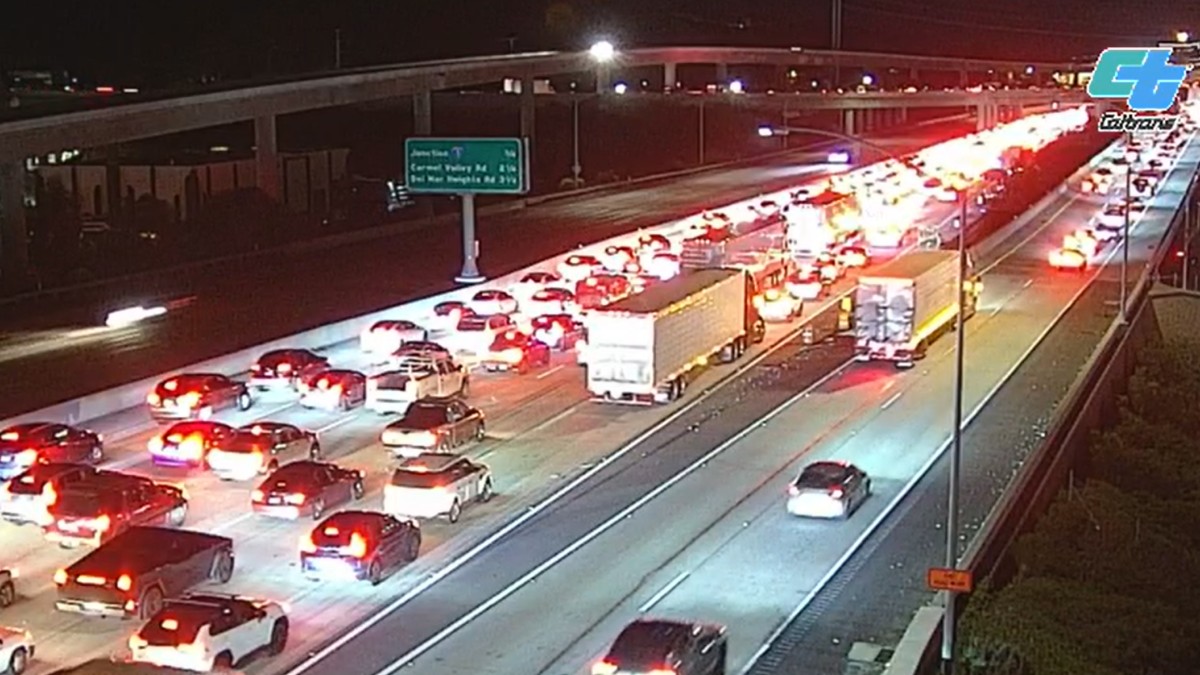
 Traffic backup on Interstate 5 north shortly after 7 p.m. Dec. 5. (Image from CalTrans camera)
Stretches of Interstate 5 have been temporarily shut down for planned or emergency closures at least once a month since September.
And apparently San Diego County motorists are fed up and have made sure their elected representatives know it. Three state senators, four assemblymembers and one San Diego city councilman signed a letter, dated Monday, to state transportation and law enforcement officials demanding answers for how the agencies handle prolonged freeway closures, in the wake of the latest incident, on Dec. 5.
“We’ve heard from many about the unintended consequences of the Dec. 5 shutdown,” they wrote in the letter, which was also directed to the San Diego Police Department. “Parents could not pick up kids from childcare, people missed flights, workers couldn’t get to their jobs or get home from their jobs. When a major transportation artery is closed, it has profound negative rippling effects across our society.”
In the Dec. 5 case, one of three emergency closures over the course of the past seven weeks, a person threatening to jump from the Del Mar Heights Road bridge caused officers to post full and partial closures of I-5 lanes in the area for about eight hours.
That followed a closure that stretched for well over 12 hours in Oceanside on Nov. 22, prompted by a law enforcement pursuit and shooting.
A month earlier, a demonstration with live ordnance at Camp Pendleton in honor of the U.S. Marine Corps’ 250th anniversary led the state to close all I-5 lanes in the vicinity. Political opponents of Gov. Gavin Newsom mocked the decision, until it was revealed that a piece of the artillery hit a California Highway Patrol vehicle, was part of the security details for Vice President JD Vance’s motorcade.
In addition, each closure occurred on a Friday or Saturday, prime time for motorists heading to San Diego for weekend getaways or locals wanting to make the trip to Los Angeles or Orange counties.
Though the lawmakers took pains to note that public safety is a priority, they also said full closures can cause safety consequences too.
“We saw pictures of ambulances that were stopped on city streets in complete gridlock and their lights and sirens were on,” state Sen. Catherine Blakespear said following a Tuesday news conference on the issue.
Blakespear, who posted the letter on her office’s website, was joined by local state Senate colleagues Steve Padilla and Akilah Weber Pierson in signing it. They wrote that “the cumulative effect” of bringing freeways to a standstill, “raises serious concerns about coordination, communication and operations of our freeway system.”
They also sought to find ways to better connect law enforcement to the public in such situations.
“Collectively, these incidents underscore the need for greater clarity about how freeway closures are managed, how decisions are made in real time to address the incident, how to expeditiously reopen freeway operations, and how public communications are handled,” they said.
They raised one specific option, asking “are mass text message communications for freeway closures feasible?”
The letter was sent to Caltrans Director Dina El-Tawansy, , CHP Commissioner Sean Duryee and SDPD Chief Scott Wahl. Joining the senators in signing were assemblymembers David Alvarez, Tasha Boerner, Darshana Patel and Laurie Davies, along with San Diego City Council President Joe LaCava.
READ NEXT