
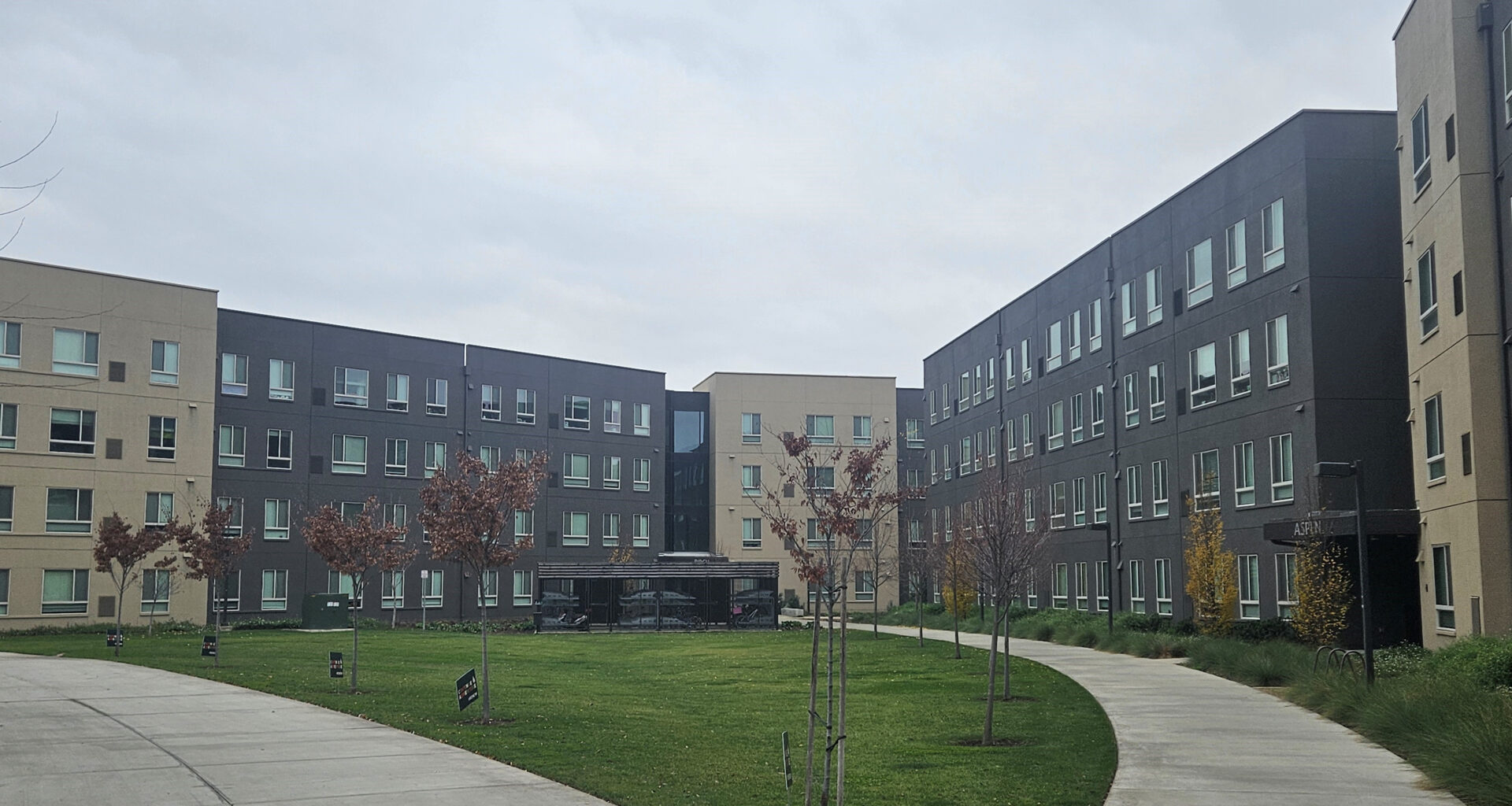
Starting in Fall 2026, the dorm experience for many freshmen at Sacramento State will become mandatory, under a new university policy that will require non-transfer, first-time students to live their first two years on-campus.
With this change, Sac State becomes one of a handful of California State University campuses to institute a live-on policy. University President Luke Wood announced the requirement in August as a way to provide for a student’s basic needs and academic success.
He also referred to the new requirement in the context of moving Sac State away from being a “commuter campus” and toward a more residential experience.
University officials have outlined a list of exceptions to the policy, but the requirement has drawn criticisms about potential costs to students — particularly those who are low-or-middle-income — and questions about whether Sac State has the capacity to house them.
Nadine Kelley is the Executive Director for Housing Services at Sac State. She spoke with Insight Host Vicki Gonzalez about the new housing policy, and how the university is navigating student concerns and potential exemptions.
This interview has been edited for length and clarity.
Interview highlights
What happens within Sac State’s housing department with this new living requirement?
So the idea actually comes from beyond housing. Having a live-on requirement is something that is a part of many institutions nationwide, and I would say as far as I remember it was a requirement for a lot of schools when I was looking at colleges in the 90s. There’s some research that really shows that having students have the opportunity to live on campus their first year, their first two years, really helps ground them for on-time graduation.
I know one of the biggest things we’re trying to do in California is get our students graduated within four years… just reducing the time that they’re spending with us and even reducing some additional expenses that they take on by extending their graduation. So just living on campus really gives that well-rounded experience. Students get to meet people, get engaged quicker with campus, and really just walk away with a lifelong experience that really excites them… and just a real connection with their institution, and really creating lifelong Hornets.
There has been talk over the last several years of shedding the “commuter campus” identity of Sacramento State, going back to former President Robert Nelsen. Why is now the right time to implement a requirement like this?
I think the exciting part is our students have shown us that they have a large interest in living on campus. We’ve done a number of studies over the past couple of years and students are asking for more places to live on campus or near campus. We’re fairly landlocked, so there’s not very many more spaces for us to grow, but they want more opportunities to be engaged and have that live-on-campus experience. That’s definitely something coming from mostly our students that are living out of the area.
Something that we notice is that out of that 50-mile-and-out population, we’ve naturally captured 80% of that student population already self-selecting to live on campus. We’re having conversations with the academic deans about what does this really mean to have so many first year students living on campus? How do we bring the academic experience to where they’re living? One of the top reasons why students enjoy living on campus from a lot of the surveys that we’ve done year after year… convenience. We want to make sure that we can provide our students with the convenience to all of the resources and all of the things that they get to experience on campus.
Do you have the capacity to hold all of these students?
We definitely do. We have a lot of students at Sacramento State, but this policy does not require all of the 31,000 students to live on [campus.] In fall of 2024 we had a little over 3,900 true freshmen that enrolled at Sacramento State. Out of that number… about 1,400 students lived 50 miles and out. We actually have the capacity now, and starting next year, for that. Even with the onboarding of Mt. Whitney, we can hold a little over 1,800 first-year students.
Why should Sacramento State become one of a handful of CSU campuses that have mandatory on-campus living?
We are one of the few that are going to have it, but there’s quite a few that are in the exploration phase. The recent research really is strong, and it shows year after year after year across the nation, how students are having these opportunities to be successful. It goes beyond just the act of living on campus. It’s everything that we, the institution, are going to want to put into that experience. We have resident advisors. We have full-time professionals that live on campus. We function 24/7 for our students. Crisis, good things, great things, we are there for their support.
The policy initially sets a 50-mile threshold, but that shrinks to 30 miles after the first year.
We actually still have a great deal of students that choose to live on campus that see the benefit of being even closer. Already we’re capturing, I want to say around 400 students each year that live within the 0-50 miles. We’re seeing that interest, their desire to be part of this community that we’re trying to grow and develop, and the experiences that we’re offering them.
There are definitely students in that population that are not interested for a variety of reasons and they’ve chosen not to live on, and a lot of them are going to fall within that exemption area. Our student parents, those that are married, students that are so much older when they come to college, in financial hardships.
There are financial exemptions, but how is the university going to help low-to-middle-income students if they fall under this housing requirement? Wouldn’t this further financially strap them?
I can’t speak to what that experience is going to do for an individual family, but when they do those financial exemptions, they get to tell their story. We actually already have financial exemption processes. So, when students apply for college and they apply for housing sometimes things change. They come back and they tell their story, and we take a look at where we can provide some support… whether we have to release them from their agreement, are there other resources through the CARES Office or through Advancement, is there a scholarship we might have missed?
When we’re looking at those students that have probably already made those decisions, we’re looking at a population that’s under 300 right now based on the capture rate that we have. Then we have that group of students that didn’t choose to live on campus that might fall in those exemptions. That’s a little under 300, and those are the students that are probably dealing with financial hardship.
This new requirement is also coming at a time when tuition and the cost of living are increasing. How do you respond to people that are concerned this might price them out?
There’s a lot happening in society and we understand that, and that’s why our policy has exemptions. That’s why we are open to hearing every family and every student’s story. If this is something that’s really out of their ability to do so, we are willing to even look at something that doesn’t fall in that box. We call it a case-by-case review. We will look at and hear from every single student that has a concern.
When you’re living on campus you have housing, but you also have meal plans, parking, and additional costs. That money goes to the university right?
University Housing Services is not a state-funded or federal-funded or university-funded department. All of the fees that we have actually just regenerates into serving the students that live on campus. Our staff is all state employees, but our department actually funds itself.
We provide our students with a lot of resources. There’s no utility fees. They have no cost for laundry. We feed back into their experience with their resources. All of their fees pays for our mortgages, our utilities, all of the expenses that it takes to operate University Housing Services. And, some of it gets seeded to fund new properties. We did have a contribution towards the Mt. Whitney facility and all of those revenues goes towards now creating more additional housing for students at Sacramento State.
Students are going to be getting their acceptance letters. What should they prepare for regarding this policy?
We’ve already been having conversations. We actually notified students officially Oct. 1 when the CSU Apply application opened up, so we’ve been very transparent with this new policy. Every incoming student knows, and then they’ve actually committed to understanding the policy. Our prospective students are gearing up for this particular process. They know that once they get accepted, one of their next steps after saying “yes” to Sacramento State is going to be filling out the housing application so that they’re in compliance with the policy.
Editor’s note: CapRadio is licensed to Sacramento State, which is also an underwriter.