
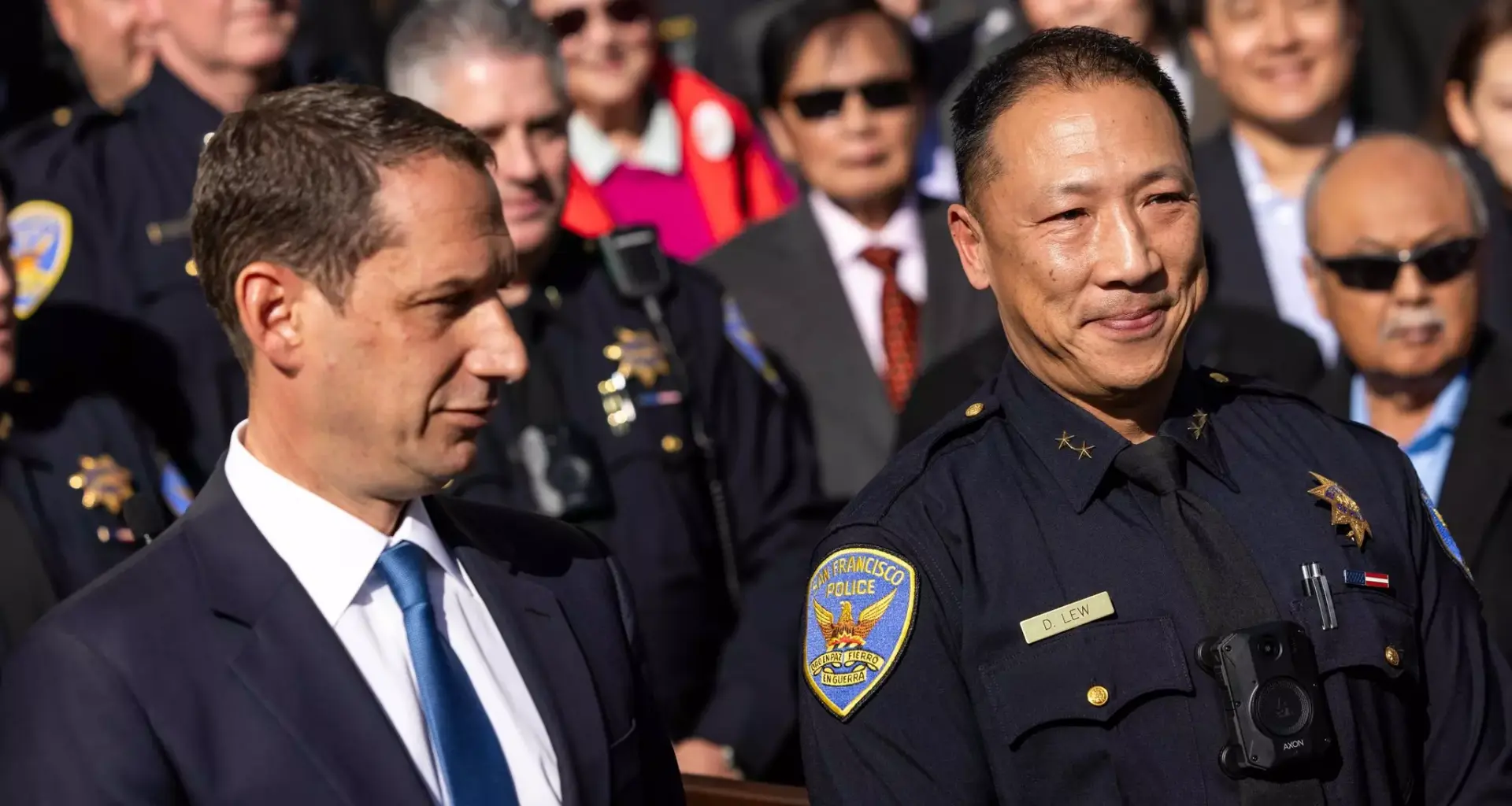
The man Mayor Daniel Lurie chose as San Francisco’s police chief nearly wasn’t even a contender.
Derrick Lew, the former deputy chief of operations whom Lurie elevated to top cop, was the most polarizing of the three candidates sent to the mayor by the San Francisco Police Commission, according to two sources with direct knowledge of the hiring process.
The other two finalists, Deputy Chief of the Administration Bureau Nicole Jones and Commander Jack Hart, both received unanimous endorsements from the seven-member commission, which vets the finalists. Lew received four votes in favor of his nomination and three against it. Details of the commission’s vote have not been previously reported.
At issue for the commissioners who voted no were concerns about Lew’s lack of experience as top brass, as well as a fumble during a public-facing crisis, sources say. But his selection by the mayor raises the question of whether his elevation was a foregone conclusion.
Lurie’s choice of Lew reveals the complicated calculus that goes into choosing the top cop: a careful weighing of identity, experience, labor relations, self-presentation, and pliability.
 Lew takes command Dec. 22. | Source: Amanda Andrade-Rhoades/The Standard
The selection process offers early signs of the type of leader Lew may be when he takes command Dec. 22. It also reveals Lurie’s priorities for a department that is invigorated by recent drops in crime while simultaneously turning its back on long-promised reforms.
The search begins
The May retirement of Chief Bill Scott, long anticipated after eight years under three mayors, kicked off the search for a permanent replacement, as interim Chief Paul Yep minded the store.
Scott had been brought in from Los Angeles in 2016 to lead a reform effort inspired by several high-profile officer-involved shootings, only to pivot late in his tenure toward crackdowns on drug markets.
San Francisco’s post-Covid era of law enforcement can be characterized by a cultural retrenchment backed by a political establishment and voters who had lost patience for soft-on-crime policing. In recent months, as crime dropped to near-historic lows, City Hall has kneecapped the Police Commission’s power, removed a dissident commissioner, and handed the SFPD new toys like drones and automated license-plate readers. Officers have also been granted broader discretion in car chases. Lurie, elected on promises to restore order and target street-level drug dealing, was eager to find a chief aligned with those goals.
 Deputy Chief Nicole Jones was a finalist. | Source: Amanda Andrade-Rhoades/The Standard
The commission and an outside search firm, aided by listening sessions with the public, assembled a list of 34 candidates. Lew joined late — encouraged, a source says, by higher-ups to put in his application just before the deadline. When asked whether he pushed Lew to apply, Yep offered the diplomatic line: “I encouraged every commissioned officer who qualified.”
Inside the department, Lew is largely seen as a nuts-and-bolts operator — less a charismatic leader than a steady hand.
Prior to his promotion to deputy chief, Lew had a minimal public profile and modest high-level experience. But he brought two assets prized in this political moment: leadership of the SFPD’s recent drug-market suppression efforts and symbolic resonance as an Asian American (opens in new tab) in a city where that demographic has become a key voting bloc.
“We are 37% of the population now. It’s long overdue,” said former Deputy Chief Garret Tom, a Chinese American who said his money was on Lew from the beginning.
Reading the tea leaves
When stacked against other contenders, Lew’s résumé was comparatively thin. He had been deputy chief for only six months and had led just one station as captain. Most of his work as a cop had been investigatory, and he managed the city’s drug crackdown effort as head of the Drug Market Agency Coordination Center.
However, a longer tenure in leadership means more time to make mistakes. Choosing a chief is a delicate dance between finding a polished representative of the department and choosing someone who has the respect and admiration of rank-and-file cops.
 Commander Jack Hart. | Source: Courtesy SFPD
Jones, who was promoted to deputy chief by Yep, had more administrative experience than Lew and plenty of face time with politicians (opens in new tab) and the public. She has run one station as a captain, with a promotion in 2021; later that year, she was promoted again to commander, giving her four years in the upper ranks.
Under Scott, she rose quickly because of her leadership chops and worked on reform efforts. While Jones has fans who see her as a capable leader with an eye on leading the department one day, her lack of experience as a street cop and efforts working on reform did not sit well with many officers.
Hart, who became an officer in 1999, was made captain in 2016. Since then, he has led several stations and the academy and worked closely with the reform efforts under Scott. An attorney, Hart was promoted to commander in the risk management unit in May. Popular and beloved by some in the department, Hart is seen as a true believer and a passionate advocate for police work.
Lew’s ascent to the top of the candidate list began even before the commission kicked off its vetting work. Scott elevated him to deputy chief just before resigning. Lew, who joined the SFPD in 2003, climbed the ranks quickly after becoming a captain in 2022, when he was assigned to lead the Ingleside station. He was named a commander in 2024. Lew is seen as a cop’s cop, someone who looks the part and has worked the streets but has remained unblemished by discipline reports or skeletons in his closet.
‘I wish him well. I just think he bit off more than he can chew.’
Tony Montoya, former Police Officers Association president
“Derrick Lew has a ton of experience that will go into managing a large organization,” said SFPD spokesperson Evan Sernoffsky, adding that as deputy chief of operations since May, Lew had been overseeing all 10 district stations.
During the commission debate over his candidacy, Lew’s lack of experience was a major point of contention. Some commissioners thought Lew had scant management experience and little of the prime-time, public-facing chops a chief needs. When he spoke for the department about how SFPD should manage Immigration and Customs Enforcement and the protests around them, his response didn’t land well with everyone (opens in new tab). He said the SFPD will act as peacekeepers instead of protecting the public against ICE. He was perceived by some commissioners as a candidate without a large, grand vision for the department.
Others found that lack of ambition to be a positive, viewing him as a “boots on the ground” leader whom the troops would follow. His time leading DMACC was seen as an asset in line with a major political priority for Lurie: ridding the city of open-air drug dealing. There was also a sense that he was close to Yep, providing a level of continuity with the interim chief’s leadership.
 Former SFPD Commander Steve Ford was later police chief in Antioch. | Source: Courtesy SFPD
The two other candidates’ negatives were fewer, although Jones and Hart’s association with reform and their supposed lack of gravitas gave some pause, according to sources with knowledge of the debate.
A fourth candidate, who missed out on the shortlist by one vote, was former Commander Steve Ford. Commissioners believed he had too much baggage from his time as chief of Antioch’s scandal-plagued department.
As the mayor deliberated over the three finalists, there were subtle signs that Lew was in pole position. During a public response to a proposed National Guard deployment in October, Lew appeared beside Lurie (opens in new tab) as acting chief. At a Nov. 13 memorial ceremony for an officer killed in action, Lew was positioned to the right of Yep, another indication of succession planning.
Experience matters
Many inside the department describe Lew as a capable choice with a strong rapport among rank-and-file officers, an important factor in any leader.
Former colleagues, including onetime interim Chief Toney Chaplin and Lew’s former boss Commander Teresa Ewins, praise his work ethic and temperament. Those who are apprehensive speak of the difficulties and political and administrative realities of running an $800 million, 2,000-member department.
“I wish him well. I just think he bit off more than he can chew,” said former Police Officers Association President Tony Montoya, highlighting an incident in which he saw Lew “overwhelmed” at the site of a shooting soon after becoming captain of Ingleside station.
 Lew, center, alongside police colleagues earning promotions in 2024. | Source: Tâm Vũ/The Standard
His challenges loom large. Lew will oversee recruitment, facilities, fleet management, long-term staffing strategies, and the delicate dance with the Police Commission. It’s a far cry from street-level policing.
“Navigating the commission will be steep learning curves for him,” said Catherine Maguire, former executive director of the SFPD’s Strategic Management Bureau. “And then there’s the need to develop and set the overall vision for the future of the police department. What is the future state of SFPD that everyone works together to become?”
Still, Lew enters the job with deep investigative and patrol experience, a powerful ally in Yep, a clear mandate to put reform on the back burner and focus on quality-of-life crimes and drug enforcement, and a mayor whose own political standing is tied closely with the chief’s success in reducing crime.
San Francisco may have a new chief, but the old order is very much back in command.