
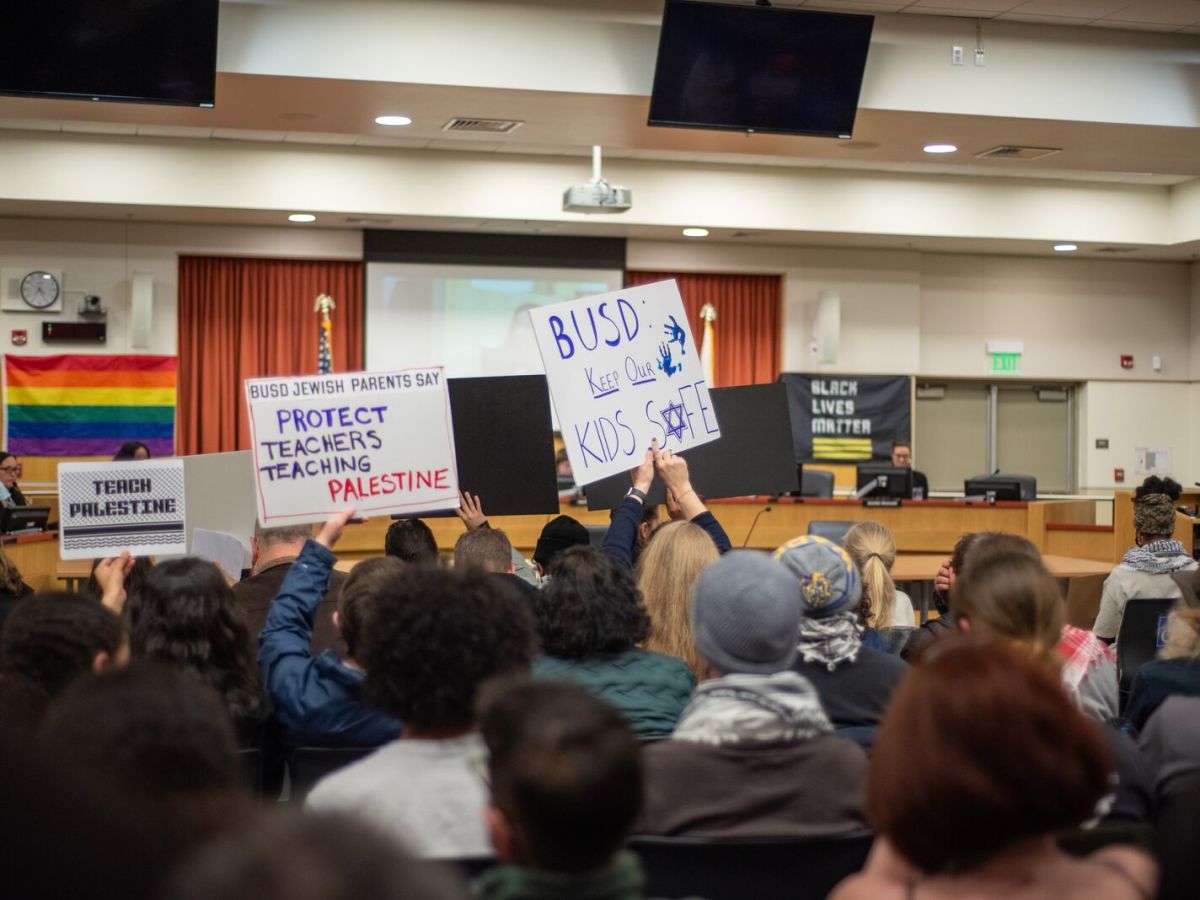
 In this March 2024 file photo, members of the Berkeley school community packed a BUSD board meeting in support of ethnic studies programs focusing on Palestinian history. Credit: Ximena Natera, Berkeleyside/CatchLight
Berkeley Unified again found itself thrust into the center of a national debate over how to teach the Israel-Palestine conflict in classrooms, after congressional Republicans announced last month that the district is one of three being investigated over claims of antisemitism.
Now, some Berkeley Unified community members are urging district leaders to not comply with requests from Congressional Republicans conducting a federal probe into alleged antisemitism in Berkeley schools, citing privacy and safety concerns.
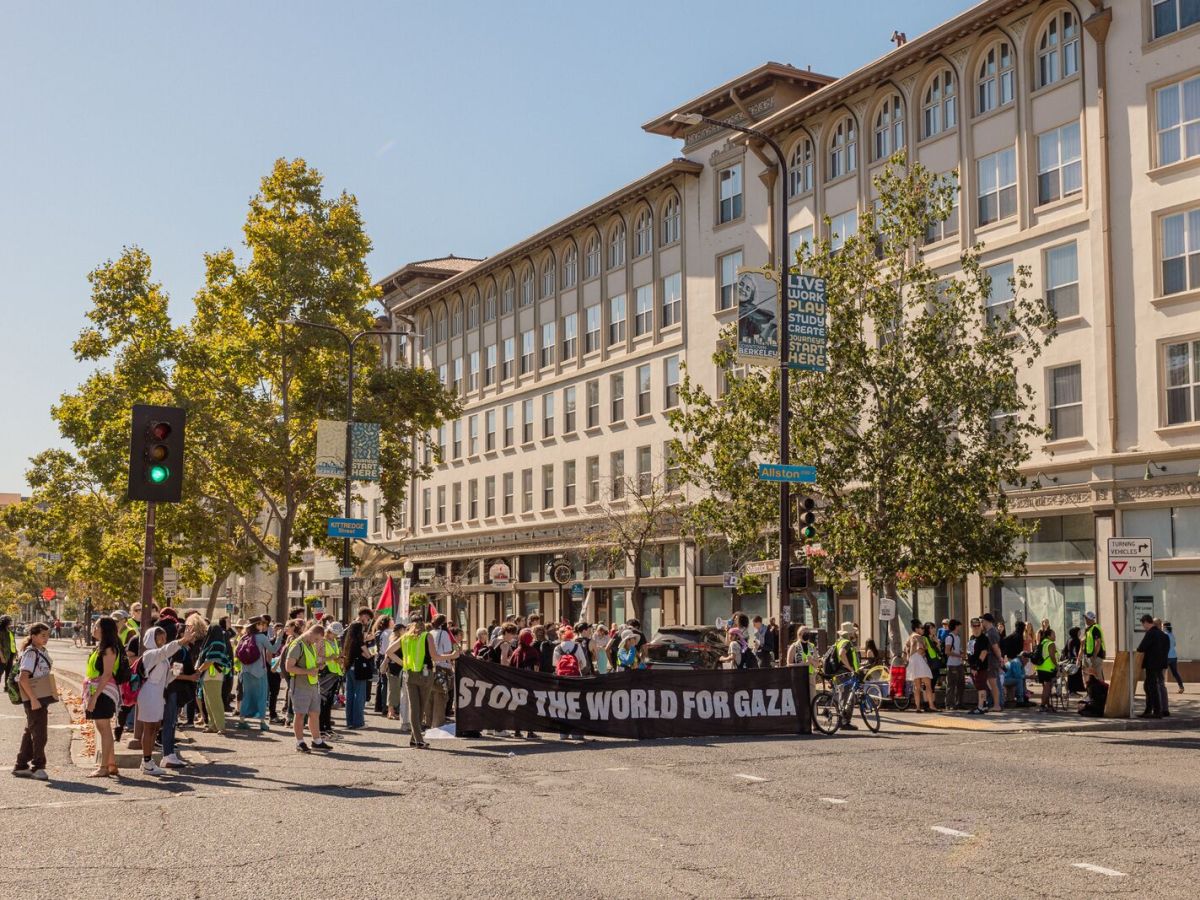
Berkeley Unified School District (BUSD) was one of three districts named in the investigation announced in late November, along with Fairfax County Public Schools in Virginia and School District of Philadelphia. In their statement, Republican lawmakers referenced walkouts and demonstrations, offensive imagery and harassment of Jewish students from BUSD educators and staff in “classrooms and hallways.” District leaders at the time said the claims are old and have been addressed, and that the inquiry would be responded to “appropriately.”
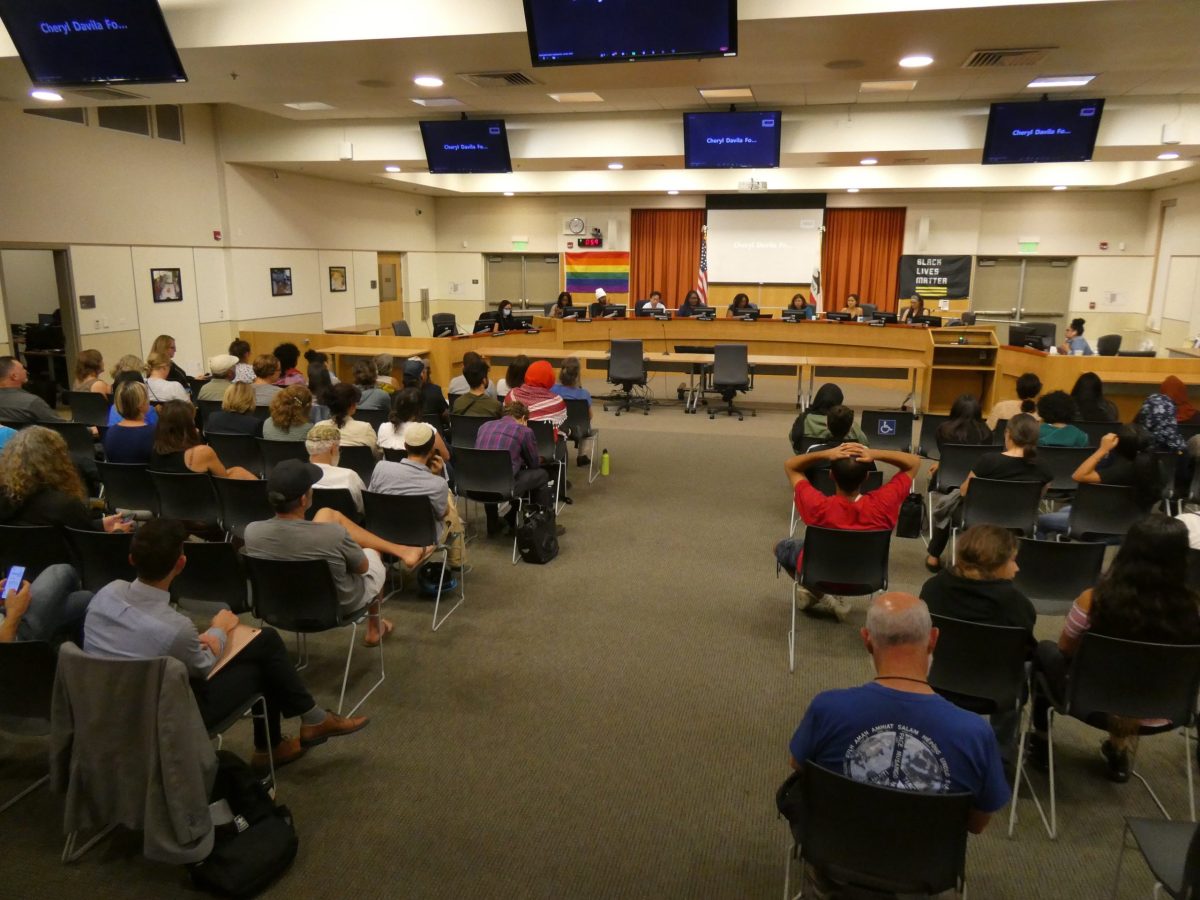
Last Wednesday, several Jewish BUSD students and members of the community attended the final school board meeting of the year, asking that district leaders protect free speech at schools. They said releasing personal information to the federal government for its inquiry could lead to privacy breaches that have negative consequences for students and staff.
“I truly appreciate how hard the district has worked to protect its students, families and staff in the wake of these trials. I know that you will continue to protect us, but I sincerely hope you do not comply with these requests,” Hannah Slattery Weisberg, a Berkeley High junior, told the board Dec. 10. “By providing information to the House Republicans, we open the gates to doxing and witch hunts, neither of which makes anyone safer.”
Emmett Davis, a freshman at Berkeley High, also spoke during public comment, sharing with the board that his teachers have appeared “frightened or nervous” when the subject of Palestine is brought up during relevant class lessons.
“I urge you to protect our teachers and our right as students to learn about atrocities, current and in the past, even if they make some people feel uncomfortable,” he said.
School board member Jen Corn said during the meeting that she was “very grateful” for the advocacy “on behalf of our students and teachers.” Board members clarified that no vote on the federal inquiry would take place that night, and it was not clear what, if any, information would be requested in the probe or released by the district.
The congressional investigation into BUSD was announced two months after UC Berkeley released the names of about 160 students, staff and faculty to the U.S. Department of Education in September, as part of a different federal probe into antisemitism on college campuses. The decision drew criticism from many students and faculty, who raised similar concerns about privacy and free speech.
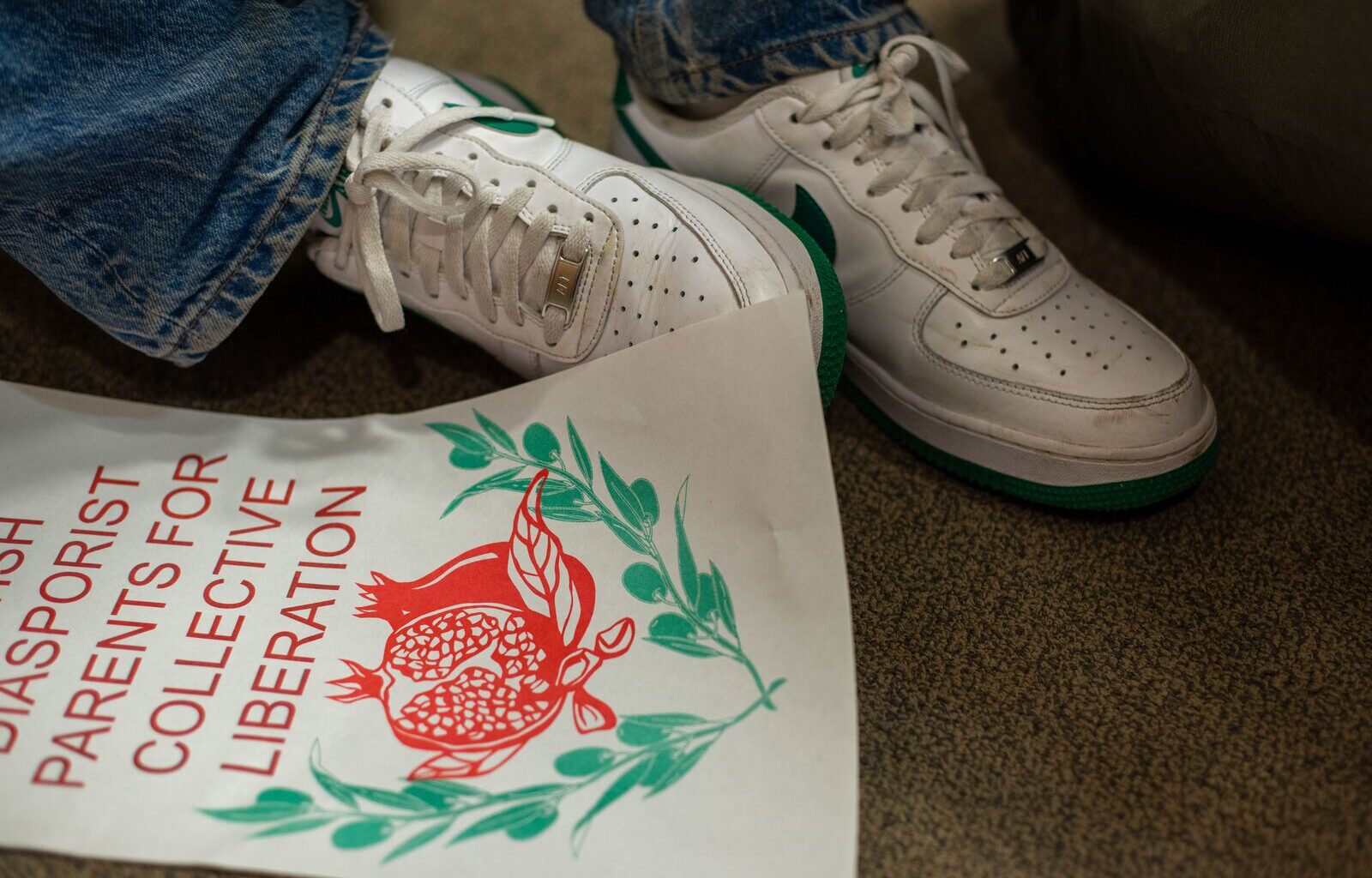
In a statement released after the announcement of the federal inquiry into BUSD in November, local activist group Berkeley Jewish Parents for Collective Liberation said the claims are “tired, fully investigated and determined to be baseless.” They also called on district leadership, including the superintendent and board members, to not comply with requests for documentation.
“Jewish children are safe and thriving in Berkeley’s diverse schools. Congress is cynically using Jewish students to attack BUSD’s long-standing commitment to social justice,” according to the statement. “We support our educators teaching our students about global history, U.S. militarism, and race, in connection to current events.”
Other members of Berkeley’s Jewish community are more supportive of the federal investigation. In an email statement to Berkeleyside on Wednesday, the Jewish Coalition of Berkeley, which sprang up in the aftermath of the Oct. 7, 2023, Hamas attack on Israel, urged BUSD to fully comply with the federal inquiry as “an important step toward restoring trust.”
“Many BUSD students have experienced antisemitism in school settings, as well as the extreme politicization of the classroom by many teachers that has left Jewish students feeling targeted, isolated, and unwelcome,” according to the statement. “A civil rights investigation is needed to affirm the lived experiences that have been reported repeatedly by families across multiple schools in the school district, and to push district leaders to take necessary steps to reform and enforce policies that protect the rights of Jewish students.”
BUSD’s role in California’s new K-12 antisemitism legislation
In its November letter to BUSD, the congressional Committee on Education and Workforce said the federal investigation aims to determine whether the district is or was a hostile environment for Jewish students. The committee is seeking documents to assess compliance and to determine whether federal legislation to “specifically address antisemitic discrimination” is needed.
State legislators have already passed a similar law. California Assembly Bill 715, signed in October, aims to prevent and address antisemitism and discrimination in K‑12 schools. It will go into effect Jan. 1.
But the bill has faced pushback, with a coalition of four California public school teachers, the organization LA Educators for Justice in Palestine, and three public school students filing a lawsuit seeking an injunction to prevent AB 715 from going into effect next year, according to EdSource. They argue the law is overbroad and would violate their First Amendment rights to openly discuss the Israeli-Palestinian conflict.
A federal judge in San Jose heard arguments on Wednesday for Prichett v. Newsom, named for lead plaintiff Andrea Prichett, a history teacher at Berkeley’s Willard Middle School. Prichett has been under investigation for months, according to the complaint, due to her drawing a connection between colonialism and Israeli settlements in the West Bank.
Prichett has been a public pro-Palestinian voice, urging the Berkeley City Council to support a ceasefire resolution, according to the complaint. She also helped create the “Watermelon Society,” a student club at her school that offers a “safe space to talk about their feelings regarding Israel and Palestine … and share cultural traditions.”
Before the club’s first meeting, the school principal informed Prichett that some parents were uncomfortable with its existence and asked her to avoid using words like “genocide” and “colonization.” According to the court document filed by the plaintiff coalition, Prichett has been the subject of two complaints at the school, both of which were determined to be unfounded following investigations.
Prichett said in the court filing that she has “almost no doubt that I would be a target under the new law.”
The role of Berkeley Unified and other Bay Area schools in shaping this legislation cannot be overlooked. A 2024 federal civil rights complaint alleging unaddressed “severe and persistent” harassment of Jewish students in BUSD propelled the school district into the national spotlight. In May that year, Superintendent Enikia Ford Morthel testified before Congress and denied that antisemitism was widespread in Berkeley schools.
Allegations of antisemitism within BUSD were raised repeatedly this year at the state Capitol during hearings and public comments on AB 715. Sen. Jesse Arreguín (D-Berkeley) said during a Senate floor hearing on Sept. 12 that he was in “strong support” of the bill.
“Prior to my election to the Senate, I served as the mayor of Berkeley, and I’ll say that the issue around antisemitism is a very serious issue and a very visible issue in my community,” Arreguín said.
He mentioned a few incidents he said occurred after Oct. 7, 2023. He said Berkeley High teachers authorized a walkout in which students chanted antisemitic slurs, and an art teacher showed pro-Hamas videos in class and “papered his classroom walls with anti-Israel antisemitic images.”
In a different September hearing, David Schonholtz with the Jewish Community Relations Council of the Bay Area spoke in support of the bill during public comment. “I’m a Berkeley resident who is terrified for Jewish students in California,” he said.
BUSD did not respond to questions about how the state legislation is expected to impact its policies once it goes into effect next year.
AB 715 has also received pushback from Bay Area activist groups, such as the Berkeley Faculty for the Freedom to Learn, and the Berkeley Families for Collective Liberation.
Advocates and plaintiffs in the suit argue that AB 715 is vague, overly broad and would violate their First Amendment speech rights and chill an open discussion of the Palestinian-Israeli conflict. State officials responded that the law is consistent with other anti-discrimination legislation.
Five days after Arreguín’s comments in September, BUSD school board member Jennifer Shanoski, during a school board meeting, expressed disappointment with “the way that Berkeley Unified was incorrectly called out at some of those hearings.”
Shanoski said they “look forward to seeing changes to that bill in the year ahead.”
Additional reporting from EdSource.
Related stories
A debate over Israel-Palestine curriculum flares at Berkeley schools
March 21, 2024March 25, 2024, 11:18 a.m.
Berkeley school district walks thin line in response to Israel-Hamas war
November 3, 2023Nov. 6, 2023, 2:00 p.m.
BUSD, UC Berkeley student groups walk out over Israel, Gaza, Lebanon
October 8, 2024Oct. 10, 2024, 2:50 p.m.
“*” indicates required fields