
Two Venezuelan Americans living in Los Angeles, despite having opposing political views, agree that Nicolás Maduro, Venezuela’s authoritarian president, must be removed from power as soon as possible – by force, if necessary – so that democracy can return to the troubled South American nation.
Manuel and Lorena (not their real names) closely monitor news developments about their homeland. Venezuela has endured two decades of political repression and economic turmoil, resulting in nearly 8 million Venezuelans relocating to neighboring countries, with a small portion also migrating to the United States.
For months, President Donald Trump warned Maduro he must step down or face American might. Trump has significantly increased military and economic pressure on Venezuela to isolate the “leftist” president. This includes at least 25 recent military strikes on alleged drug trafficking boats in the Caribbean and Pacific, which resulted in at least 95 civilian deaths. He has designated the Venezuelan government as a foreign terrorist organization, seized an oil tanker and issued ultimatums along with airspace closures. Earlier this week, Trump escalated the situation further by ordering a blockade of all Venezuelan oil tankers.

Now there is talk of war, and Manuel from Reseda and Lorena from West LA expressed their hope for imminent change in an interview with the San Fernando Valley Sun/el Sol.
Manuel holds right-leaning views and Lorena leans to the left, but both desire a swift return to democracy to their South American homeland. They hope that Trump’s pressure on Maduro suggests that regime change is on the horizon after decades of turmoil.
“I believe there will be a significant action to help Venezuela recover its democracy,” Manuel said, “which involves confronting a regime that is damaging the Venezuelan people.”
“We need radical change,” said Lorena. “Venezuelans have not been able to unseat Maduro in elections. If you have people that don’t have a recourse for political change, they don’t have any [other] recourse.”
Both interviewees requested that their real names be kept confidential due to concerns about potential repercussions for themselves and their families, both in the United States and Venezuela.
Over 7.7 million Venezuelans have left their country since 2014, according to the United Nations, making it one of the world’s largest displacement crises, with most residing in Latin America and the Caribbean, driven by economic collapse, hyperinflation, shortages of essentials and political repression, creating a massive exodus known as the Bolivarian diaspora. Over half a million of those migrants reportedly live in the U.S.
Manuel supports Trump’s actions against Maduro’s government, including a potential U.S. military action on Venezuelan soil to restore democracy. “I believe it would be in legitimate self-defense, in defense of the Venezuelan people.” He likened the situation in his homeland to that of a house where a woman and child are being abused, suggesting that the police have a right to intervene due to the abuse of power. Manuel added that the United States has the right to intervene in the face of such grave injustice.
“I believe that a targeted military intervention by the United States, with minimal impact on civilians, could bring an end to the situation that has persisted for over 25 years,” he said, adding that large portions of Venezuela’s military and police force are prepared for a change of regime.
Lorena initially opposed any American military action due to concerns about potential civilian casualties. Instead, she supported political and economic measures aimed at weakening Hugo Chávez and Maduro. However, after more than 20 years of authoritarian rule, she has recently become more receptive to Trump’s threat of military force to remove Maduro from power.
The woman had hoped that the election of Chávez in 1999 would bring about the social and economic justice she envisioned for oil-rich Venezuela.
However, Lorena soon became disillusioned. She remembered witnessing military personnel beating someone in a back alley during a protest in Caracas, the nation’s capital, in 2001. She also attended another protest that turned into a massacre, during which armed militias began shooting. Lorena recalled, “Chávez’s armed militia started shooting at us, and one of my friend’s mothers was shot, while another friend’s sister was killed.”
Ultimately, she decided to leave for New York. However, blogging about Venezuela from the U.S. led to her receiving death threats.
Lorena said that the international community has failed Venezuela, particularly criticizing the Organization of American States for its inaction since Chávez’s abuses in the early 2000s. She returned to her native country to serve as an international observer during a presidential referendum, visiting rural Venezuela and speaking with impoverished citizens who reported being bribed with food baskets in exchange for voting for Chávez. Additionally, she spoke with ministry staff who had been threatened by their superiors, who warned them that the automated voting system would reveal how they had voted.
Lorena’s family has been directly impacted by the ongoing crisis in Venezuela. Her brother, a pediatrician with 40 years of experience working at a state hospital, faced pressure from his superiors to classify child deaths as due to natural causes rather than a lack of resources.
When he refused to comply, he was threatened, which ultimately led him to relocate his family to the U.S. about four or five years ago. He currently works in a warehouse during night shifts in his 60s.
Lorena shared that a nephew was deported from the U.S. and expressed concern for the safety of Venezuelans in the country, especially following the end of Temporary Protected Status (TPS) and the continued deportations to Venezuela, despite the presence of warships directed at the nation. “That’s totally cruel,” she said.
Additionally, Lorena mentioned that she has another nephew who is a doctor but now installs air conditioners in the U.S., while another nephew works at night installing windows.
Both Manuel and Lorena were pleased to hear that María Corina Machado, the Venezuelan opposition leader, won this year’s Nobel Peace Prize. The Norwegian Nobel Committee recognized her for her “tireless work promoting democratic rights for the people of Venezuela” and for her efforts toward achieving a “just and peaceful transition from dictatorship to democracy.”
“Corina is truly a heroic figure,” said Lorena, who expressed her disagreement with Machado’s recent statements praising Trump. “I don’t know what it’s like to walk in her shoes. Maybe that was her only option to achieve anything, you know?”
Manuel said, “I really loved the acceptance speech that Machado’s daughter gave at the Nobel Prize ceremony when picking up the award,” noting that the award winner herself did not attend the event in person.
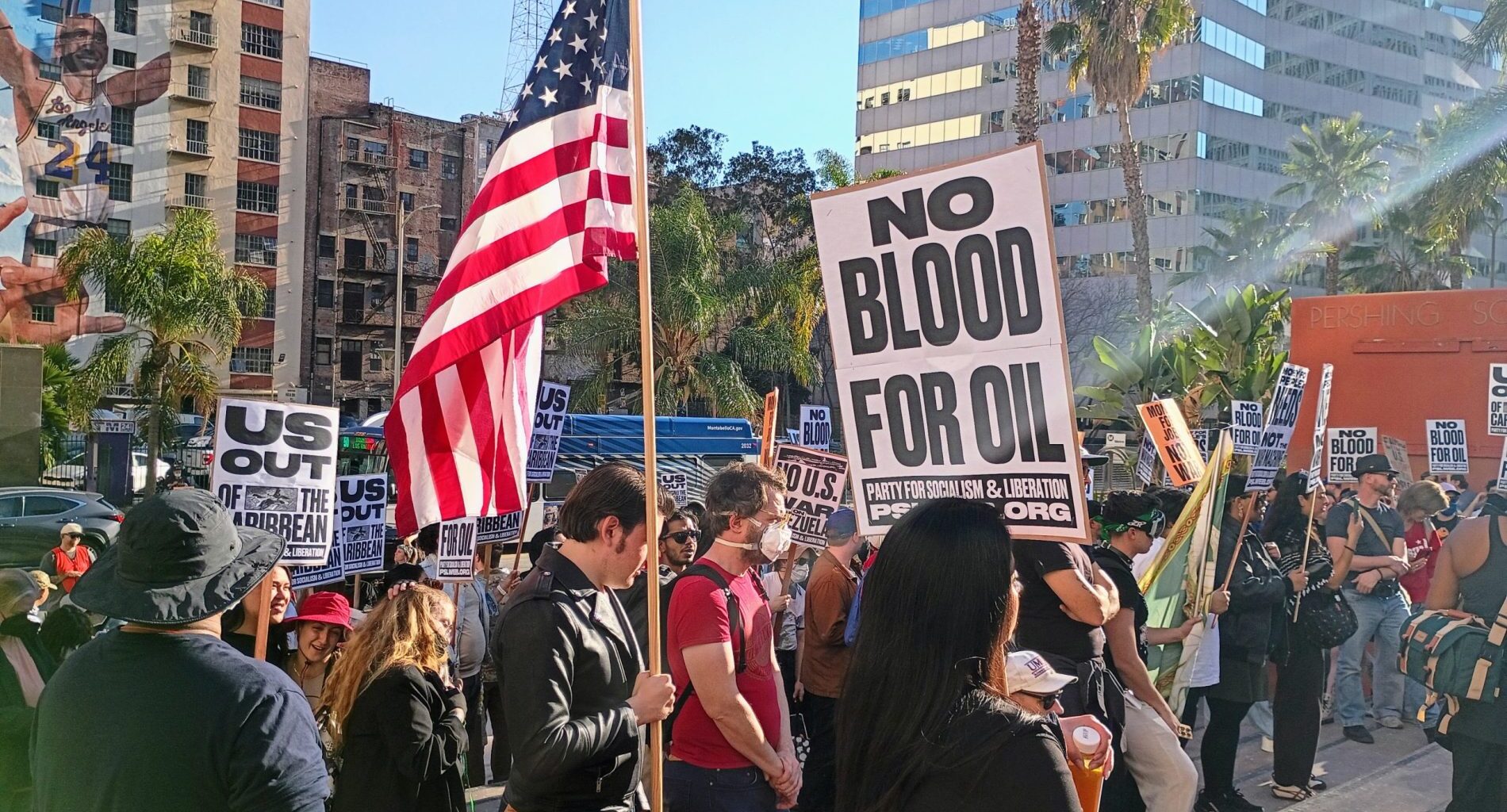
Earlier this month, demonstrations both for and against American military intervention in Venezuela took place in cities across the U.S. and around the world. In LA, hundreds gathered at downtown Pershing Square to rally against a war with Venezuela. Meanwhile, supporters held pro-Machado demonstrations in over 80 cities worldwide to support her efforts for democracy in Venezuela and to celebrate her recent Nobel Peace Prize.
Manuel and Lorena said they encouraged everyone who cares about Venezuela, regardless of their political beliefs, to educate themselves by reading reliable news sources and engaging in conversations with Venezuelans directly.
Meanwhile, Manuel and Lorena remain hopeful about the future in the coming days, weeks or months.
“I have learned from trustworthy news sources that there is a plan for the day after Maduro’s departure,” Manuel said. “This plan is very professional and outlines actions for the first 100 days, the first year and includes a call for new elections to normalize the situation.”
Lorena added, “Venezuelans have the right to choose the best candidate in a free and fair election.”
Related