
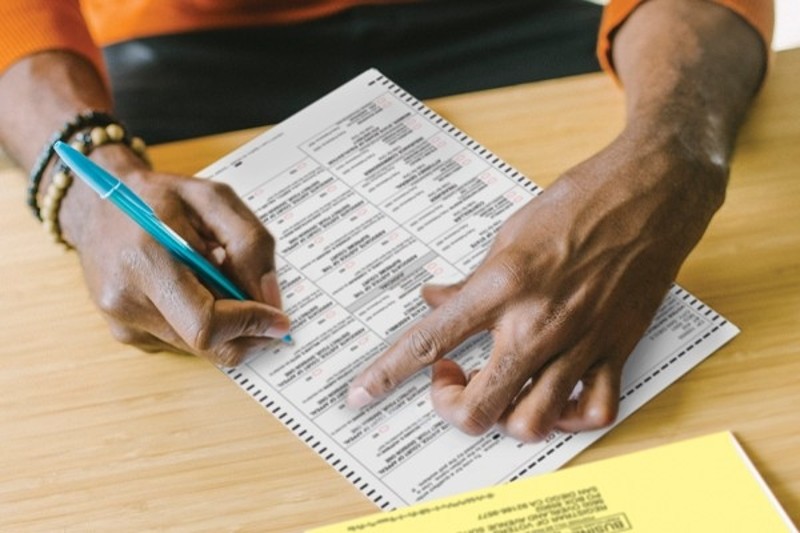
 Marking a mail ballot. (File photo courtesy of the San Diego County Registrar of Voters)
This column is probably a waste of your time.

Because this column is about voter ID. And even a minute spent debating voter ID is a minute thrown away.
Unfortunately, California is joining a pointless national debate over whether to require voters to show government-issued identification when they vote.
The occasion is a ballot initiative effort led by San Diego County-based state assemblymember Carl DeMaio, a Republican.
The Life Is Not Short and These Are Not Dangerous Times So Let’s Focus on Trivia Initiative (OK, that’s my name for it — its real name the CA Voter ID Initiative) is on the streets for signatures for the November 2026 ballot.
Under current law, when we Californians register to vote, we must affirm under penalty of perjury that we are U.S. citizens and provide information to verify our identities, including our dates of birth, Social Security numbers, or driver’s licenses.
The initiative goes further, by adding an amendment to the state’s dysfunctional and overstuffed constitution. The amendment would require voters to present either government-issued identification at the polls, or provide the last four digits of a government-issued ID number (probably your Social Security number) when voting by mail. The initiative also mandates that election officials report the percentage of each county’s voters whose citizenship they have verified.
Proponents of the initiative say that voter ID is necessary to prevent voter fraud.
Opponents of the initiative say that voter ID will lead to voter suppression.
Both are wrong.
Voter ID doesn’t prevent voter fraud, for two reasons.
The first is that there is precious little voter fraud in this country. Last year, the Brookings Institution, using data from the right-wing Heritage Foundation (the folks behind Project 2025), found that voter fraud has never altered an election outcome in the U.S..
The Heritage data shows that in Pennsylvania, over the past 30 years, more than 100 million voters have cast votes; the state has found only 39 cases of voter fraud. In Arizona, the rate of fraudulent votes over the past 25 years was .0000845%.
The second reason is that what voter fraud does exist very rarely involves the sort of fraud voter ID is supposed to prevent: people impersonating voters at the polls. The Heritage site documents just 34 cases of impersonation, when people pretended to be someone else so they could vote. Surveying all available data, the Brennan Center for Justice, a progressive policy institute, concluded that “the consensus from credible research and investigation is that the rate of illegal voting is extremely rare, and the incidence of certain types of fraud — such as impersonating another voter — is virtually nonexistent.”
This is common sense. Ask yourself, if you were trying to steal an election, would you send individuals out to impersonate voters? No, because that would involve stealing votes one by one, which is inefficient. It would also require a massive and expensive operation with many thousands of fake voters, any one of whom could turn you into authorities.
For election stealers, it makes much more sense to attack or corrupt the counting of votes. Donald Trump, leader of the most brazen attempt to steal an election in recent U.S. history, did exactly that, attempting to get election officials and the courts to tamper with the counts and throw out thousands of votes.
Indeed, Trump’s and Republicans’ vocal support for voter ID laws is a distraction from their own plans to steal next year’s elections. It’s also more evidence of bad faith. Voter ID comes from Trump supporters who in one breath tell you that American elections are rigged and illegitimate — and in the next breath insist that results of those same elections give them the right to do anything they want. Anything includes sending secret police to abduct your immigrant neighbors and to beat you up when you object to those abductions.
Opponents of voter ID may be more sympathetic than the Trumpian proponents — but they aren’t any more credible on this issue.
Democrats and good government groups argue that voter ID is a tool for voter suppression. They routinely claim that minority, poor and disabled people are less likely to have government-issued IDs, so any requirement to show ID to vote is de facto voter suppression. Such claims draw on the country’s long history of systematic voter suppression. But in our era, extensive studies, including by liberal scholars, have thoroughly debunked that claim. Voter ID does not suppress the vote.
The most compelling study, co-authored by Harvard’s Vincent Pons and the University of Bologna’s Enrico Cantoni in 2019, looked at 10 states with voter ID laws, and found that the statutes didn’t decrease voter turnout in any demographic.
Why doesn’t voter ID suppress the vote? One common explanation is there are offsetting effects: that voter ID discourages some voters from casting ballot but spurs other voters to go to the polls, to defend their voting rights and protest ID requirements.
The 2019 researchers tried to identify such a “protest effect” — but did not find any sign of it in available data.
The conclusion is clear: Voter ID doesn’t affect voting much at all. But it does affect our politics.
For one thing, voter ID campaigns, for and against, spread misinformation. For another, such campaigns distract attention, and divert resources, from fights against real election threats. And those threats are mounting. President Trump and his aides have indicated a willingness to send federal agents and the military to intimidate voters and to interfere with ballot counts by election officials. (I highly recommend this Atlantic story about what such cheating might look like in the 2026 mid-terms.)
But even more profoundly, the attention to voter ID ends up reinforcing America’s over-emphasis on elections as tools of democracy. Elections and democracy are not the same thing. Elections often undermine democracy. Many of the world’s leading anti-democracy authoritarians — among them Vladimir Putin, Recep Tayyip Erdoğan, Viktor Orban, and Donald Trump — came to power via elections.
Democracy is self-government, the hard work of everyday people governing ourselves, by collaborating on making laws, setting policy, and providing services in our communities. Democracy requires our full attention. When Republicans and Democrats battle over nonsense issues like voter ID in order to enhance their own power, they distract us from the real work of democracy.
So, to anyone still reading at this point, I apologize for wasting your time. I’ll stop now so you can get back to work.
Joe Mathews writes the Connecting California column for Zócalo Public Square, an ASU Media Enterprise publication.
Want to submit a letter to the editor, guest column or opinion piece? Find our guidelines and submission form here.
READ NEXT