
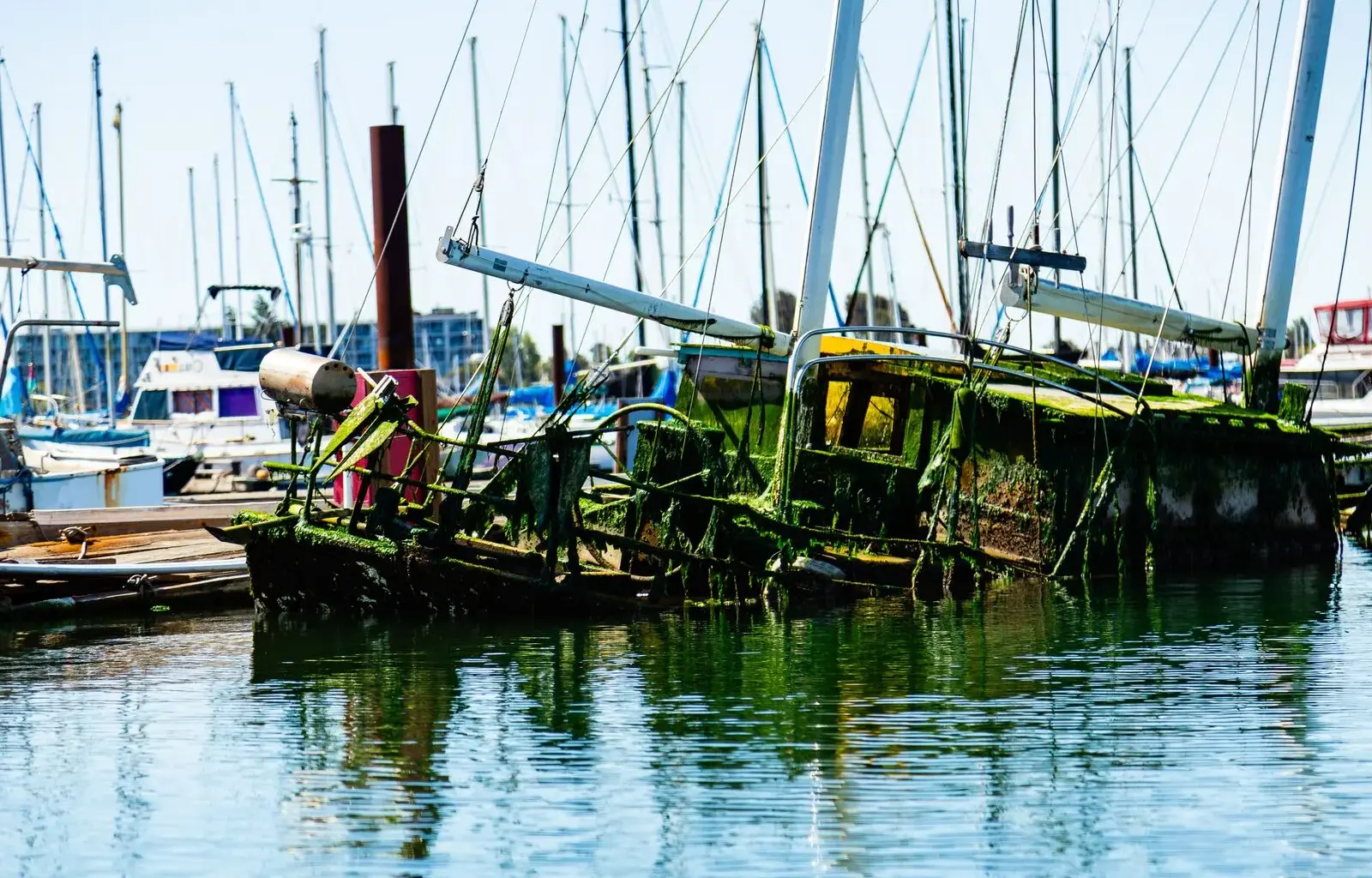
Dozens of sunken or abandoned boats polluting the Oakland estuary will soon be lifted out of the waters under a two-year contract approved by the Oakland City Council on Tuesday night.
The council authorized a $1.5 million agreement with Lind Marine, a Vallejo-based dredging, barging, and tugging company that has previously worked in Oakland.
Through the end of 2027, Lind Marine will remove an estimated 36 vessels from the estuary, some sunken or abandoned, and others floating boats that people live on without authorization.
The money for the contract is coming from a $3.2 million 2024 grant from the National Oceanic and Atmospheric Administration, along with a $150,000 California Parks and Recreation grant.
“The abandoned vessels make the estuary unsafe and cause potential hazards,” wrote OPD Interim Chief James Beere in a report asking the council to approve the Lind agreement. They can pollute the waters, he wrote, or come loose and crash into rowers or boats in the marina.
Oakland can be subjected to steep fines by the state if it permits residential boats anywhere outside of official marinas, including in the estuary, according to the city. OPD can remove these unauthorized houseboats under the Nuisance Vessel Ordinance passed by the council in 2023, but its marine patrol unit has only one officer.
The ordinance was praised at the time by many marina residents and people who use the estuary for recreation, some of whom had repeatedly complained to the city about boats left behind or used as homes. But some members of Oakland’s homeless community criticized the move, saying people unable to afford housing in the city and pushed off the streets end up depending on shelter out on the water.
The city has set aside the rest of the $3.2 million federal NOAA award for an ongoing shoreline cleanup project in partnership with I Heart Oakland-Alameda Estuary and the East Bay Regional Park District.
Mary Spicer, founder of the I Heart estuary stewardship organization, said her group has elaborate plans for that portion of the grant.
The organization has facilitated cleanups on the shoreline, collecting “tons and tons of trash,” for a decade; under the new contract, the group will host three per year for the next three years, Spicer said. Her group also plans to work with the city to develop a long-term program for handling abandoned vessels, and to collaborate with high school students on mapping and analyzing debris around the estuary.
While there were some frustrating bureaucratic delays in getting the grant-funded projects underway, I Heart now has a signed contract with the city, which Spicer is enthusiastic about. Spicer took Oaklandside reporters out on an aquatic tour of the estuary last summer.
“The estuary has been easy to ignore,” she said, “but if our shores and watershed aren’t stable, the city isn’t stable.”
The Lind Marine work is an important, but challenging, piece of cleaning up the estuary, Spicer said.
“Abandoned and derelict vessels on the Oakland Estuary are very complex, once you get into jurisdictional issues, the law, the environment, and all the money it takes to actually raise up sunk boats,” she said.
Lind Marine will need to bring out barges and cranes, handling each boat differently depending on its size and materials and taking care to prevent leakage of oil or gas. The cost of each removal varies significantly, said Daniel Hamilton, the city’s chief resilience officer, who oversees the NOAA grant for the city, in an email.
Storms this winter could sink even more vessels, Spicer said.
The council approved the Lind Marine contract unanimously on its “consent calendar,” a package of typically less-controversial items passed with a single vote.
“*” indicates required fields